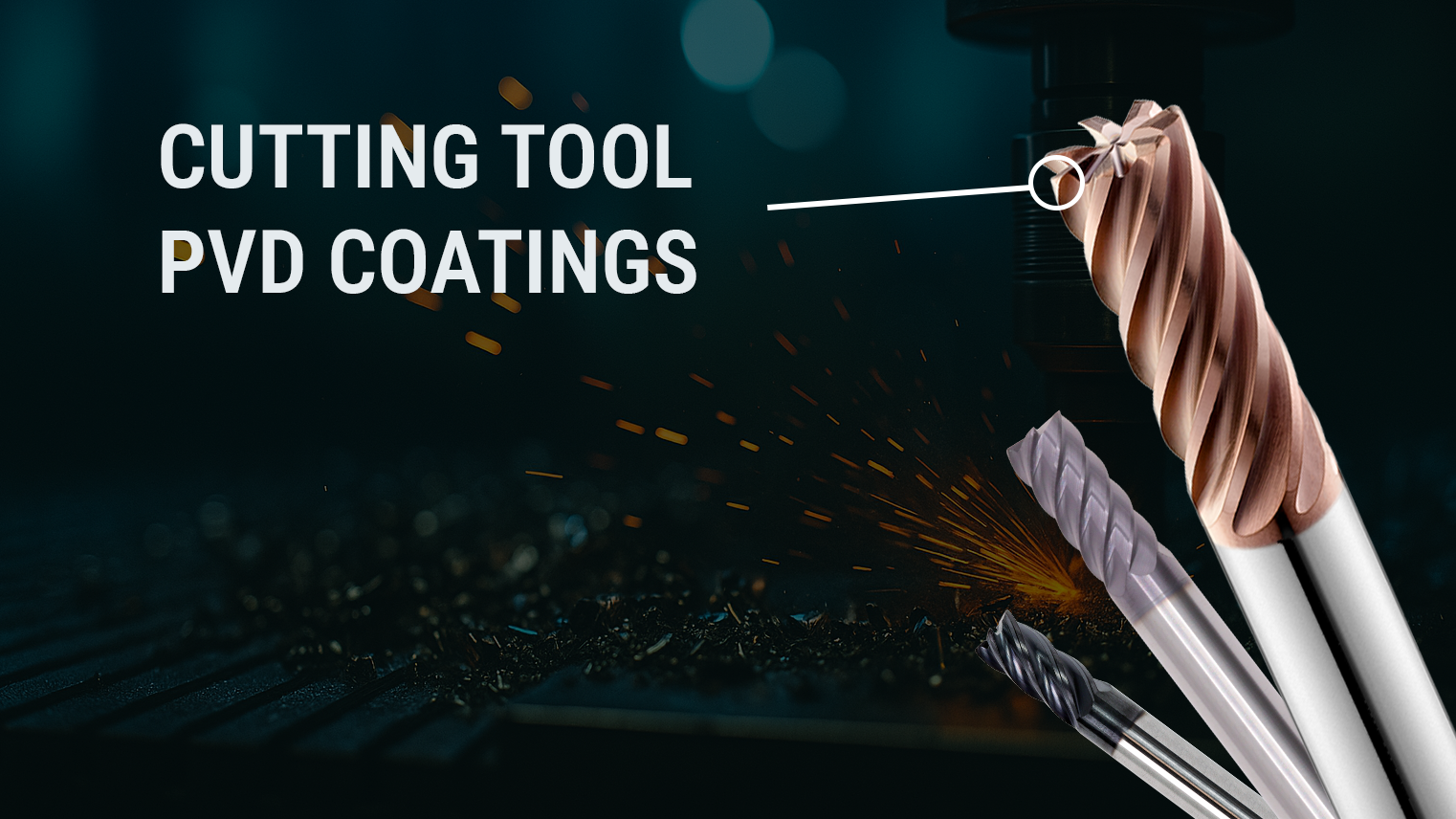
7 PVD Coatings for Cutting Tools That Actually Extend Tool Life (And What Most Shops Get Wrong)

Tool life is rarely discussed in isolation. When a shop experiences premature wear, broken inserts, or inconsistent surface finishes across a production run, the conversation quickly moves beyond the tool itself and into how the tool was prepared for the job. Coating selection is one of the most consistently overlooked decisions in that conversation.
Most machinists and production managers are familiar with the idea that coated tools outlast uncoated ones. What gets less attention is the degree to which the wrong coating — or a coating applied without regard for the specific material and operation — can perform no better than bare carbide, and sometimes worse. The assumption that any coating is better than none has cost shops real money in scrap rates, tool inventory, and unplanned downtime.
This article covers seven physical vapor deposition coatings that have a demonstrated track record in cutting applications, what makes each one suited to specific conditions, and where shops most commonly go wrong when selecting or specifying them.
Table of Contents
Why PVD Coating Technology Is the Right Starting Point
Physical vapor deposition is a vacuum-based process that deposits thin, hard films onto tool surfaces at relatively low temperatures. Unlike chemical vapor deposition, which requires significantly higher process temperatures and can affect the substrate’s mechanical properties, PVD maintains the base material’s integrity while adding a functional surface layer. This distinction matters in cutting tool applications where edge sharpness and substrate toughness must be preserved.
For manufacturers and job shops evaluating their tooling programs, understanding pvd coatings for cutting tools at a process level — not just a product level — changes how coating decisions get made. The process governs what’s physically possible in terms of coating chemistry, thickness uniformity, and adhesion quality. These factors directly influence how a coated tool behaves under thermal and mechanical stress during a cut.



The International Organization for Standardization has established classification frameworks for cutting tool coatings that reflect the industry’s recognition of coating performance as a measurable, specifiable property — not simply a value-add feature.
The Adhesion Problem Most Shops Don’t Catch Until It’s Too Late
Coating adhesion failure often looks like tool wear. Flaking or delamination at the cutting edge during machining is frequently misread as a substrate problem or a cutting parameter issue. In reality, poor adhesion is almost always traceable to surface preparation before coating — contamination, residual oxides, or inadequate etching during the PVD cycle.
When adhesion fails early in a tool’s life, the coating that was supposed to reduce friction and heat transfer instead becomes an abrasive layer at the cutting edge. The tool degrades faster than an uncoated equivalent would. This outcome is not visible from a product data sheet, and it won’t be caught without a structured incoming inspection process or a reliable coating supplier with process controls in place.
Titanium Nitride: The Baseline That Still Has a Place
Titanium nitride remains one of the most widely applied PVD coatings in general machining. Its gold color is familiar across most tooling catalogs, and its hardness and low friction coefficient offer meaningful improvements over uncoated tools in low-to-medium duty applications. Where shops go wrong with TiN is applying it to situations that have long since moved past what it was designed to handle.
TiN performs well in lower-speed applications, on softer steels, and in operations where heat generation is manageable. When applied to high-speed cutting of hardened steels or stainless alloys, it oxidizes at temperatures the coating was not designed to sustain, and its protective properties degrade rapidly. Using TiN in these conditions is not a cost-saving measure — it is an accelerated tool failure waiting to be documented.
Where TiN Still Earns Its Place
The coating continues to add value in threading, tapping, and drilling operations on mild steel and aluminum where cutting speeds are moderate and tool replacement costs outweigh performance optimization. For shops running general-purpose work across a range of materials, TiN-coated tooling can reduce wear and extend intervals between changes without requiring premium coating investment on every operation.
Titanium Carbonitride and Its Edge Retention Advantage
Titanium carbonitride adds carbon to the TiN chemistry, which increases the coating’s hardness and improves its resistance to abrasive wear. The result is a coating that holds its edge geometry longer under conditions where workpiece material or chip formation tends to erode the cutting face. This makes TiCN a logical step up from TiN when abrasion is the primary wear mechanism.
The practical benefit shows up in drilling and reaming operations where edge geometry must stay intact across a full run. When edge breakdown occurs mid-run due to abrasive wear, hole quality degrades without triggering an obvious alarm. TiCN-coated tools extend the window in which geometry remains within tolerance, which directly supports dimensional consistency in production environments.
TiAlN: The Workhorse for High-Temperature Cutting
Titanium aluminum nitride has become a standard coating for demanding cutting conditions, particularly in dry and semi-dry machining of hardened steels, cast iron, and high-temperature alloys. The aluminum content forms a protective aluminum oxide layer at elevated temperatures, which insulates the tool’s cutting edge from the heat generated during the cut. Rather than transferring that heat into the substrate, the coating manages it at the surface.
This thermal behavior is why TiAlN-coated tools are specified for high-speed machining applications where flood coolant is either not used or not practical. The coating becomes more effective as temperature increases, which aligns with the conditions that cause the most damage to uncoated or less sophisticated coatings. The operational logic is straightforward — the coating strengthens under the conditions it was designed to address.
The Aluminum-to-Titanium Ratio and Why It Matters
The performance characteristics of TiAlN are not fixed. They shift based on the ratio of aluminum to titanium in the coating’s composition. Higher aluminum content generally improves high-temperature oxidation resistance, while higher titanium content increases toughness and adhesion. Coating suppliers adjust this ratio based on the specific application, and shops that treat all TiAlN coatings as equivalent miss the opportunity to optimize for their actual cutting conditions.
When evaluating pvd coatings for cutting tools in high-heat applications, requesting information about coating composition rather than just product name is a reasonable and productive step.
AlTiN: When the Chemistry Shifts Toward Higher Aluminum Content
AlTiN reverses the elemental balance, with aluminum as the dominant element. This increases the coating’s maximum operating temperature and extends its effective range in aggressive machining environments. In practice, AlTiN is selected when TiAlN reaches its performance ceiling — typically in operations involving hardened materials, abrasive composites, or sustained high-speed cutting where thermal buildup is severe.
The distinction between TiAlN and AlTiN is frequently glossed over in tooling discussions, yet the operational difference in demanding applications is real. Shops that have standardized on TiAlN as their high-performance coating may find that switching to AlTiN on their most demanding operations reduces replacement frequency without any changes to cutting parameters.
CrN and Its Relevance in Non-Ferrous and Corrosive Applications
Chromium nitride offers a different profile than the titanium-based coatings. Its primary strengths are chemical inertness, low friction against non-ferrous materials, and resistance to corrosion. This makes it a logical choice for machining aluminum, copper alloys, and plastics, where built-up edge — the adhesion of workpiece material to the cutting edge — is a more significant problem than abrasive wear.
In environments where coolant chemistry is aggressive, or where tools are stored and handled under conditions that would corrode a less stable coating, CrN’s resistance to oxidation and chemical attack extends usable tool life without requiring changes to the machining process itself. Its lower hardness compared to TiAlN or AlTiN makes it a poor choice for hard material cutting, but for the applications it suits, the performance advantage is consistent and repeatable.
DLC Coatings and the Non-Ferrous Precision Case
Diamond-like carbon coatings represent a distinct category. Their extremely low coefficient of friction and chemical inertness make them effective in applications where surface finish quality is the primary metric rather than tool hardness or thermal resistance. Precision machining of aluminum, magnesium, copper, and certain polymers benefits from DLC because the coating prevents material adhesion and produces very clean surface finishes at the workpiece.
DLC is not a general-purpose upgrade. It requires careful attention to substrate preparation and is not suited for ferrous materials, where carbon from the coating can diffuse into the iron matrix and cause adhesion failure. In the right application, the improvement in surface finish and reduction in built-up edge can meaningfully reduce secondary operations and inspection time. In the wrong application, it is an expensive failure waiting to be attributed to something else.
Matching Coating to Operation Is the Core Discipline
The common thread across the coatings discussed here is that each one addresses a specific combination of wear mechanisms, workpiece materials, and cutting conditions. Shops that approach pvd coatings for cutting tools as a single-category upgrade — rather than a set of distinct solutions for distinct problems — will consistently underperform against the technology’s actual potential.
Production environments that have moved toward structured coating selection — based on material, operation type, and primary failure mode — tend to carry less tool inventory while maintaining or improving output consistency. The discipline is not complicated, but it requires asking more specific questions before specifying a coating.
ZrN and Specialty Coatings for Specific Material Groups
Zirconium nitride occupies a narrower role than the coatings above. It performs well in non-ferrous machining, particularly with copper, brass, and titanium alloys, where its chemical stability and low reactivity reduce workpiece contamination risk. In medical, electronics, and aerospace contexts where material purity is critical, ZrN-coated tools are specified to ensure the workpiece surface is not affected by coating interaction during the cut.
Understanding where ZrN belongs in a tooling program requires understanding the workpiece requirements first. It is rarely the right coating for a general shop environment, but for the operations it addresses, it is difficult to substitute effectively.
What Most Shops Get Wrong When Selecting PVD Coatings
The most common error is selecting coatings based on familiarity rather than application analysis. TiN became widespread because it was the first widely available PVD coating for cutting tools and because it performs adequately across a broad range of general applications. Shops that have been specifying TiN for decades often continue doing so out of inertia rather than evaluation, even when their work has shifted toward harder materials, tighter tolerances, or higher throughput requirements.
The second common error is treating all suppliers of a given coating type as equivalent. PVD is a process-sensitive technology. Two suppliers offering the same coating designation can produce meaningfully different results depending on their equipment calibration, process controls, substrate preparation procedures, and quality verification steps. Evaluating suppliers on process documentation and measurable outcomes — rather than product names and price — is the more reliable approach.
A third error involves applying pvd coatings for cutting tools to tools that are already worn or improperly ground. Coating a damaged or out-of-tolerance tool does not restore its geometry. It adds a hard layer to a tool that will still fail early. Coating is a surface treatment for a properly prepared substrate, not a restoration process.
Closing Thoughts
PVD coating technology has matured considerably, and the range of available coatings now covers most cutting scenarios a production or job shop will encounter. The gap between what the technology can deliver and what most shops actually achieve is not a technology gap — it is a selection and specification gap.
Shops that invest time in understanding the primary wear mechanism in each operation, matching that to the appropriate coating chemistry, and working with suppliers who can demonstrate process control will see tool life improvements that cannot be achieved through cutting parameter adjustments alone. The decisions are not technically complex. They require operational discipline and a willingness to look beyond familiar defaults.
For operations where consistent tool life, reduced scrap, and fewer unplanned tool changes matter to production output, the case for structured coating selection is built into the cost of the alternative. Continuing to replace tools that the right coating would have kept running longer is an expense that rarely shows up as a line item until someone decides to look for it.