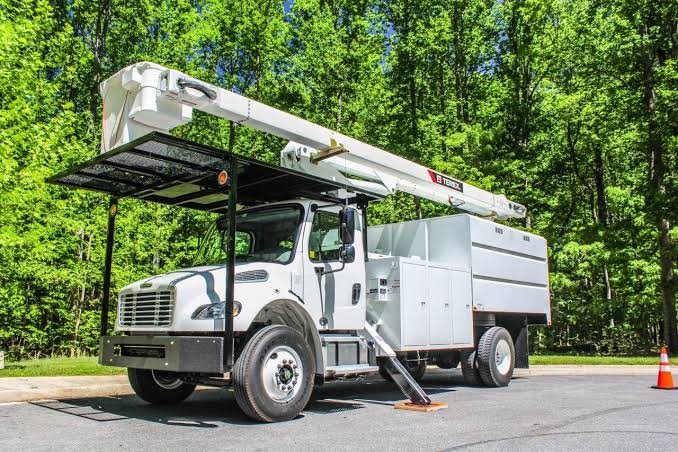
Buying a forestry boom truck is not a casual equipment decision. These machines operate in some of the most demanding conditions in the country — uneven terrain, dense canopy work, right-of-way clearing, and utility corridor maintenance where precision and mechanical reliability are not optional. A wrong purchase can mean extended downtime, costly repairs, or a unit that loses its value faster than anticipated in a secondary market.
The US market currently has a wide range of forestry boom trucks available across multiple configurations, ages, and chassis types. Some of these units are well-suited for sustained production work. Others are better positioned as secondary machines or regional support equipment. Understanding what separates a strong buy from a regrettable one requires more than looking at the hour meter or the boom spec sheet.
This ranking examines ten of the most commonly available forestry boom trucks across the US market right now, with attention to the factors that matter most to fleet managers, independent operators, and tree care contractors: payload capacity relative to chassis weight, effective working reach, and how these units tend to hold their value when it comes time to sell or trade.
Table of Contents
Why These Three Criteria Define a Smart Equipment Investment
When evaluating any forestry boom truck for sale, three variables consistently determine whether a unit performs as expected in the field and retains enough value to justify its acquisition cost: payload, reach, and resale trajectory. These are not abstract specifications — each one connects directly to real operational and financial outcomes that affect day-to-day business decisions.
Payload capacity determines how much a truck can carry beyond the boom and body assembly, including personnel, wood chips, rigging equipment, and any additional tooling. A unit with an inadequate payload rating for its intended application will either be overloaded routinely — which creates liability and accelerates mechanical wear — or it will require a second vehicle to carry what it cannot. Neither outcome is acceptable for operations trying to run tight schedules with minimal vehicle count.
Reach, specifically the effective working reach rather than the theoretical maximum, affects which job sites the unit can serve without repositioning or supplementing with additional equipment. A boom that looks impressive on a spec sheet but loses significant capacity at extended reach is a unit that will disappoint in production conditions. Operators who work near power lines, in residential canopy, or in municipal settings need consistent reach with stable load ratings throughout the arc.
Resale value is the factor that most buyers underestimate at the point of purchase. A forestry boom truck that holds its value reflects strong market demand, reliable brand reputation, and a parts and service ecosystem that keeps the unit operational over a longer working life. For operators reviewing a forestry boom truck for sale, understanding resale patterns is just as important as understanding the current asking price.
How Payload Ratings Translate to Real Fleet Decisions
Payload ratings on forestry boom trucks are often misread because buyers focus on gross vehicle weight rating without accounting for what the mounted body, boom, and auxiliary systems already consume. The net payload — what actually remains for tools, personnel, and material — can be significantly lower than what the chassis GVWR implies. Units built on medium-duty chassis with heavy boom assemblies can leave very little margin before the truck is technically over its rated capacity under normal working conditions. Operators running crews with full chip boxes frequently discover this only after the purchase has been made.
Reach Ratings in Working Conditions Versus Static Conditions
Reach specifications provided by manufacturers are typically measured under static, controlled conditions on level ground with specific counterbalancing. In actual forestry and arborist work, those conditions rarely exist. Ground slope, crew weight in the bucket, and the dynamic forces introduced by cutting operations all reduce effective working reach below the published figure. Units that maintain stronger load ratings throughout their working arc — not just at minimum reach — give operators more flexibility without compromising safety compliance under OSHA aerial lift regulations that govern bucket truck and boom lift operation.
The Ten Models That Consistently Appear in the US Market
The following units represent configurations that appear regularly in the US forestry and tree care equipment market, whether through fleet sales, dealer inventory, or private listings. Each has a distinct profile in terms of application fit, durability record, and secondary market activity.
Altec AT40-P
The AT40-P is one of the most widely circulated forestry boom trucks in the country. Its articulating-over-articulating boom design allows access in tight canopy situations where a telescoping unit would need to reposition. Fleet managers who need a consistent, mid-range workhorse for urban tree work and utility trimming tend to hold these units for long service cycles, which speaks to their durability under repeated use. Resale demand remains strong due to parts availability and broad service network coverage.
Terex XT60-70 Series
Units in the Terex XT series are frequently cited by contractors who prioritize reach without sacrificing stability. These trucks carry a good reputation for boom response consistency and tend to appear in municipal and right-of-way contracts. Their resale value is stable, though it depends heavily on the condition of the chassis, which in older units can become the limiting factor before the boom assembly shows serious wear.
Elliott 40141R Forestry Truck
Elliott builds equipment specifically for heavy-duty forestry applications, and the 40141R reflects that focus. Its design accommodates higher payload demands, making it appropriate for operations that carry significant rigging equipment or work on high-clearance applications. These units trade at a premium in the secondary market, which reflects both their build quality and the relatively smaller volume of available inventory compared to more common configurations.
Altec LR756 Forestry Unit
The LR756 is configured for larger crew operations and appears frequently in utility corridor work where extended reach and crew capacity are both required. Its tandem rear axle configuration improves stability on uneven terrain, and units in good condition tend to retain value well. Buyers should pay particular attention to the boom rotation system and hydraulic condition on older examples of this model.
Dur-A-Lift DPM-Series
Dur-A-Lift units are known for straightforward mechanical design and accessible service points, which reduces maintenance time in the field. The DPM series appears regularly in smaller contractor fleets and municipal equipment pools. Resale value is consistent at the lower end of the market, making these units a reasonable acquisition for operations building out secondary vehicle capacity without a large capital outlay.
Versalift SST-40-EIH
The SST-40-EIH is a utility-grade unit that crosses into forestry applications regularly, particularly for mixed-use fleets that handle both tree work and distribution line trimming. Its insulated boom configuration adds operational flexibility, though that same feature requires additional inspection discipline to maintain dielectric integrity. Resale is consistent, though buyers should verify insulation test records on any used example.
Altec AA55-MH
The AA55-MH occupies a mid-range position between lighter utility trucks and full forestry configurations. It sees significant use in transmission line work and is occasionally found in forestry applications where the required reach falls within its working envelope. These units move quickly in the secondary market because of broad application fit, which is both an advantage for sellers and a reason to act decisively when a clean example appears.
National Crane 600E-Series Boom Truck
While not exclusively a forestry unit, the 600E-series appears in configurations adapted for heavy canopy removal and large-diameter removal work where crane-assist is part of the operation. Payload capacity is a strength of this configuration, and resale values reflect sustained demand from both forestry and construction-adjacent markets. Maintenance records are particularly important on these units given their dual-market use history.
Terex HL4676-MH
The HL4676-MH is a heavy-duty model that handles sustained production forestry work. Its rotation range and boom articulation make it suitable for operations where canopy obstruction is a consistent variable. These trucks hold value well in regions where forestry activity is concentrated, but can take longer to move in markets where the demand profile is lighter.
Altec TA60 Forestry
The TA60 Forestry edition is built explicitly for arborist and forestry contractor applications, with structural reinforcement and design features that reflect decades of feedback from tree care operations. It consistently earns strong reviews for crew comfort and control precision. Resale activity for this model is among the healthiest in its class, with clean, well-documented units commanding prices that reflect sustained buyer interest.
What the Secondary Market Reveals About These Units
Secondary market behavior is one of the most honest indicators of equipment quality and operational suitability. Units that hold value well do so because buyers trust them — they have known service histories, available parts, established service networks, and strong performance records across a range of conditions. Units that depreciate quickly often reflect the opposite: high maintenance burden, limited parts availability, or a narrow application fit that reduces the buyer pool when the original owner is ready to sell.
Service Network Depth and Its Effect on Resale
One of the clearest predictors of resale value for any forestry boom truck is whether a robust service network exists in the region where the unit operates. Equipment that can be serviced at multiple independent shops, not just at a single dealership, tends to remain in service longer and commands better resale prices. Operators who purchase units from brands with thin regional support often find that repair timelines extend, downtime accumulates, and buyers in the secondary market discount accordingly when the time comes to sell.
Matching the Right Unit to the Right Operation
No single unit on this list is universally the best forestry boom truck. Each operation has a distinct profile — terrain type, crew size, job mix, regional service access, and financial structure all influence which configuration makes the most sense. An independent arborist running residential accounts in a dense suburban market needs a different machine than a utility contractor managing hundreds of miles of corridor maintenance.
The most durable equipment decisions come from buyers who start with their operational requirements and work backward to the unit, rather than starting with a price point or a brand name and hoping the machine fits the work. Payload, reach, and resale value are the filters that bring discipline to that process.
Conclusion
The US market for forestry boom trucks is active and varied enough that buyers at almost every budget and application level can find suitable inventory. But availability does not equal suitability, and the volume of options can make the decision more complicated rather than simpler. The units listed here represent configurations with documented market presence, established performance records, and resale behavior that reflects real buyer demand.
Approaching any purchase in this category with clear criteria — payload margin, verified working reach, and secondary market position — provides a framework that protects against both operational disappointment and financial loss. A well-matched unit purchased at a fair price, with a clean service history and accessible parts support, will consistently outperform a bargain purchase that doesn’t fit the work. That principle holds whether the buyer is adding to an existing fleet or acquiring a first machine for a growing operation.
-

-
-
-
-

-