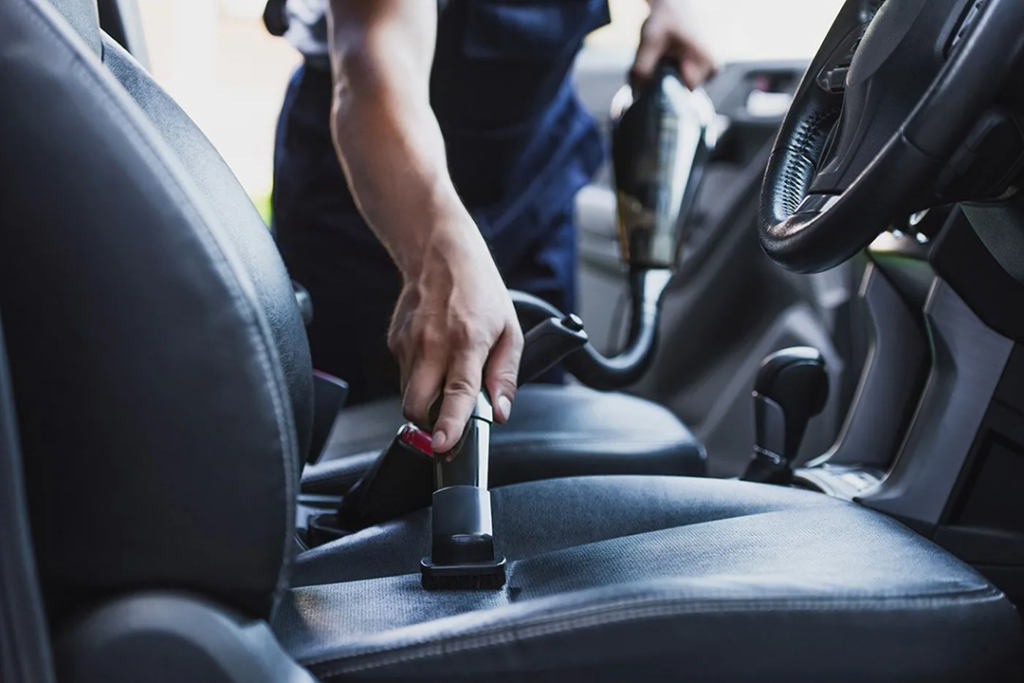
Leather interiors require a level of care that fabric simply does not. The material is porous, sensitive to chemical imbalance, and prone to irreversible damage when treated incorrectly. Yet most vehicle owners approach interior cleaning with the same casual attitude they apply to a routine wash. The result is often accelerated wear, discoloration, or cracking that reveals itself months after the cleaning — long after any recourse is practical.
Whether you own a single vehicle or manage a small fleet, choosing who handles your leather interior is a decision with lasting consequences. Not all cleaning operations are equal. Some rely on generic chemical solutions not suited to automotive leather. Others lack the equipment, training, or process discipline to produce results that hold up over time.
The questions below are designed to surface those differences before you commit. They are not meant to be adversarial — they are practical checkpoints that reveal whether a provider understands the material, respects the work, and can deliver consistent outcomes.
Table of Contents
1. What Training or Certification Do Your Technicians Hold?
When evaluating a car leather cleaning service, the first useful question is about the people doing the actual work. Leather is a treated animal hide, and its behaviour under chemical exposure varies depending on tanning method, finish type, and age. A technician who understands these variables will approach a semi-aniline seat very differently from a heavily pigmented leather surface.
Why Certification Signals Genuine Process Discipline
Formal training in leather care is not universally required, but its presence tells you something important. A technician who has completed structured learning in material science and chemical compatibility is less likely to default to trial and error on your interior. They are also more likely to identify pre-existing damage accurately — distinguishing between a surface scuff and a coating failure, for instance — which prevents misdiagnosis and inappropriate treatment.
2. Do You Assess the Leather Before Choosing a Cleaning Method?
Cleaning leather without first understanding what type of leather you are dealing with is one of the most common errors in this industry. Automotive leather ranges from full-grain natural surfaces to heavily coated synthetic blends, and each responds differently to solvents, pH levels, and mechanical agitation.
The Risk of a One-Method Approach
Providers who apply a fixed cleaning protocol regardless of material type are cutting a corner that matters. A solution effective on coated leather may strip conditioning agents from an aniline surface, leaving it dry and vulnerable. Understanding whether a provider conducts an initial assessment tells you whether they are operating systematically or simply moving through jobs as quickly as possible.
3. What Products Do You Use, and Are They Formulated for Automotive Leather?
The cleaning agent applied to leather determines much of the outcome. Products formulated for household leather, upholstery fabric, or general-purpose surface cleaning are not equivalent to automotive-grade leather solutions. The pH range, solvent concentration, and conditioning agents vary in ways that affect both immediate results and long-term material integrity.
Reading Product Claims With Appropriate Scepticism
Many providers describe their products as “professional” or “specialist” without specifying what that means in practice. A useful follow-up is to ask whether their cleaning products are pH-neutral and whether their conditioning agents are designed to restore the plasticisers in automotive leather. Providers who can answer this clearly are drawing on genuine product knowledge, not marketing language.
4. How Do You Handle Pre-Existing Damage or Wear Before You Begin?
This is the question most people do not think to ask, and it is frequently the most consequential one. Leather that enters a cleaning process with existing cracks, delamination, or coating loss will not be improved by cleaning alone — and in some cases, aggressive cleaning will worsen the condition significantly.
Separating Cleaning From Restoration
A responsible provider will distinguish clearly between what cleaning can achieve and what requires restoration or repair. If a technician proceeds with a standard cleaning protocol on leather that has visible cracking without flagging it first, you have no way of knowing whether any post-cleaning deterioration was pre-existing or caused by the treatment. Getting a documented pre-service condition note protects both parties and sets accurate expectations from the start.
5. What Does Your Process Look Like From Start to Finish?
A vague answer here is informative in itself. A structured car leather cleaning service will have a defined sequence — surface preparation, cleaning, conditioning, and protection — with specific reasons for each step. Providers who describe their process in loose, general terms are more likely to be improvising than following a tested method.
Process Consistency and Its Effect on Results
Consistency in process directly affects consistency in outcomes. When a provider follows the same structured sequence for every vehicle, the variables that affect quality become manageable. When each job is approached differently based on technician preference or time pressure, results become unpredictable. Ask them to walk you through a typical service and listen for whether their explanation reflects genuine procedural discipline.
6. Do You Offer a Conditioning and Protection Step, or Just Cleaning?
Cleaning removes contaminants. Conditioning restores the moisture balance that keeps leather supple. Protection reduces future soiling and slows UV-related fading. These are three distinct functions, and skipping the latter two produces a result that looks good immediately but deteriorates faster than it should.
Understanding Why Conditioning Is Not Optional
Automotive leather, as noted in material care guidance from organisations such as the International Organization for Standardization, is a processed material whose long-term integrity depends on maintaining appropriate moisture and flexibility within the hide structure. Cleaning strips surface oils along with dirt. Without reintroducing a conditioning agent, the leather begins drying from the cleaning treatment itself. A service that does not include conditioning is an incomplete service regardless of how thorough the cleaning appears.
7. How Long Has Your Team Been Specifically Working on Automotive Leather?
General cleaning experience does not transfer seamlessly to automotive leather work. The confined geometry of a vehicle interior, the combination of leather with stitched seams and adjacent plastic and vinyl surfaces, and the need to avoid oversaturation in enclosed spaces all require specific handling knowledge that develops through focused experience.
Tenure as an Indicator of Operational Reliability
This is not simply about years in business — it is about whether the people delivering the service have encountered enough variation in vehicle types, leather grades, and condition states to respond appropriately when something unexpected arises. A team with deep, specific experience in this category is less likely to cause incidental damage to adjacent surfaces or to misread a condition that requires a different approach.
8. Can You Provide References or Examples of Similar Work?
Evidence of past work is more reliable than assurances about capability. Photographs, client references, or case examples allow you to assess whether the quality of results a provider describes aligns with what they have actually delivered in comparable situations.
What to Look for in Past Work Evidence
When reviewing before-and-after photographs or speaking with references, focus on vehicles with similar leather grades and wear levels to your own. A provider who has consistently produced clean, uniform results on well-maintained luxury interiors may not have the same track record on heavily soiled or aged leather. Matching the evidence to your specific situation gives you a more realistic basis for evaluation.
9. What Happens If Something Goes Wrong During or After the Service?
Damage during a professional cleaning service is not common, but it is possible. Chemical reactions to undisclosed previous treatments, over-saturation near seams, or mechanical abrasion can produce outcomes that were not anticipated. Understanding in advance how a provider responds to these situations tells you whether accountability is built into their operation.
Warranty, Documentation, and Dispute Resolution
Ask specifically whether the provider carries insurance covering accidental damage, and whether they offer any form of service guarantee. A provider who becomes vague or defensive when asked about remediation processes is signalling that accountability is not a structural part of how they operate. Clear documentation of the pre-service condition, agreed scope of work, and service outcome creates a shared record that makes any necessary resolution straightforward.
10. How Do You Price the Service, and What Does That Price Include?
Pricing in this category varies widely, and the range often reflects genuine differences in material quality, process depth, and time invested rather than arbitrary markup. A very low price for a car leather cleaning service typically signals either a shortened process, lower-grade products, or less experienced labour.
Understanding What You Are Actually Paying For
Ask for a clear breakdown of what the quoted price includes. Does it cover conditioning and protection, or only the cleaning stage? Are all seating surfaces included, or just the main contact areas? Is the process carried out at a fixed facility with controlled conditions, or in a mobile setting where environmental factors may affect results? These distinctions explain price differences more accurately than surface-level comparisons and help you assess value rather than simply cost.
Approaching the Hiring Decision With Appropriate Care
Leather interiors represent a meaningful part of a vehicle’s value and daily comfort. They are also one of the easier things to damage through poor maintenance choices. The ten questions above are not meant to create friction in the hiring process — they are meant to filter out providers who lack the specific knowledge, process discipline, or accountability that this type of work requires.
Most providers who genuinely know their work will welcome these questions. They demonstrate that the client takes the service seriously, and they give a competent provider the opportunity to explain clearly what separates their approach from a generic cleaning operation. Providers who deflect, generalise, or grow impatient are providing useful information as well — just not the kind you want to test on your interior.
Asking questions before the service begins is considerably less costly than discovering their answers afterward. The time invested in a direct, structured conversation with a potential provider is the most practical form of quality assurance available to a vehicle owner before any work begins.
-

-

-

-

-
-