If you’ve ever spent a sweltering Saturday afternoon pushing a heavy mower across your yard, battling uneven terrain and aching muscles, you know the frustration of traditional lawn care. What should be a simple task often turns into hours of exhausting work, leaving you drained and your grass looking less than perfect. But what if you could mow your entire lawn from the comfort of your patio chair, guiding a precision machine with nothing more than a handheld controller?
Remote control lawn mowers are transforming how homeowners maintain their yards, combining cutting-edge technology with remarkable ease of use. This article will walk you through everything you need to know about using these innovative machines to achieve flawless, healthy grass without the backbreaking effort. We’ll explore the key benefits that make remote control mowers a game-changer, provide a detailed step-by-step usage guide, spotlight standout models like the MOWRATOR S1 Pro, and share expert tips to keep your lawn looking pristine season after season.
Table of Contents
Understanding Remote Control Lawn Mowers and Modern Lawn Care Technology
A remote control lawn mower is a motorized cutting machine that you operate wirelessly using a handheld transmitter, smartphone app, or dedicated controller. Unlike a traditional push or ride-on mower that demands your physical presence behind or atop the machine, a remote control model lets you guide every movement from a distance — often up to several hundred feet away. This distinction also separates it from a fully autonomous robot mower, which navigates your yard independently using boundary wires or GPS mapping. While a robot mower handles everything on its own schedule, a remote control lawn mower keeps you in the driver’s seat, giving you real-time command over speed, direction, and cutting path.
The core lawn care technology powering these machines typically combines radio-frequency or Bluetooth communication, brushless electric motors, and onboard sensors that monitor terrain and blade performance. Many models feature tracked or all-wheel-drive systems capable of tackling slopes and rough ground that would challenge conventional mowers. By merging human decision-making with mechanical precision, remote control mowers occupy a unique space in modern lawn maintenance — they automate the physically demanding work while still allowing you to adapt on the fly around flower beds, trees, and tight corners. The result is a smarter, safer approach to keeping your yard in top shape without surrendering full control to a machine.
Key Benefits: Time-Saving and Effortless Lawn Maintenance for Homeowners
The most immediate advantage of a remote control lawn mower is the dramatic reduction in mowing time. Because you can guide the machine at a steady, optimized pace without stopping to catch your breath or reposition yourself, most homeowners cut their total mowing duration by a third or more. You simply point the mower where it needs to go, and it powers through thick patches and open stretches alike without the stop-and-start rhythm that slows down manual mowing. For busy professionals and weekend warriors who’d rather spend their free hours relaxing or with family, that reclaimed time adds up fast over a full mowing season.




Beyond the clock, the physical relief is transformative. Pushing a conventional mower across hilly or uneven ground punishes your back, shoulders, and knees — especially in summer heat. A remote control mower eliminates that strain entirely, making easy lawn maintenance accessible to older adults, people recovering from injuries, and anyone who simply wants to stop dreading yard work. Meanwhile, the consistency these machines deliver translates directly into perfect grass. Motorized blades spinning at a uniform height produce a cleaner, more even cut than most people achieve by hand, reducing ragged tips that invite disease and browning. The combination of saved time, reduced effort, and superior cutting quality makes remote control mowers one of the most practical upgrades a homeowner can invest in for their lawn.
Step-by-Step Guide to Using Your Remote Control Lawn Mower for Perfect Grass
Owning a remote control lawn mower is one thing — getting the most out of it requires a deliberate approach each time you mow. The following step-by-step process will help you achieve perfect grass consistently, whether you’re a first-time user or looking to refine your technique. From initial preparation through final storage, every phase matters for both the quality of your cut and the longevity of your equipment.
Pre-Operation Setup: Safety and Preparation
Before powering anything on, walk your entire lawn and remove sticks, rocks, toys, and any other debris that could damage the blades or become a projectile. Check for hidden obstacles like sprinkler heads or shallow tree roots. Next, inspect the mower itself — confirm that the blades are secure and sharp, the tires or tracks are free of buildup, and the battery is fully charged. Power on the remote control and verify that the connection is stable by testing the joystick or app response before the blades engage. Always keep children and pets indoors or well away from the mowing area, and wear closed-toe shoes even though you won’t be walking behind the machine.
Mastering the Controls: Basic Operation and Maneuvering
Start in an open, flat section of your yard to get comfortable with the controls. Most remotes use dual-stick inputs — one for forward and reverse movement, the other for steering. Begin at a low speed setting and practice smooth, gradual turns rather than sharp corrections, which can tear turf. Gradually increase speed as your confidence builds. Pay attention to how the mower responds on slight inclines, since throttle adjustments may be needed to maintain a straight line on slopes. Once basic navigation feels intuitive, practice guiding the mower along a fence line or garden edge to develop the precision you’ll need for tight spaces.
Optimal Mowing Patterns for Even and Healthy Grass
The pattern you follow has a direct impact on how your lawn looks and grows. Parallel stripes are the simplest approach — mow in straight, slightly overlapping rows across the yard, then alternate your direction by ninety degrees on your next session to prevent the grass from leaning one way. A crisscross pattern every few weeks encourages upright growth and a denser turf. Set your cutting height so you never remove more than one-third of the grass blade at a time; cutting too low scalps the lawn and stresses the root system. On slopes, guide the mower across the incline rather than straight up and down to reduce wheel slip and uneven cutting.
Post-Mowing Care: Cleanup and Storage Best Practices
Once you’ve finished mowing, turn off the blades first, then drive the mower back to a hard surface like a driveway or garage floor. Use a stiff brush or compressed air to clear grass clippings from the undercarriage, blade housing, and ventilation ports — caked-on debris traps moisture and accelerates corrosion. Wipe down the remote control and store it in a cool, dry place away from direct sunlight. If you won’t be mowing again within a week, charge the battery to around eighty percent rather than a full hundred, as this practice extends overall battery lifespan. Store the mower indoors or under a weatherproof cover to protect its electronics from humidity and temperature swings.
Choosing the Right Mow Lawn Mower: Features and the MOWRATOR S1 Pro Spotlight
Selecting the right remote control mow lawn mower means evaluating a handful of critical features that directly affect performance and satisfaction. Battery life determines how much ground you can cover in a single session — look for models that deliver at least an hour of continuous runtime to handle medium and large yards without interruption. Cutting width matters too, since a wider deck reduces the number of passes needed but may limit maneuverability in tight spaces. Durability is non-negotiable, especially if your property includes rocky patches, steep grades, or dense vegetation that demands rugged construction and reinforced blade assemblies. Track-driven systems generally outperform wheeled designs on slopes and wet turf, providing superior traction without tearing the grass.
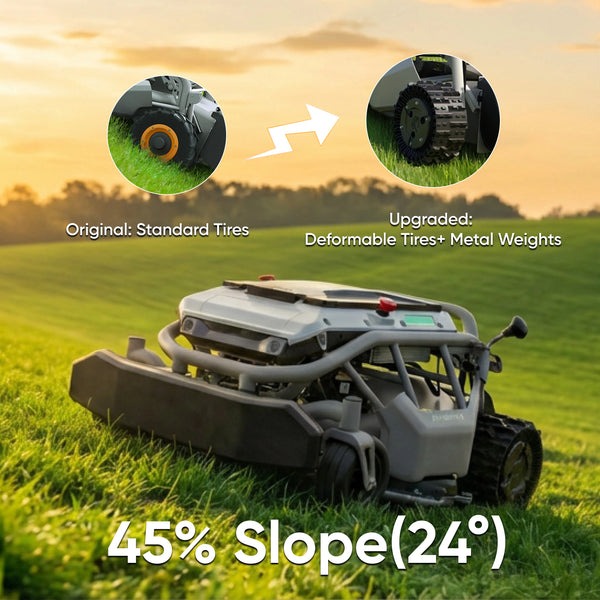
The MOWRATOR S1 Pro stands out as a compelling option that merges remote control precision with robot mower intelligence. Its tracked chassis handles inclines that would stall conventional mowers, while its responsive wireless control system gives you real-time command over speed and direction from a comfortable distance. The S1 Pro’s low center of gravity keeps it stable on hillsides, and its compact frame slips easily between garden beds and fence lines where bulkier machines struggle. Compared to fully autonomous robot mowers that require buried boundary wires or lengthy GPS calibration, the MOWRATOR S1 Pro lets you start cutting immediately while still benefiting from advanced lawn care technology. When stacked against other remote control models, its combination of slope capability, build quality, and intuitive controls makes it a top contender for homeowners who want both flexibility and professional-grade results.
Pro Tips and Maintenance for Long-Term Lawn Care Success
Achieving perfect grass isn’t just about how you mow today — it’s about adapting your approach as seasons change and keeping your equipment in peak condition. In spring and fall, when grass grows aggressively, mow more frequently at a slightly higher cutting height to encourage deep root development. During summer heat, raise the deck another notch and mow in the early morning or late evening when the turf is less stressed. These seasonal adjustments prevent scalping and keep your lawn thick enough to crowd out weeds naturally.
Blade sharpening deserves attention every eight to ten hours of cumulative mowing time. Dull blades tear grass rather than slicing it cleanly, leaving frayed tips that turn brown and become entry points for fungal disease. Most remote control mowers allow easy blade removal with basic hand tools — sharpen with a flat file or bench grinder, keeping the original bevel angle, and balance the blade on a nail before reinstalling to prevent vibration. If you notice the mower pulling to one side, uneven cut lines, or unusual motor noise during operation, troubleshoot by checking for bent blades, debris lodged in the drive system, or a weak wireless signal caused by low controller batteries. Firmware updates, when available, can also resolve connectivity glitches and unlock improved motor efficiency. Committing to this regular maintenance routine ensures your remote control lawn mower delivers consistent, professional-quality results for years without costly repairs or declining performance.
Embrace Smarter Mowing for a Healthier, More Beautiful Lawn
Remote control lawn mowers represent a genuine shift in how homeowners approach yard maintenance, replacing physical exhaustion and inconsistent results with precision, comfort, and efficiency. Throughout this guide, we’ve seen how these machines leverage modern lawn care technology to put you in command without demanding your body as the engine. The benefits are clear — significant time savings, elimination of physical strain, and a consistently even cut that promotes healthier, denser turf throughout every season.
By following the step-by-step process outlined here — from thorough pre-mowing preparation and mastering your controls to choosing smart mowing patterns and committing to proper post-session care — you can achieve professional-quality results every time you mow. Models like the MOWRATOR S1 Pro demonstrate how far this technology has come, offering slope-conquering capability and intuitive operation that makes perfect grass attainable for virtually any homeowner. As battery technology improves and smart features continue to evolve, remote control and hybrid mowers will only become more capable and accessible. Now is the ideal time to step off the mower and onto the patio, letting intelligent engineering handle the hard work while you enjoy a lawn that looks better than ever.