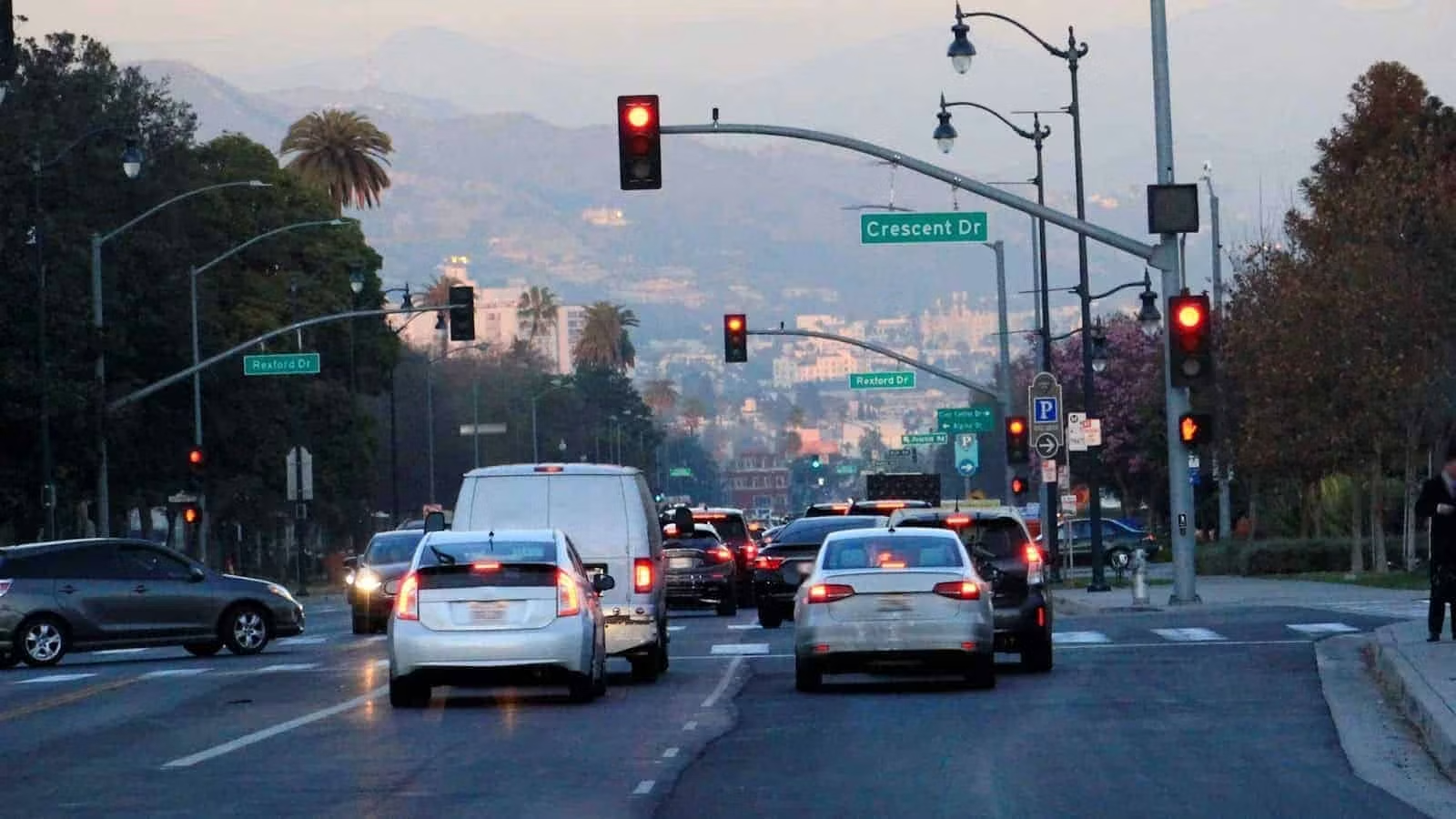
Few pieces of infrastructure have shaped daily life in America as quietly and consistently as the signal controlling vehicle movement at intersections. It sits at the center of road safety, urban planning, and transportation logistics — yet most people interact with it dozens of times a day without giving it a second thought. For those who manage roads, oversee construction zones, or coordinate traffic flow in high-demand environments, however, the history and mechanics of this device carry real operational weight. Understanding how it developed, and where it stands today, informs decisions about deployment, maintenance, and technology investment in ways that matter on the ground.
Table of Contents
The Origins of the Traffic Stoplight in American Infrastructure
The traffic stoplight did not emerge from a single invention. It developed over decades through a combination of need, experimentation, and municipal pressure as American cities grew faster than their road systems could handle. In the early twentieth century, traffic officers stood at busy intersections to direct vehicles manually. This worked in small cities, but as automobile ownership expanded, the limitations of human-directed traffic management became obvious — inconsistency, fatigue, and the sheer number of intersections that needed coverage made manual control unsustainable.
The earliest automated signals used simple two-color systems, drawing from railroad signaling conventions already familiar to the public. The addition of a third signal — the yellow caution indicator — came later and represented a meaningful shift in how the system communicated with drivers, giving them transition time rather than abrupt changes. By the 1920s and 1930s, fixed-cycle mechanical signals were being installed across major American cities, and the basic framework of what most people recognize today was already in place.
Why Standardization Took Decades to Arrive
Early signal installations varied widely from city to city. Different manufacturers used different color sequences, different timing cycles, and different housing designs. Drivers moving between cities encountered inconsistent systems that created confusion rather than order. The federal government eventually stepped in to bring uniformity to the process, establishing guidelines that would govern signal design and placement nationwide.
The Manual on Uniform Traffic Control Devices, maintained by the Federal Highway Administration, became the foundational document for how signals should operate, what colors mean, and how they should be sequenced. Standardization reduced driver confusion, allowed for predictable road behavior across state lines, and created a baseline that engineers and planners could build from. Without it, the expansion of the American highway system would have introduced far more risk than it resolved.




The Mechanical Era and Its Real Limitations
For much of the mid-twentieth century, traffic signals operated on fixed electromechanical timers. A predetermined cycle would run on a loop — green for a set number of seconds, yellow for a brief transition, red for another set period — regardless of actual traffic volume. This approach was straightforward to install and maintain, which made it attractive to municipalities with limited technical resources. It also had significant drawbacks that became more apparent as cities grew more complex.
Fixed-cycle signals could not respond to conditions. A major arterial road might hold vehicles at a red light while the crossing street sat empty. Rush hour patterns required completely different timing than midday or overnight conditions, but mechanical systems could not adapt in real time. Engineers often installed manually adjustable timers so technicians could change the cycle length based on the time of day, but this required regular physical intervention and left gaps during unexpected surges in traffic volume.
Maintenance Challenges and Operational Downtime
Mechanical systems introduced a maintenance burden that was often underestimated at the planning stage. Moving parts — motors, relay switches, timing drums — wore out under continuous operation and required routine inspection and replacement. A single failed component could knock an intersection out of service entirely, creating safety risks and traffic disruption that required immediate response from field crews.
For departments responsible for large numbers of intersections, this created ongoing operational pressure. Technicians needed specialized knowledge of each system variant, spare parts had to be stocked for multiple generations of equipment, and unexpected failures rarely occurred at convenient times. The reliability gap between what mechanical signals promised and what they delivered in real-world conditions was a recurring problem for traffic engineers throughout this period.
The Transition to Electronic and Computerized Control
The shift from mechanical to electronic signal control began in the 1960s and 1970s, driven by advances in solid-state electronics that eliminated most of the moving parts responsible for mechanical failures. Electronic controllers were more reliable, easier to program, and capable of storing multiple timing plans that could be activated automatically based on time of day or day of the week. This represented a genuine improvement in operational consistency and reduced the frequency of service calls.
The next major development came with the introduction of networked control systems. Rather than managing each intersection independently, traffic engineers could connect signals along a corridor and coordinate green phases so vehicles traveling at a consistent speed would encounter consecutive green lights without stopping. This concept — often called signal progression or green wave coordination — improved traffic flow on major roads and reduced fuel consumption and emissions across the corridor as a whole.
Centralized Traffic Management Centers
As networking capabilities expanded, many cities built centralized traffic management centers where operators could monitor and adjust signals across an entire city from a single location. This gave transportation departments far greater visibility into system-wide conditions and allowed for rapid response when incidents disrupted normal flow. A collision blocking a major intersection, for example, could prompt an operator to manually extend green phases on alternate routes to redistribute traffic before congestion spread.
These centers also enabled more detailed data collection. Engineers could track how long vehicles were waiting at specific intersections, identify timing plans that were underperforming, and make adjustments based on evidence rather than assumption. The shift toward data-informed management changed how traffic departments operated internally, creating new roles and requiring new skill sets that had not previously existed in public works organizations.
Sensor-Driven Systems and Adaptive Signal Control
The next significant development in signal technology was the introduction of detection systems that allowed signals to respond to actual vehicle presence rather than running on a fixed schedule. Loop detectors embedded in the pavement could sense when a vehicle was waiting and communicate that information to the controller, which would then adjust the signal timing accordingly. Intersections with low traffic volume could now move through cycles more efficiently instead of holding empty lanes at red while vehicles waited unnecessarily on the opposing approach.
Adaptive signal control technology extended this principle further. Rather than simply detecting vehicle presence, adaptive systems continuously measure queue lengths, arrival rates, and intersection saturation levels, then calculate signal timings that minimize overall delay across the network. These systems operate in real time and update their calculations every few seconds, making them substantially more responsive than any fixed or manually adjusted plan could achieve.
The Role of Vehicle Detection in Reducing Operational Waste
From a fleet and logistics standpoint, the improvement in cycle efficiency that detection-based systems offer has real cost implications. Vehicles idling at red lights consume fuel, add wear to engines, and contribute to delays in time-sensitive operations. In urban delivery environments, construction zones, or industrial corridors where commercial vehicles travel in volume, the cumulative impact of inefficient signal timing is measurable. Detection-based systems address a portion of that inefficiency by matching signal behavior to actual demand rather than projected averages.
AI-Powered Signals and the Current Frontier
The most recent generation of traffic signal technology applies machine learning and artificial intelligence to intersection management. These systems go beyond real-time detection by learning from historical traffic patterns, accounting for variables such as weather, nearby events, or incident reports, and generating predictive timing plans before congestion develops. Rather than reacting to conditions as they occur, AI-powered signals attempt to anticipate them.
Some deployments integrate data from connected vehicles, mobile navigation applications, and city-wide sensor networks to build a more complete picture of traffic demand across an entire road network simultaneously. The complexity of these systems is considerably greater than anything in previous generations, and their implementation requires meaningful investment in infrastructure, data management, and technical support. Early deployments in American cities have shown measurable reductions in average travel time and idle time at intersections, though performance varies based on network density and data quality.
Operational Considerations for Cities Adopting New Systems
Advanced signal technology introduces capabilities that older systems could not offer, but it also introduces new dependencies. AI-powered systems rely on continuous data feeds, stable communications infrastructure, and software that requires regular updates and cybersecurity attention. A department that previously maintained signals with mechanical skills now needs staff who understand software diagnostics, network connectivity, and data integrity. The transition is not simply a hardware upgrade — it changes how the entire traffic management operation functions.
For smaller municipalities or regional transportation departments with limited technical staff, the gap between capability and capacity can be significant. Vendor support agreements, regional coordination programs, and phased implementation strategies are commonly used to manage the complexity of adoption without overwhelming existing teams.
Conclusion: A Century of Development Still in Motion
The evolution of the traffic stoplight in America spans more than a century and reflects the country’s broader relationship with transportation, technology, and urban growth. From manually operated signals to AI-driven adaptive systems, each phase of development addressed limitations in the one before it — improving reliability, responsiveness, and the ability to manage increasingly complex road networks. What began as a simple substitute for a traffic officer now functions as a networked node in a city-wide transportation system, gathering data, making decisions, and communicating with vehicles in real time.
For engineers, planners, and transportation managers, the practical takeaway from this history is straightforward: the technology underlying signal systems continues to change faster than most procurement cycles can keep pace with. Understanding where current systems sit in that arc of development — and what operational demands they were designed to meet — remains essential for making sound decisions about maintenance, upgrades, and long-term infrastructure planning. The infrastructure may be visible everywhere, but the thinking behind it deserves equal attention.