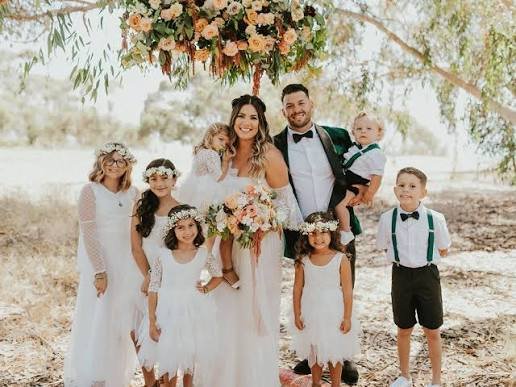
Most couples invite children to their wedding because the alternative — excluding them — creates its own set of complications. Family dynamics, travel distances, nursing mothers, and close relationships between guests and their kids make a strict adults-only policy difficult to enforce without causing friction. So the children come. And when they do, the experience for everyone in the room depends almost entirely on how well the couple planned for their presence.
This is not a question of sentiment. It is a question of logistics. A child who is bored, tired, or overstimulated at a five-hour reception will find ways to make that known. That reality affects the atmosphere for the adults around them, the comfort of the parents who feel responsible for managing the situation, and ultimately the couple’s own experience of the day. Planning a wedding that genuinely works for both children and adults requires treating those two groups as having different needs that must be addressed separately — not as one combined audience with a single solution.
Table of Contents
Why Childcare at the Venue Changes Everything
One of the most effective decisions a couple can make when children are on the guest list is arranging dedicated, professional childcare within the venue itself. This is not about removing children from the wedding — it is about giving them a parallel experience that is appropriate for their age and energy level, so that the main event can proceed on adult terms without constant interruption or parental stress.
Booking a babysitting service for wedding events has become a more common part of wedding coordination, particularly at venues that host multi-hour receptions with formal dinners, open bars, and late-night dancing. The reason is practical: parents who attend weddings with young children are not fully present. They are managing. They are watching the door, cutting food into small pieces, calculating how long until a meltdown, and scanning the room for an exit route. That is not the guest experience any couple wants for the people they invited.
When professional caregivers are stationed in a separate room — ideally one equipped with age-appropriate activities, snacks, and a quiet area for naps — parents are released from that continuous management role. They can sit through the ceremony. They can have a conversation at the reception. They can stay through the toasts. The children, meanwhile, are in the care of adults who are trained for exactly this kind of environment and whose full attention is on them.




What to Look for When Hiring Wedding Childcare Professionals
Not every babysitter is prepared for the specific conditions of a wedding. The environment involves unfamiliar spaces, a mix of ages, varying schedules, elevated noise levels, and children who may be dressed formally and feeling out of their routine. The caregivers you hire should have verifiable experience in group childcare settings — not just one-on-one home babysitting — and should be comfortable managing transitions, unexpected emotions, and the kind of low-level chaos that comes with a group of children between the ages of two and ten.
Background checks are a reasonable baseline expectation. Beyond that, couples should ask how caregivers handle situations where a child is inconsolable, how they communicate with parents during the event, and whether they have a method for quickly locating a parent if needed. A clear communication protocol between caregivers and parents — even something as simple as a shared phone contact — removes anxiety from the equation on the day itself.
How the Childcare Room Should Be Set Up
The physical space matters. A repurposed storage room with a few folding chairs is not the same as a properly arranged children’s area, and that difference will be felt within the first thirty minutes. The space should have enough room for children to move around, a surface for activities, comfortable seating or floor padding for younger children, and ideally some separation between active play and a quieter corner for tired or younger guests.
Supplies do not need to be elaborate. Age-appropriate crafts, a selection of picture books, simple puzzles, and a few familiar toys cover most of what is needed for the younger age groups. For older children, a movie option or a structured activity like a scavenger hunt tied loosely to the wedding theme can provide enough engagement to prevent restlessness. Food and drinks in the children’s room should be discussed with the venue in advance, particularly around allergies.
Designing the Ceremony Experience With Children in Mind
Children do not inherently disrupt wedding ceremonies. They disrupt ceremonies when the experience asks them to do something they are not developmentally capable of — which is sitting still and being silent for an extended, emotionally charged event that has no meaning to them yet. Designing the ceremony with this in mind does not mean shortening your vows. It means removing the structural friction that makes children’s natural behavior feel like a problem.
Seating placement is one of the most overlooked elements. Families with young children seated at the end of rows near the aisle can exit quietly without disturbing the entire seating arrangement. Families seated in the center of a long pew cannot. This one consideration significantly reduces the visible disruption when a toddler reaches their limit and needs to be taken out.
Keeping Ceremonies Shorter Without Compromising the Moment
Most wedding ceremonies can be structured to run between twenty and forty minutes without losing any of their meaning. Readings, musical interludes, and extended welcome remarks often extend ceremonies well past the point at which young children can remain calm. Couples who are aware of this tend to make more deliberate choices about what to include — prioritizing what holds meaning for them over what fills time or meets traditional expectations.
A brief, well-structured ceremony is not a lesser ceremony. For many couples, trimming to the essential elements makes the moment more focused and memorable, not less. The benefit to parents and children in the room is a secondary outcome of a decision that serves the ceremony itself.
Providing Quiet Comfort Kits for Young Guests
Some couples prepare small bags for children attending the ceremony — not as entertainment, but as comfort. A few quiet items like a small soft toy, a simple activity book, or a familiar snack can make the difference between a child who is calm and a child who is restless. These are distributed at the door, usually by an usher or coordinator, and parents appreciate the acknowledgment that their child’s experience was considered.
According to child development guidelines maintained by institutions like the CDC’s Child Development resources, children under five have limited capacity for self-regulation in unfamiliar, high-stimulation environments. Working with that reality, rather than against it, is the practical approach.
Managing the Reception for Mixed-Age Groups
The reception presents a different set of challenges than the ceremony. It is longer, more unstructured, and transitions between eating, speeches, and dancing in ways that can confuse or exhaust young children who have already had a full day. Parents managing a child through a four-hour reception while also trying to enjoy the event are rarely succeeding at both.
Couples who think about the reception timeline through the lens of a family with a toddler tend to make adjustments that benefit everyone. Dinner service that begins relatively early gives families a natural exit window. A dedicated children’s table near the childcare room allows older children to eat with peers before transitioning to the supervised play area. These structural decisions reduce the pressure on parents without requiring anyone to leave the celebration.
Programming That Accounts for Children Without Centering on Them
There is a difference between a wedding that plans for children and a wedding that orients itself around children. The goal is the former. Some couples include one or two moments that acknowledge younger guests — a short dance set at a tempo that even children can participate in, or a small activity station at cocktail hour — without restructuring the event to suit children’s preferences throughout.
This approach acknowledges that children are present and that their comfort is considered, while keeping the overall tone and atmosphere of the event oriented toward the adults who make up the majority of the guest list. Parents respond well to this because it signals that the couple has thought about their situation without making them feel like a burden or a special case that needed to be managed.
Communicating the Plan to Guests in Advance
Logistics that are not communicated in advance do not work as well as they should. If you have arranged a babysitting service for wedding guests’ children, that information should reach parents before the day itself. It allows them to prepare their children for the idea of being in a separate space, to ask questions about the caregivers and setup, and to arrive at the wedding without anxiety about how the day will unfold.
The wedding website is the most practical channel for this kind of detail. A short paragraph describing the children’s room, the caregivers’ qualifications, the location within the venue, and how parents can reach the childcare team during the event answers most of the questions parents will have. It also signals that the couple has handled the logistics competently, which reduces the follow-up questions that would otherwise come in the weeks before the wedding.
Setting Expectations Without Being Prescriptive
Telling guests about childcare arrangements is not the same as telling them what to do with their children. Some parents will want their children with them throughout, regardless of what is available. That is their choice to make. The goal of communicating the plan is to give parents an option — a well-organized, professionally staffed option — so that their experience of the wedding is not defined by the absence of alternatives.
Couples who present childcare as an amenity rather than a requirement tend to get better uptake and more goodwill from parents. The framing matters. It is a service provided for their comfort and their child’s enjoyment, not a directive to remove their children from the main event.
Closing Thoughts
Planning a child-friendly wedding that also works for adult guests is largely a matter of treating the two groups as distinct audiences with different needs, and then making structural decisions that serve both. It does not require elaborate children’s programming or dramatic changes to the event. It requires thoughtful seating, appropriate ceremony length, a dedicated and properly staffed childcare space, and clear communication with guests who are traveling with children.
The couples who get this right are rarely the ones who spent the most money or planned the most activities. They are the ones who acknowledged the reality of what it is like to attend a long wedding with a young child, and who made decisions that took that reality into account. The result is a wedding where parents are genuinely present, children are comfortable and engaged, and the adult atmosphere of the celebration remains intact from the ceremony through the final hour of the reception.
That outcome is achievable with planning. It does not happen on its own, but it is also not as complicated as it initially appears. Most of the work is in asking the right questions early and making deliberate choices before the day arrives.