
At the WONDR Kemala Run 2026, DRI Clinic didn’t just show up at the Bali United Training Centre with a canopy and some ice packs. They operated a designated Recovery Zone – physiotherapists, sports massage practitioners, a cold plunge, on-site doctors – positioned as a named partner, not a peripheral add-on. The apparatus required to make recovery visible at a competitive race was substantial: a formal agreement, a physical zone, a dedicated designation. Strip away any one of those, and participants disperse the moment they cross the finish line.
That dependency on formal apparatus reflects a broader pattern. Most people who train regularly treat a session as complete when they leave the floor – stretching is optional, passive rest is the default, and cold or heat therapy reads as equipment for elite athletes and their specialist staff. The barrier isn’t informational; most gym-goers have encountered the arguments for recovery and skipped them anyway. The question is whether environmental design can change that decision architecture in a way that awareness cannot.
Table of Contents
A Cultural Gap, Not a Knowledge Gap
The physiological rationale for structured recovery is real, but it is conditional. A 2022 Cochrane Review of 17 small trials covering 366 participants found some evidence that cold-water immersion reduces muscle soreness compared to passive recovery at multiple timepoints up to around 96 hours. The same review noted that optimum methods and safety remain unclear, partly because adverse events were often not actively tracked. A 2024 systematic review and meta-analysis in the European Journal of Sport Science adds a timing-dependent wrinkle: cold-water immersion applied immediately after resistance training may attenuate hypertrophy. Whether it helps depends on goal and context, which means neither a universal prescription nor simple advocacy follows from the evidence.
Training culture has always located productive discomfort where the session is happening – in the lift, the run, the class. Recovery sits outside that frame. This is not an ignorance problem. People who know the case for recovery still skip it, because knowledge hasn’t changed what feels like the natural endpoint of effort. Treating the gap as an information deficit produces more earnest gym posters; it doesn’t produce a different relationship with the body.
Any solution that addresses this informationally misdiagnoses the problem. The live question follows: when tools built for a scaffolded environment – one with progressive structure, supervision, and coaching relationships – migrate into mainstream fitness settings without that scaffold, does the problem of staying with and interpreting discomfort resolve or compound?



What Gets Lost in the Migration
When recovery tools move from elite and clinical settings into commercial fitness environments, the operating conditions that make them effective don’t necessarily follow. In Bali’s commercial recovery market, at least some access is framed explicitly as self-serve: AMO Spa markets “a self-guided ice bath and sauna circuit” in Canggu. The missing scaffolding is not mystical – it is a bundle of teachable and screenable constraints. Watermark Hotel & Spa Bali publishes contraindications for sauna and ice-plunge use, covering certain health conditions, pregnancy, illness, and alcohol. Indonesian instructional material from Kemdiktisaintek LMS, a government-linked learning platform, specifies contrast-bath parameters: cold around 10–15°C, hot phases longer than cold, starting and ending cold. The tools can arrive without any of that protocol logic in the room.
At the WONDR Kemala Run, DRI Clinic operated a staffed Recovery Zone – physiotherapists providing tailored sessions alongside sports massage and a cold plunge – rather than a self-guided facility where participants determine their own path through the options.
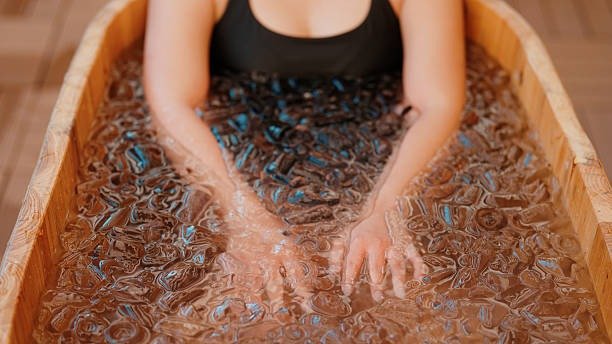
Cold immersion is the sharpest case of what absent scaffolding costs. The discomfort is embodied and immediate, and without a coaching relationship or progressive introduction, the ordinary response is to step back out. Alexandre Tsuk, founder and cold exposure coach at BreathingCold Bali, describes what he typically observes when newcomers face an ice bath for the first time: “You’re standing there – looking at your first ice bath and your body is going ‘No way! You’re joking… I am not getting in that.’ The resistance can be tough. Often the first 15 or so seconds… is the hardest.” That first encounter is precisely where progressive introduction translates discomfort into something participants can interpret and stay with – and without it, the pool wins.
When the Environment Carries the Work
Bali’s Governor Regulation No. 97/2018, which restricts the generation of single-use plastic waste, operates on a different problem – but it works on the same architectural logic. Rather than asking people to remember the right choice at each transaction, it changes what options are available in the moment. The behavioural load shifts from deliberate recall to changed defaults. I Made Dwi Arbani, Head of the Waste/LB3 & Environmental Damage Control Division at the Environment and Forestry Agency of Bali Province (DKLH Bali), described what followed once plastic bags were restricted in modern retail: “Over time, consumers became accustomed to bringing their own shopping bags, so visits to modern stores became stable again.” The friction had changed; the behaviour followed.
Recovery adoption can shift on the same principle when it’s embedded into the same places and rhythms as training. Nirvana Life Bali, a fitness and wellness club in Canggu, illustrates this mechanism in practice. Its recovery center – ice baths, infrared sauna, steam room, and jacuzzi – is physically and sequentially adjacent to the training floor and class spaces. Members move from a strength session, yoga class, or any other scheduled class directly into recovery without leaving the grounds, and access is built into all membership tiers, not sold separately. Removing the separate transaction removes something more specific than cost – the decision itself. That small purchase moment can be where a habit breaks.
The question a member faces shifts from “will I make a separate journey to a recovery facility?” to “will I stop here before the café?” That is a structurally different question – one that no longer requires deliberate motivation to clear. Whether the same mechanism generalises depends on a condition the architecture alone cannot supply.
Access Without Conditions Is Not Enough
Access and conditions are separable – and the gap between them is where consistent practice breaks down. Identical modalities are framed differently across Bali’s recovery market: as self-guided circuits in some settings, as structured practice with defined guardrails in others. The difference is not the equipment. Those guardrails include screening and contraindication rules, guidance on temperatures and timing, and explicit sequencing instructions. Whether that layer travels into any given room depends on what the environment chooses to carry.
Structural adjacency doesn’t carry sequencing knowledge, framing, or coaching presence into the room. Recovery positioned as the next step still needs someone – a practitioner, a protocol, a clear piece of signage – to explain what that step involves, why it follows in that order, and why the discomfort of an ice bath at the end of a session is productive rather than arbitrary. Embedding recovery into a facility is the necessary first condition. Without deliberate cultural scaffolding around the access, the migration from clinical to commercial settings preserves the equipment while letting the protocol become optional.
Making Recovery Structurally Inevitable
Structural design can change when people encounter recovery; it cannot by itself change whether they understand what they’re doing or why it works. Both conditions have to hold – architecture that removes the discrete decision to seek recovery out, and a cultural framing that gives the discomfort a purpose participants can actually act on. When one is absent, the other compensates imperfectly. Information without friction-removal produces awareness that doesn’t translate into habit. Friction-removal without framing leaves someone standing at the edge of a cold plunge, motivated enough to show up, uncertain enough to walk away.
Nirvana Life Bali’s arrangement in Canggu shows what the first condition looks like when it’s built in rather than bolted on – recovery positioned as the next step rather than an optional detour. Whether the second condition follows depends on what fitness environments do with the access they create.
The tools are increasingly available. The harder question is who explains what to do with them.