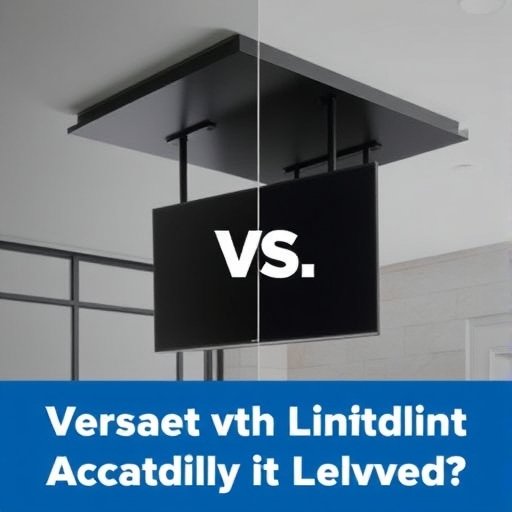
When a ceiling-mounted TV lift fails mid-presentation, or stutters in front of a room full of clients, the immediate problem is not just inconvenience. It is a visible breakdown in the reliability that facility managers, AV integrators, and commercial space operators are expected to maintain. For anyone specifying or installing motorized ceiling lift systems—whether in a boardroom, hospitality venue, house of worship, or large residential installation—the choice of equipment carries real operational weight. A lift that deploys inconsistently or requires frequent servicing creates costs that go well beyond the equipment itself: labor disruption, scheduling around downtime, and the reputational friction of a system that simply does not perform on demand.
The category of TV ceiling lifts has grown considerably as flat panel displays have become standard in professional and commercial environments. With that growth has come a wider range of products, from basic entry-level lifts to purpose-engineered systems designed for repeated, reliable use in demanding settings. Understanding what separates these categories—and why those differences matter in practice—is essential for anyone responsible for specifying, installing, or managing AV infrastructure.
Table of Contents
What Sets Versa Lift East Apart From Generic Ceiling Lift Alternatives
The versa lift east designation refers to a specific product line available through specialized AV equipment distribution channels, built around motorized ceiling lift mechanisms designed to handle larger display sizes, heavier load ratings, and more frequent deployment cycles than what standard consumer or light-commercial lifts can sustain. For anyone who follows professional AV equipment, versa lift east systems are positioned at the upper end of the specification range—not because of branding, but because of how they are built and what they are built for.
Standard ceiling lifts—often sourced from general AV distributors or mass-market channels—are typically designed to meet a price point. They may function adequately in low-use settings where the lift deploys a handful of times per week and the display is modest in size. The issue arises when those same lifts are placed into commercial environments where deployment frequency is high, ceiling heights are non-standard, or the display itself is large and heavy. In those conditions, the engineering compromises built into lower-tier lifts begin to show. Motor strain increases, mechanical tolerances drift, and what was acceptable in a controlled demo environment becomes a liability in daily use.
Information on the full range of versa lift east products and their intended applications is available through specialized distribution, and those looking to understand which models suit which environments can find that context through versa lift east product listings that cover the distinct lift configurations offered within this line. The engineering decisions that differentiate these systems from generic alternatives are not cosmetic—they reflect a fundamentally different assumption about how the equipment will be used.


Load Capacity and the Real Cost of Underpowered Systems
One of the most consequential differences between purpose-built ceiling lifts and standard alternatives is how they handle weight over time. A lift operating near the top of its rated capacity will wear faster, behave less predictably, and require more maintenance than one operating comfortably within its design range. This is not a theory—it reflects how mechanical systems behave under sustained stress.
When a facility installs a ceiling lift system and then upgrades to a larger or heavier display a year later, a lift with limited load headroom may technically still hold the weight while quietly accumulating wear that shortens its service life. The failure often does not come immediately—it comes eighteen months later when the motor begins struggling or the lift drops inconsistently. At that point, the cost of a replacement lift, plus the labor to re-access a ceiling installation, typically far exceeds what would have been saved by choosing a more capable system at the outset.
Deployment Consistency Across Repeated Use
In a commercial setting, a ceiling lift may deploy and retract dozens of times per week. Each cycle should perform identically: smooth, quiet, and completing at the correct position without adjustment. Standard lifts often meet this standard initially, but their mechanical components—particularly drive mechanisms and limit switches—may not be engineered for the cumulative wear of high-frequency use.
Purpose-built lifts in the versa lift east category address this through more robust internal components and tighter mechanical tolerances, which means the system behaves consistently over thousands of cycles rather than performing well for the first few hundred. For AV integrators who carry service responsibility after installation, that difference is not abstract—it is the difference between a client who rarely calls with issues and one who expects ongoing troubleshooting.
How Standard AV Lifts Are Typically Specified and Where They Fall Short
Standard ceiling lift systems are frequently specified by price and by surface-level compatibility: the lift fits the ceiling joist spacing, it accepts the display mounting bracket, and it falls within the project budget. These are legitimate considerations, but they do not fully account for the environment in which the system will operate. A lift specified this way may perform acceptably in a small conference room with a modest display and occasional use—but that same specification applied to a hotel meeting space or a permanent training room will produce different results over time.
The standards that govern electrical and structural safety in AV installations—such as those maintained by organizations like the National Fire Protection Association for electrical compliance—are relevant here because ceiling-mounted equipment involves both structural attachment and powered operation. Generic lift systems sometimes pass minimum compliance thresholds without being engineered to sustain real-world conditions above those minimums. That gap between compliance and durability is where performance differences become visible.
The Specification Gap in Commercial Projects
Many AV integrators working on commercial projects encounter a familiar pattern: the initial specification is written around a budget, a lift is selected that meets the minimum requirements on paper, and the installation proceeds without issue. Problems surface six to twelve months later, often after the original integration team has moved on to other projects. By then, the client associates the performance issues with the installation itself, not with the upstream specification decision.
This is not a failure of installation craft—it is a failure of equipment selection. The lift was asked to do more than it was designed to do reliably. Choosing equipment that is genuinely rated for the application, rather than technically capable of meeting minimum specs, is the practical difference between a clean installation record and a pattern of callbacks.
Ceiling Height and Structural Variability
Commercial and institutional spaces present ceiling conditions that residential or light-commercial lift systems are not designed for. Higher ceilings require longer travel distances, which places greater demands on the lift mechanism and the cable or drive system that extends it. Non-standard ceiling structures may require adapters or custom rigging that interact with the lift’s load path in ways that a light-duty system cannot handle without accelerated wear.
The versa lift east line accounts for these variables by offering configurations suited to a wider range of ceiling heights and structural conditions. This flexibility is not a marketing feature—it reflects the reality that professional installations rarely occur in perfectly standardized conditions.
What the Total Cost of Ownership Actually Looks Like
When evaluating ceiling lift systems, the purchase price is the most visible number but rarely the most meaningful one over a three-to-five year horizon. A lower-cost lift that requires two service visits per year, each involving a technician accessing a ceiling installation, carries a total cost that often exceeds what a more capable system would have cost upfront.
The costs that accumulate around an underperforming lift include technician labor, parts, scheduling disruption, and the indirect cost of a system that is visibly unreliable in a professional environment. For facilities that host clients or use AV systems as part of their core operations, the reputational weight of a lift that fails during use is difficult to quantify but very real.
Maintenance Intervals and Service Accessibility
Purpose-built lift systems in this category are generally designed with serviceability in mind. Components that experience wear are accessible without requiring full disassembly of the ceiling installation, and the systems are designed to provide consistent performance between service intervals rather than requiring ongoing adjustment. This matters practically because most commercial facilities do not have in-house AV technicians—every service visit is a scheduled cost.
A system designed for low maintenance frequency and straightforward servicing when maintenance is needed fits more naturally into the operational reality of a commercial facility than one requiring frequent attention. The engineering investment in reliability translates directly into lower total cost of ownership, even when the upfront price is higher.
Making the Right Specification Decision for Your Environment
The comparison between versa lift east systems and standard ceiling lift alternatives is not a question of which product is universally better. It is a question of which system is appropriate for the actual conditions of the installation—the frequency of use, the weight and size of the display, the ceiling height, and the tolerance for service interruptions.
For low-use residential or light-commercial applications where a modest display deploys infrequently, a standard lift may perform adequately. For commercial, institutional, or high-use environments where consistency and longevity matter, the engineering differences that define purpose-built systems like the versa lift east line translate directly into better outcomes over the life of the installation.
The decision ultimately belongs to whoever is responsible for the long-term performance of the space—whether that is an AV integrator, a facilities manager, or a project owner. But that decision should be made with a clear understanding of what each category of equipment is actually built to do, not just what it is technically capable of doing under ideal conditions.
Closing Thoughts
Ceiling lift systems occupy a quiet but operationally important role in professional AV environments. When they work well, they are invisible—the display appears, the meeting proceeds, and no one thinks about the mechanism above the ceiling. When they fail or perform inconsistently, they become the central problem in a room full of people who expected something better.
The difference between a lift that sustains reliable performance over years of use and one that becomes a recurring service problem often comes down to decisions made before installation: how the equipment was selected, what assumptions were made about its operating conditions, and whether the specification matched the real demands of the environment. Understanding the technical and operational differences between versa lift east systems and standard alternatives gives specifiers and facility decision-makers the context they need to make those decisions well the first time.