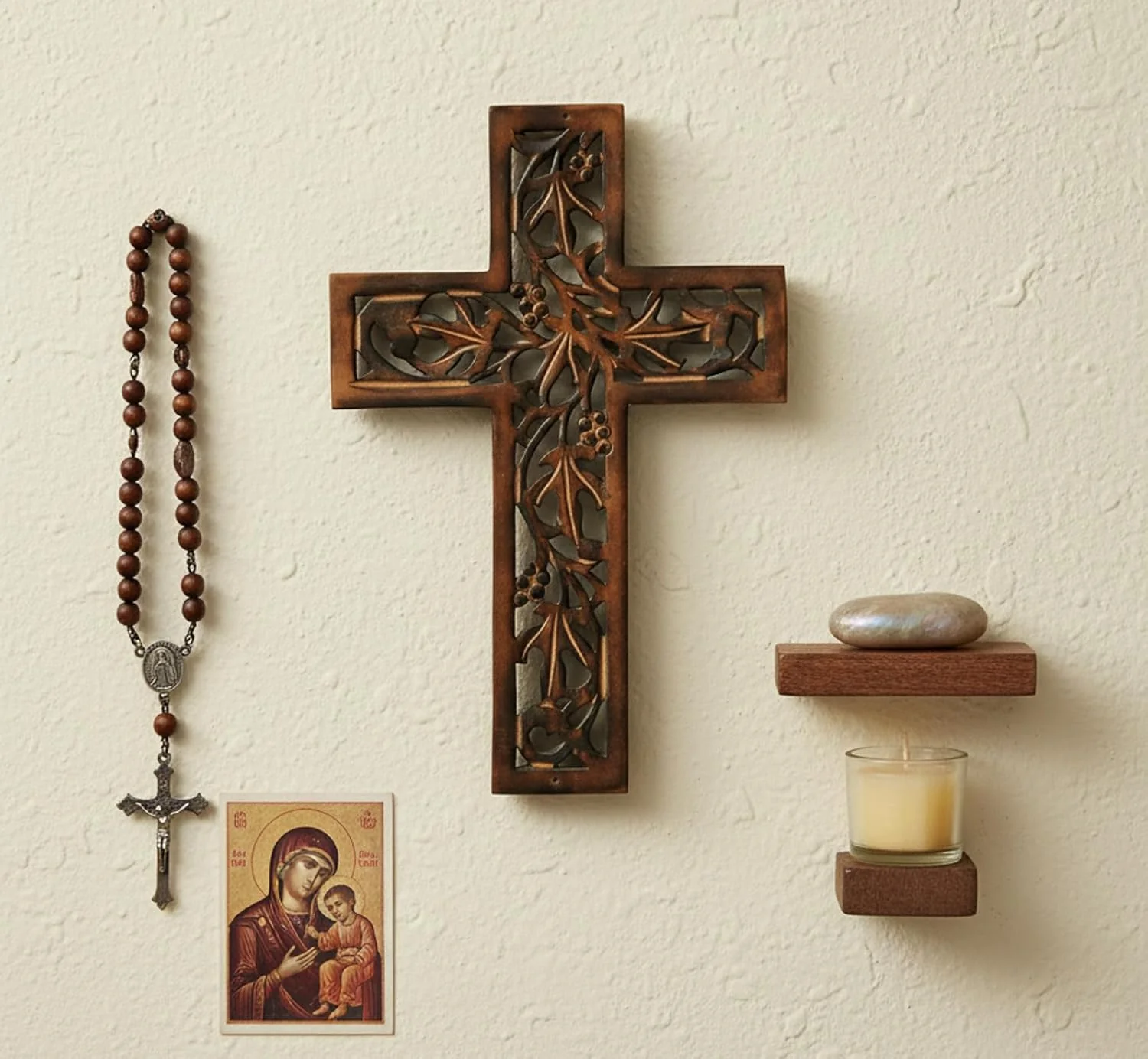
Every family I know has a story about wooden crucifixes, and it usually involves a hallway, a slightly wonky nail and somebody’s grandmother.
Mine hung by the front door of my grandmother’s house, at exactly the height where you could not avoid it. Coats were hung beneath it and umbrellas leaned against the wall below. Visitors nodded to it without thinking, the way you might nod to a neighbour. It was dark, a little scuffed at the edges, and entirely unremarkable to a child in a hurry. It took me years to realise it was the most important object in the house.
Table of Contents
Why wood has always suited the crucifix
There is something fitting about carving the Cross from wood. The Cross itself was timber, and Christ grew up in a carpenter’s household, so the material carries a quiet logic that metal and glass never quite manage. Wood is humble, ordinary and warm to the touch.
Wooden crucifixes have been part of Catholic life for centuries, from monastery cells to farmhouse kitchens across Europe. Craftsmen in mountain villages carved them by the dozen for local parishes, and families would save for one the way we now save for a decent sofa. Olive wood from the Holy Land became especially treasured, partly for its swirling grain and partly because pilgrims liked to carry a piece of the journey home with them.
I find that handcrafted pieces reward a second look. You can often see where the chisel paused, and no two grains are ever quite alike. Mass produced décor rarely earns that sort of attention.



Reading the symbol
A crucifix and a plain cross are not quite the same thing. A crucifix bears the figure of Christ, known as the corpus, and speaks plainly of the Passion and sacrifice. A bare cross tends to point towards the Resurrection and victory over death. Neither is better, but it helps to know what you are hanging on your wall.
Styles vary more than people expect. The classic Latin crucifix is the one most of us picture. The San Damiano crucifix, inspired by the one before which St Francis prayed, has a serene, icon like feel. Then there are simple, minimalist designs that suit a contemporary space without looking stark.
It is worth studying the details too. The small INRI plaque at the top, the carved expression, the proportions of the arms. I can happily spend ages on these, which is either devotion or a mild obsession with craftsmanship, and I have made peace with both.
Choosing the right wood and finish
Choosing a piece is really a matter of matching the wood and finish to the room. A few pointers to get you started.
- Olive wood is pale to honey coloured with dramatic grain, and it is the traditional favourite from the Holy Land.
- Walnut is rich, dark and elegant, and sits well in classic interiors.
- Oak is sturdy, with a bold grain that suits farmhouse or rustic homes.
- Cherry starts light and deepens beautifully with age, developing a lovely glow.
- Pine is lighter and more affordable, and works well for smaller spaces or gifts.
Finish matters just as much. Natural or waxed surfaces keep the grain of solid wood visible, polished finishes add a formal gleam, and darker stains give a more monastic feel. Painted details can bring a touch of colour to devotional art.
I would gently suggest resisting the urge to match a crucifix to the sofa. Choose it for its character, and the rest of your religious home décor will sort itself out.
Where a wooden crucifix belongs in the home
Traditionally, a wall crucifix hangs above the bed, over a doorway or in the entrance hall, so that it blesses the comings and goings of the household. Living rooms are popular too. Scale matters more than people think, and one well placed piece with room to breathe usually looks better than a crowded gallery wall.
A prayer corner is a lovely way to give a crucifix a proper setting. A small table, a candle, a Bible and a rosary are all you need. It does not have to be grand. What I love is how a single visible sacred symbol shifts the mood of a room, turning an ordinary corner into somewhere you naturally slow down.
Caring for wood, and passing it on
Wood is forgiving but not indestructible. Dust it gently with a soft dry cloth, keep it away from damp and direct sunlight, and give it an occasional light wax if the finish allows. Harsh cleaning sprays can strip the surface, so leave them under the sink.
It is also worth having a new crucifix blessed by a priest, particularly when it is going into a home for the first time. It is a small and simple tradition, and it turns a decorative purchase into something rather more meaningful.
That meaning is why crucifixes make such good gifts, whether for a wedding, a housewarming, a First Communion or a Confirmation. And, as my grandmother’s hallway proved, they have a habit of becoming heirlooms.
Why wooden crucifixes still earn their place on the wall
After my grandmother died, the crucifix came to me. Taking it down revealed a pale rectangle on the wallpaper where it had hung for decades, a faint outline of how long it had kept watch over that front door. I understand now that it was never just decoration. It was a quiet companion to every arrival and departure.
That is the enduring appeal. Design trends fade, but wood ages with grace and a crucifix keeps its meaning. For those looking to explore different styles, materials, and finishes, browse a dedicated selection available online. Choose the one that feels like it belongs, and I suspect the wooden crucifixes we bring home today will become somebody else’s hallway story one day.