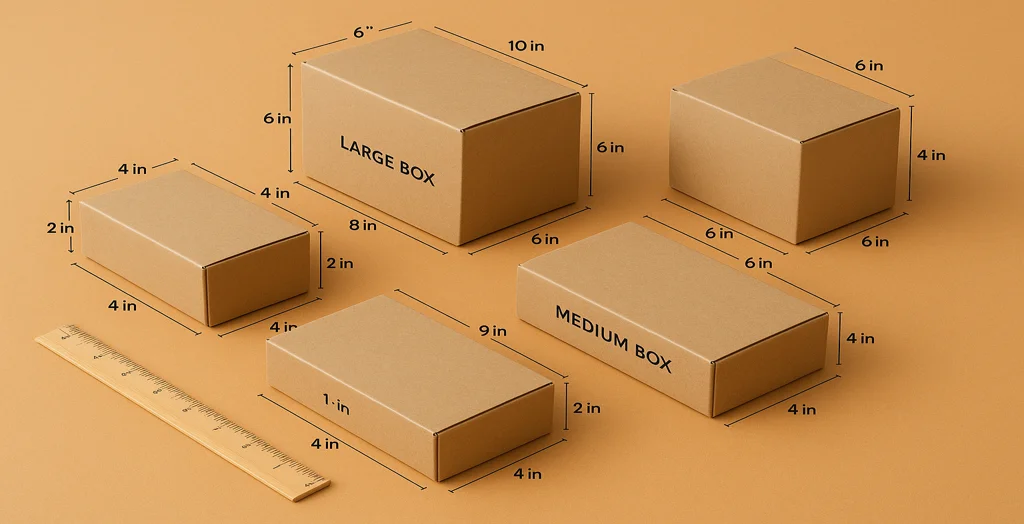
Warehouse space is a managed resource, not an unlimited one. Every SKU you carry in packaging takes up shelf room, ties up capital, and demands a decision every time an order gets picked. For eCommerce operations shipping a broad range of products, the packaging decision often gets made reactively — whatever box is closest, whatever is leftover from the last bulk order. That approach works until it doesn’t, and it typically stops working at scale.
The sellers who run the most consistent fulfillment operations tend to have one thing in common: a deliberate, limited set of box sizes they stock intentionally. They’ve made the calculation that a well-chosen range of corrugated cartons covers the majority of their shipments without requiring constant improvisation. This article outlines the ten box sizes most commonly relied upon across US eCommerce warehouses, why each one earns its place on the shelf, and how sizing decisions connect directly to damage rates, carrier costs, and customer experience.
Table of Contents
The Small Cube Format and Why It Anchors a Packaging Program
Small cube boxes occupy a specific and important role in eCommerce fulfillment. They handle products that are dense, compact, and don’t need additional void fill to stay protected. Cosmetics, electronics accessories, single-item apparel pieces, specialty food products, and artisan goods often fall into this range. The cube format — where height, width, and depth are roughly equal — naturally limits wasted interior space and distributes compression load evenly across the box structure.
Among the most consistently useful formats in this category is the 7x7x7 corrugated kraft shipping box. It’s a format that appears in fulfillment operations across a wide range of industries precisely because it hits a practical middle ground — substantial enough to hold a meaningful product, small enough to keep dimensional weight charges manageable. Sellers sourcing this format can review available inventory at 7x7x7 corrugated kraft shipping box options to understand availability and material specifications.
Why Cube Geometry Reduces Fulfillment Errors
When a box has roughly equal dimensions, warehouse staff can orient it in multiple directions without consequence. There’s no wrong-way-up concern, no confusion about which flap to close first. This sounds like a minor operational detail, but in high-volume pick-and-pack environments, seconds matter. Inconsistency in how boxes are handled during packing contributes to both seal failures and product shifting during transit. The cube format removes one layer of decision-making from the packing station, which tends to reduce error rates over time.




Medium Flat Boxes for Apparel and Soft Goods
Apparel is one of the most returned categories in US eCommerce, which means the box protecting those items needs to do more than survive transit — it needs to open well, close cleanly, and support a returns process that customers don’t find frustrating. Medium flat corrugated boxes, typically wider and longer than they are tall, fit folded garments, soft goods, and lightweight accessories without requiring excessive void fill to maintain structure.
The Relationship Between Box Depth and Product Presentation
When a flat box is too deep for its contents, the product shifts during shipping and arrives looking like it was thrown together at the last minute. That perception affects return rates even when the product itself is undamaged. Matching box depth to the actual folded dimensions of a garment reduces movement, presents the item more cleanly upon opening, and communicates that the seller manages quality through the entire order experience — not just up to the point of shipment.
Long Narrow Boxes for Tubes, Rods, and Linear Products
Products that don’t conform to a cube or rectangle — curtain rods, yoga mats, rolled artwork, fishing equipment, LED strip lighting — require a box geometry that most sellers don’t keep on hand until they start shipping these items regularly. Long narrow corrugated boxes protect linear products from the lateral pressure they’d experience in an oversized carton with improvised padding. The right geometry here isn’t about aesthetics; it’s about preventing the specific failure modes that long products experience in transit, including crushing at midspan and end-cap compression.
Shallow Mailer-Style Boxes for Books, Flat Media, and Documents
Rigid mailer boxes occupy a middle ground between poly mailers and full corrugated cartons. They’re appropriate for products that need rigidity — books, framed photos, vinyl records, flat-packed prints — but don’t require the depth or weight capacity of a standard shipping carton. The corrugated structure in these boxes typically uses a lower flute profile to maintain a slim footprint while still resisting the bending forces that destroy paperboard mailers when stacked under heavier parcels in a delivery vehicle.
Why Rigidity Matters More Than Cushioning for Flat Products
Cushioning protects against impact. Rigidity protects against flex. For flat products, damage almost never comes from a single drop — it comes from the cumulative bending stress that occurs across multiple handling points: the conveyor belt, the delivery vehicle floor, the stack at the distribution center. A shallow rigid mailer addresses the actual failure mechanism for these products in a way that bubble wrap inside a poly bag cannot.
Mid-Range Square Boxes for General Merchandise
The workhorse of most eCommerce warehouses is a mid-range square or near-square carton that handles the broadest range of products. Kitchenware, small appliances, toys, hobby supplies, personal care bundles — these items represent a significant portion of what US eCommerce sellers ship each day. Carrying two or three sizes in this general range, rather than one, gives fulfillment staff the flexibility to match box size to product volume without defaulting to oversized packaging.
Large Square Boxes for Bundled Orders and Subscription Products
Subscription box businesses and multi-item bundle shippers operate under different constraints than single-item fulfillment operations. The box needs to accommodate a curated set of products arranged deliberately, with enough internal volume to allow for protective inserts, tissue paper, or branded packaging elements. Large square corrugated boxes in this range also need to maintain structural integrity when stacked, since subscription shipments often go out in large batch volumes and spend more time in transit stacks than individual orders.
How Box Construction Grade Affects Subscription Fulfillment
Not all corrugated boxes are built to the same compression standard. The box compression test methodology used in the packaging industry measures how much vertical load a box can sustain before deforming. For subscription sellers shipping large quantities of similarly sized boxes that will inevitably be stacked, selecting a construction grade appropriate to the stacking weight matters. A box that performs well in isolation may fail consistently when twenty identical boxes are stacked in a pallet configuration.
Tall Narrow Boxes for Bottled Goods and Fragile Vertical Products
Bottles, candles, small sculptures, and similar products have a vertical center of gravity that makes them inherently unstable in transit. Tall narrow boxes that allow these products to ship upright — with appropriate void fill above and below — keep them in the orientation they’re designed to survive. Shipping a tall fragile item on its side in an oversized box is one of the most common causes of damage for specialty food, beverage, and home fragrance sellers.
Multi-Depth Boxes for Variable Product Ranges
Some sellers carry products that vary significantly in height but share similar footprints. Multi-depth corrugated boxes are scored at multiple heights, allowing the warehouse team to cut the box down to a shorter profile without sourcing an entirely different SKU. This format reduces the total number of box sizes a warehouse needs to stock while preserving a reasonable fit across product categories. It’s not the right solution for every operation, but for sellers with moderate volume and wide product variety, it removes the need to maintain a full inventory of every incremental box height.
Heavy-Duty Double-Wall Boxes for Dense or Fragile Items
Standard single-wall corrugated construction handles the majority of eCommerce shipments without issue. But products that are either very heavy for their size — cast iron cookware, dense hardwood goods, tool sets — or extremely fragile regardless of weight require a box construction that provides additional resistance to both compression and puncture. Double-wall corrugated cartons use two layers of fluted medium between linerboards, which increases both stacking strength and resistance to external impacts during handling.
Matching Wall Construction to Product Risk Profile
The decision to use double-wall construction shouldn’t be made uniformly across a product line. It should be applied where the cost of a damaged shipment — including replacement product, return shipping, customer service time, and negative review risk — exceeds the incremental cost of heavier packaging material. For most eCommerce operations, this calculation points to a relatively small subset of SKUs that genuinely warrant the upgrade, rather than a blanket policy that increases packaging costs across the board.
Specialty Small Boxes for Jewelry, Accessories, and High-Value Small Items
Small high-value items — jewelry, watches, premium accessories, collectibles — often require packaging decisions that balance protection with presentation. A small corrugated outer carton that accommodates an inner rigid gift box or foam-lined insert tray is a standard configuration for sellers in this space. The 7x7x7 corrugated kraft shipping box and similar compact formats are frequently used as the outer protective layer in this two-box configuration, providing corrugated strength around a more presentation-focused inner container.
Building a Box Inventory That Supports Operations, Not Just Orders
The ten formats described here don’t represent an exhaustive catalog — they represent the range that covers the operational reality of most US eCommerce sellers. The goal of a well-structured box inventory isn’t to have a box for every possible product. It’s to have a manageable set of sizes that handles the majority of shipments without generating excessive void fill waste, inflating dimensional weight charges, or creating fulfillment bottlenecks.
Sellers who approach their packaging inventory strategically tend to see measurable improvements across several areas: reduced materials cost per shipment, lower damage rates, faster packing times, and fewer carrier surcharges. The 7x7x7 corrugated kraft shipping box, along with the other formats outlined here, earns its place not through novelty but through consistent utility across a wide range of real-world shipping scenarios.
The practical step is to audit what you’re currently shipping, categorize products by their dimensional profile and fragility, and identify which box sizes would cover the largest share of your volume with the least amount of compromise. Most sellers find that a core set of eight to twelve box sizes handles well over ninety percent of their shipments when chosen deliberately. The remaining edge cases can be handled with a secondary stock of specialty formats, ordered as needed rather than held in permanent inventory.
Packaging decisions made at the warehouse level have downstream consequences that extend to carrier relationships, customer satisfaction, and return rates. Treating box selection as an operational discipline — rather than a procurement afterthought — is one of the more straightforward ways a growing eCommerce business can reduce cost and improve consistency at the same time.