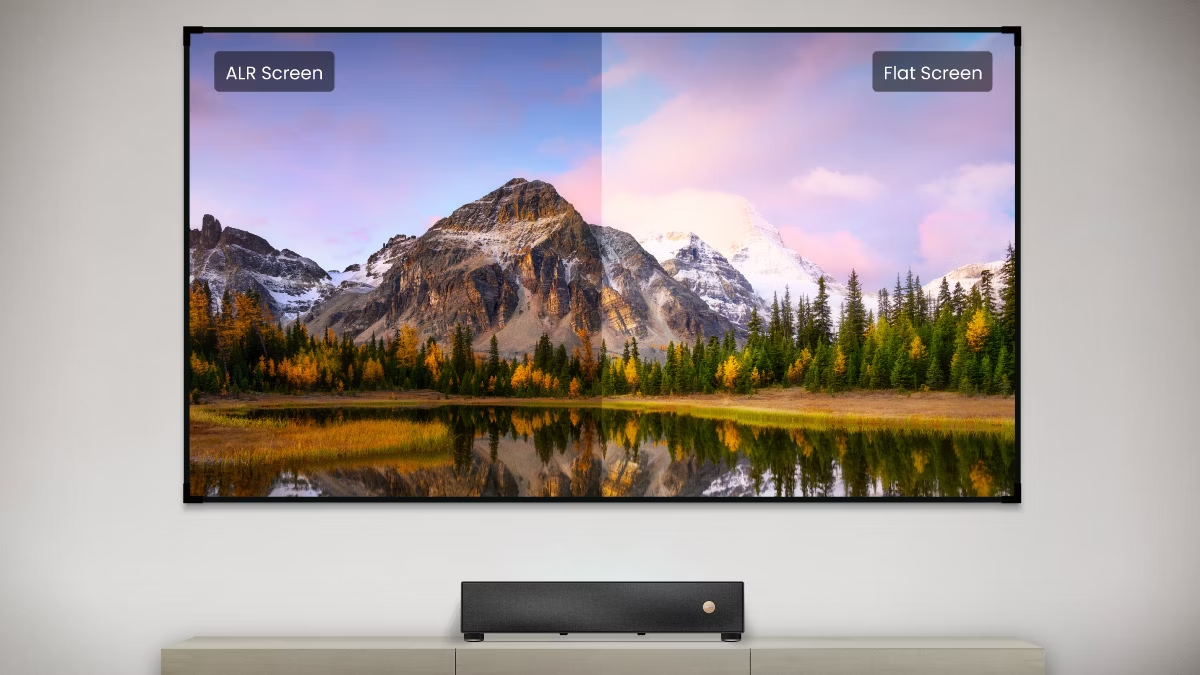
For decades, the concept of a “home theater” has been synonymous with a very specific environment: the basement “batcave.” To get a decent image from a projector, you needed blackout curtains, dark paint on the walls, and total control over every photon in the room. If someone opened a door or turned on a lamp, the image instantly washed out, turning vibrant colors into a muddy, grey mess.
This limitation kept projectors as niche products for enthusiasts. Most people want to watch sports on a Sunday afternoon with the windows open, or host a movie night without sitting in pitch blackness.
Fortunately, the “dark room mandate” is no longer a hard rule. The combination of high-brightness laser engines and, more importantly, advanced optical screen technology has created a new category of display: the Laser TV. At the heart of this revolution is a piece of engineering known as ALR, or Ambient Light Rejecting technology. But how does a passive screen distinguish between the “good” light from your projector and the “bad” light from your windows?
Table of Contents
The Physics of Contrast and Black Levels
To understand ALR, we first have to understand the fundamental weakness of projection. Unlike a television, which creates its own light and can turn pixels off to create black, a projector can only add light. It cannot project “black.” Black, in projection terms, is simply the absence of light on the screen.
Therefore, the blackest part of your image is only as dark as the screen itself. In a pitch-black room, a white screen looks black. But in a living room with sunlight pouring in, that same white screen looks bright white. If your canvas is white, you cannot display a shadow. This destroys the contrast ratio, which is the most critical factor in perceived image quality.




This is where standard matte white screens fail. They are “Lambertian” diffusers—they scatter light equally in all directions. If light hits them from a ceiling lamp, they reflect it back to your eyes, washing out the image.
How ALR Filters the World
Ambient Light Rejecting screens are not just sheets of fabric; they are complex optical filters consisting of multiple microscopic layers. While they look like a flat grey surface to the naked eye, under a microscope, they look more like a mountain range or a series of ridges.
The surface of an ALR screen is engineered with a specific microstructure—often sawtooth or prism-shaped ridges. These ridges are designed with specific angles of incidence in mind.
- Rejection (The Absorption Layer): The top side of these microscopic ridges is coated with a light-absorbing black material. This side faces the ceiling and the ambient environment. When light from overhead recessed lighting or windows hits the screen from above or the sides, it hits this black coating and is absorbed or deflected away from the viewer.
- Reflection (The Projection Layer): The bottom side of the ridges is coated with a highly reflective material. This side is angled specifically to catch light coming from a steep angle below—exactly where an Ultra-Short-Throw (UST) unit sits.
When you fire up a high-performance 4k laser projector from your media console, the light beam travels upward at a steep angle, hits the reflective side of the screen’s ridges, and is directed straight out toward the audience.
The result is an optical trick: the screen “sees” the projector but ignores the room lights. This allows the system to maintain deep black levels and high contrast even when the lights are on.
Fresnel vs. Lenticular: The Two Key Structures
Within the world of ALR for UST projectors, you will typically encounter two types of optical structures: Lenticular and Fresnel.
- Lenticular Screens use a horizontal sawtooth structure (like a ladder). They are excellent at blocking light from above (ceiling lights) but don’t block light from the sides (windows on the left or right) as effectively. However, they usually offer better viewing angles, meaning the image looks good even if you are sitting off to the side on a loveseat.
- Fresnel Screens use a semi-circular structure of concentric ripples (similar to a lighthouse lens). These are more aggressive; they block light from the top and the sides. They often provide a brighter, “punchier” image that rivals LED TVs, making them ideal for very bright living rooms. The trade-off is a narrower viewing angle; you need to sit relatively centered for the best experience.
The Synergy of Laser and Screen
It is important to note that ALR technology is symbiotic. It relies on the focused, high-intensity output of modern laser light engines. A standard, low-lumen bulb projector often lacks the horsepower to drive these screens effectively, as the ALR filtering process does cut a small percentage of the projector’s total brightness (a factor known as “gain”).
However, with modern triple-laser units pumping out 3,000+ ANSI lumens, this slight loss is negligible compared to the massive gain in contrast. The laser cuts through the ambient light, and the screen preserves the shadow detail.
Conclusion: The Screen is a Component, Not an Accessory
For years, the screen was an afterthought—a blank sheet you bought after spending your budget on the projector. In the era of Laser TV, that mindset must change. The screen is an active component of the display system.
Attempting to project a high-end laser image onto a bare wall or a cheap bedsheet is like putting bicycle tires on a Ferrari; you are bottlenecking the performance at the final mile. To unlock the true potential of 4K projection in a living room environment, selecting the right projector screen is just as critical as the projector itself.
By utilizing ALR technology, homeowners can finally break free from the basement. They can enjoy a massive, cinematic experience in the heart of the home, surrounded by windows, life, and light.