Table of Contents
Introduction
Modern businesses release software, update infrastructure, deploy cloud services, and introduce new integrations faster than ever. While these changes help organizations innovate, they also create new opportunities for attackers to exploit security weaknesses.
Traditional penetration testing provides valuable insight into security risks, but a test performed once or twice a year may not reflect the current security posture of an environment that changes every week. New vulnerabilities, configuration errors, exposed assets, and application updates can introduce risks between scheduled assessments.
Continuous penetration testing helps organizations address this challenge by incorporating recurring security assessments, attack validation, and remediation testing into their ongoing security programs.
When delivered through penetration testing as a service (PTaaS), this approach can combine expert-led penetration testing, continuous visibility, collaborative reporting, and retesting into a more streamlined security workflow.
In this guide, we explain how continuous pentesting works, why traditional testing has limitations, how organizations can integrate security testing into development workflows, and what to consider when implementing a continuous security testing strategy.




What Is Continuous Penetration Testing?
Continuous penetration testing is an approach to security assessment that involves repeatedly evaluating an organization’s applications, infrastructure, systems, and attack surface as they change.
Instead of relying exclusively on a penetration test performed at a fixed point in time, organizations use recurring assessments and risk-based testing to identify weaknesses throughout the software development and operational lifecycle.
Continuous pentesting may include:
- Ongoing external attack surface discovery.
- Periodic or event-triggered penetration testing.
- Automated security checks and attack validation.
- Manual testing by qualified security professionals.
- Retesting after vulnerabilities have been fixed.
- Security assessments following significant application or infrastructure changes.
- Centralized findings, remediation tracking, and reporting.
The exact implementation depends on the organization’s risk profile, infrastructure, testing requirements, and security objectives.
Continuous penetration testing does not necessarily mean that a human penetration tester is actively testing every system every minute. Instead, it establishes a repeatable process that keeps security assessments aligned with changes in the environment.
Continuous Penetration Testing vs. Traditional Penetration Testing
Traditional penetration testing generally evaluates a defined scope during a scheduled engagement. Continuous penetration testing expands this approach by incorporating recurring assessments and reassessment triggers.
| Area | Traditional Penetration Testing | Continuous Penetration Testing |
| Testing frequency | Scheduled intervals | Recurring or change-triggered |
| Scope updates | Usually defined per engagement | Updated as assets and risks change |
| Vulnerability validation | During the assessment | Repeated when appropriate |
| Retesting | Often a separate activity | Integrated into the workflow |
| Development integration | May occur after release | Can be aligned with development cycles |
| Reporting | Periodic reports | Ongoing findings and status updates |
| Security visibility | Snapshot of the environment | More frequent visibility into changes |
Both approaches have a place in a mature security program. Continuous testing complements comprehensive penetration tests rather than automatically replacing them.
Why Annual Penetration Tests May Not Be Enough
Annual penetration testing can provide an important assessment of security controls, application logic, and exploitable vulnerabilities. However, a point-in-time assessment has limitations when an organization’s technology environment changes frequently.
1. New Assets Can Introduce Security Risks
Organizations regularly launch new applications, subdomains, APIs, cloud resources, and third-party integrations. These assets may introduce exposure that was not present during the previous penetration test.
Without regular attack surface discovery, security teams may overlook newly accessible systems or services.
2. Software Changes Can Create New Vulnerabilities
A code update may unintentionally introduce broken access controls, insecure API endpoints, authentication weaknesses, or other security issues.
A previously secure application may become vulnerable after a feature release, configuration change, or dependency update.
3. Remediation Does Not Always Eliminate the Original Risk
Development teams may resolve a reported vulnerability but unintentionally leave the underlying issue partially addressed. In other cases, a fix may introduce a different weakness.
Retesting helps verify whether a reported vulnerability has actually been resolved.
4. Security Findings Can Become Outdated
A penetration testing report reflects the systems, configurations, and testing conditions that existed during the engagement.
As the environment changes, some findings may be resolved while new risks emerge. Recurring assessments help maintain a more current view of security exposure.
5. Development and Security Teams Need Faster Feedback
When vulnerabilities are discovered long after a release, developers may need additional time to reproduce issues, understand the original implementation, and deploy fixes.
Integrating security testing into development workflows can help teams identify and address vulnerabilities closer to the time they are introduced.
How Continuous Penetration Testing Works
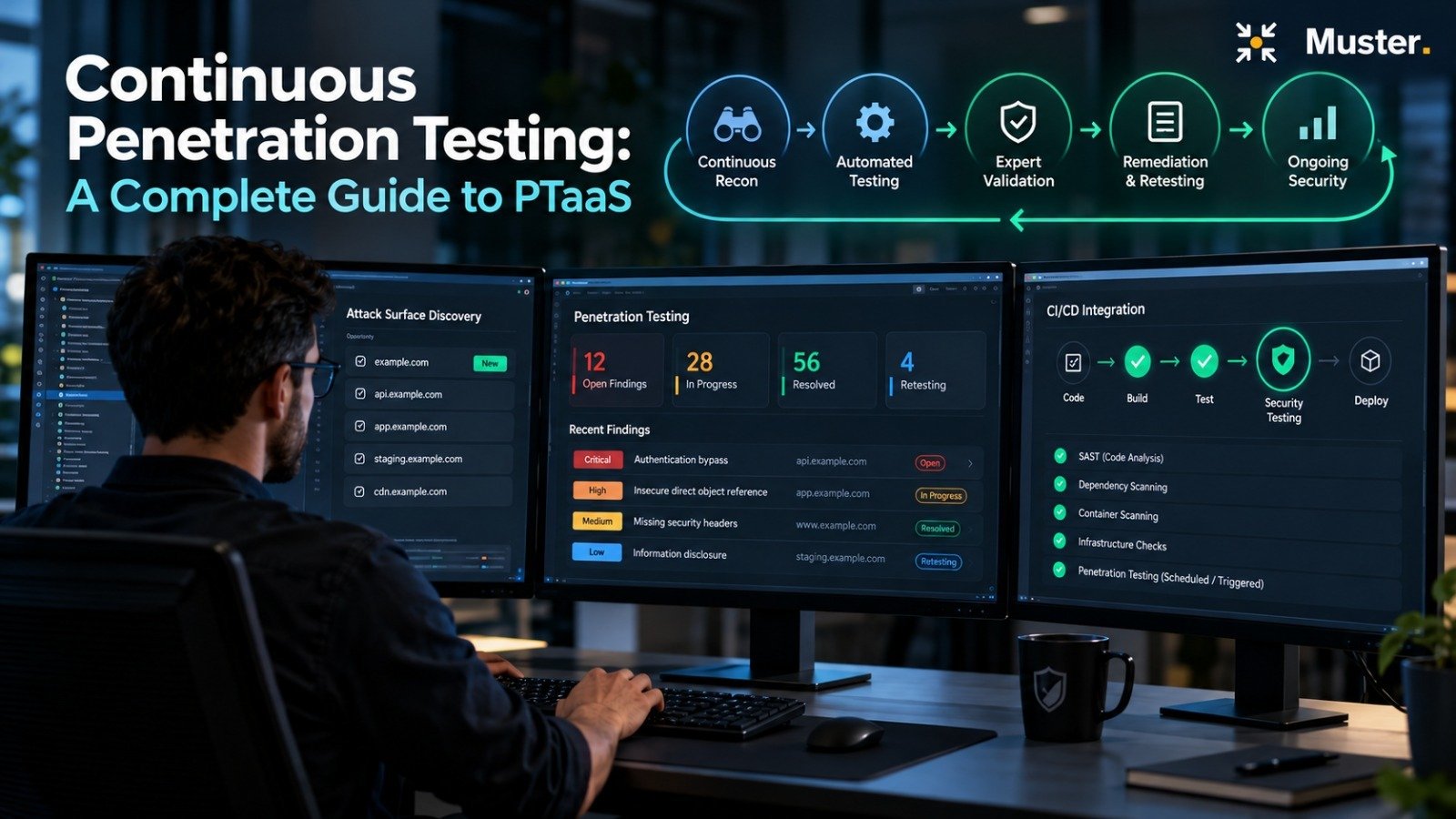
A continuous penetration testing program typically combines asset discovery, risk prioritization, security assessment, remediation, and validation.
1. Continuous Attack Surface Discovery
The first step is maintaining visibility into the assets that require security assessment.
This may include websites, web applications, APIs, public IP addresses, cloud services, subdomains, and externally accessible infrastructure.
Discovery processes can help identify new assets, changes in exposure, and systems that have moved outside the original testing scope.
Organizations should establish clear authorization and scope controls before assessing newly discovered assets.
2. Risk-Based Security Assessment
Once assets are identified, security teams determine which systems require testing and how frequently they should be assessed.
Testing frequency can depend on factors such as:
- Business criticality.
- Exposure to the public internet.
- Sensitivity of processed data.
- Application complexity.
- Frequency of software releases.
- Previous security findings.
- Regulatory and contractual requirements.
High-risk applications may require more frequent assessments than systems with limited exposure and lower business impact.
3. Automated Security Checks and Attack Validation
Automation can help identify certain vulnerabilities, configuration weaknesses, and changes in the attack surface.
However, automated scanning alone does not establish whether an attacker can exploit a weakness or determine the full business impact of a complex vulnerability.
Manual testing by experienced penetration testers remains important for evaluating business logic, chained attack paths, authorization issues, and other weaknesses that automated tools may miss.
A strong continuous security testing program uses automation where it adds value and expert-led testing where human analysis is required.
4. Vulnerability Reporting and Prioritization
Security findings should be documented in a format that enables teams to understand and address them.
Useful reporting typically includes:
- Vulnerability description.
- Affected asset or application component.
- Evidence supporting the finding.
- Potential security impact.
- Severity and risk context.
- Recommended remediation steps.
- Retesting status.
Prioritization should consider exploitability, business impact, asset exposure, and the sensitivity of affected systems rather than relying exclusively on a severity score.
5. Remediation and Retesting
Once a vulnerability has been reported, developers or infrastructure teams implement the recommended fix.
The security team then performs appropriate retesting to determine whether the vulnerability has been resolved and whether the remediation introduced any related weaknesses.
Retesting closes the feedback loop between discovery and remediation, helping organizations maintain confidence in the effectiveness of their security improvements.
For more information about the assessment process, explore how penetration testing works.
What Is Penetration Testing as a Service (PTaaS)?
Penetration testing as a service (PTaaS) is a delivery model that makes penetration testing more accessible through a combination of security expertise, technology platforms, collaborative workflows, and ongoing assessment capabilities.
Depending on the provider and service scope, PTaaS can offer centralized findings, remediation guidance, testing visibility, retesting coordination, and access to penetration testing specialists.
A PTaaS platform may help organizations manage security findings throughout their lifecycle instead of treating penetration testing as a standalone report delivered at the end of an engagement.
Key Benefits of PTaaS
More frequent security visibility: Organizations can arrange recurring assessments and obtain updated information as their systems evolve.
Improved collaboration: Developers, security teams, and business stakeholders can work from shared findings and remediation status information.
More efficient remediation: Clear technical evidence and actionable recommendations help developers investigate and address security weaknesses.
Retesting support: Teams can validate fixes and track the status of previously identified vulnerabilities.
Flexible assessment planning: Testing can be aligned with release schedules, infrastructure changes, business priorities, and risk levels.
PTaaS capabilities vary between providers. Organizations should confirm which activities are automated, which require manual testing, how often assessments occur, and whether retesting is included.
Learn more about penetration testing services to understand how professional testing can support an organization’s security objectives.
Integrating Continuous Pentesting Into CI/CD Pipelines
Continuous integration and continuous delivery (CI/CD) pipelines enable development teams to build, test, and deploy software efficiently. Security testing can be incorporated into these workflows to provide earlier feedback about potential vulnerabilities.
However, not every penetration testing activity should run automatically with every code commit. Comprehensive manual testing may require dedicated environments, coordination, and testing windows.
A practical integration strategy separates lightweight automated checks from deeper security assessments.
Recommended CI/CD Integration Steps
Step 1: Run security checks during development.
Use appropriate code analysis, dependency scanning, secret detection, and configuration checks to identify common issues early.
Step 2: Validate deployed application changes.
Run authorized security checks against staging or testing environments after significant deployments.
Step 3: Trigger risk-based assessments.
Schedule additional penetration testing when major features, authentication systems, APIs, infrastructure, or external integrations change.
Step 4: Define escalation criteria.
Determine which findings require immediate investigation, which should block a release, and which can be addressed through the standard remediation process.
Step 5: Track remediation and retesting.
Connect security findings to development tickets and ensure that fixes are validated before closure when appropriate.
CI/CD Security Testing Best Practices
- Use dedicated testing environments wherever practical.
- Define authorization and testing scope clearly.
- Protect credentials and sensitive test data.
- Avoid destructive testing against production systems without explicit approval and safeguards.
- Prevent unstable or overly aggressive tests from disrupting deployment pipelines.
- Establish clear ownership for vulnerability remediation.
- Use manual penetration testing to investigate complex attack paths and business logic vulnerabilities.
The objective is to integrate security into software delivery without introducing unnecessary operational risk or development delays.
Building Better Developer Workflows
Continuous security testing is most effective when findings can be translated into practical engineering tasks.
Security teams should provide developers with enough technical context to reproduce vulnerabilities, understand their impact, and implement appropriate fixes.
A well-designed workflow should include:
Clear ownership: Assign findings to the team responsible for the affected application or infrastructure.
Actionable evidence: Include relevant requests, responses, reproduction steps, affected components, and security impact where appropriate.
Risk-based prioritization: Address vulnerabilities according to their severity, exploitability, exposure, and potential business consequences.
Defined remediation targets: Establish reasonable response expectations based on risk and organizational requirements.
Verification: Retest vulnerabilities after remediation and document the results.
Feedback loops: Use recurring findings to identify weaknesses in coding practices, architectural decisions, and security controls.
These practices help make security testing part of the development lifecycle instead of a separate activity that teams address only before an audit or major release.
Continuous Penetration Testing for Compliance and Audit Evidence
Organizations operating in regulated industries may need to demonstrate that they regularly assess security risks and address identified vulnerabilities.
Continuous penetration testing can support these efforts by creating a more consistent record of security assessment and remediation activities.
Depending on the service and internal processes, useful evidence may include:
- Assessment dates and scope.
- Identified vulnerabilities and severity ratings.
- Remediation assignments and status.
- Retesting results.
- Risk acceptance decisions.
- Management reports.
- Records of significant changes and follow-up assessments.
However, continuous penetration testing does not automatically establish compliance with a particular regulation or security standard.
Organizations should map their testing activities to the specific requirements that apply to them and maintain any additional documentation, controls, and independent assessments that those requirements demand.
Compliance evidence should be accurate, traceable, and supported by actual testing and remediation records.
How to Implement a Continuous Penetration Testing Program
Organizations do not need to transform their entire security program at once. A phased approach can help establish a sustainable process while demonstrating measurable progress.
Step 1: Define Your Security Objectives
Determine what the program should accomplish. Common objectives include reducing exposure, validating remediation, improving release security, and increasing visibility into critical applications.
Step 2: Inventory Critical Assets
Identify important applications, APIs, infrastructure, cloud resources, and internet-facing systems. Establish ownership and define which assets are authorized for testing.
Step 3: Assess Your Current Testing Approach
Review existing penetration testing engagements, vulnerability management processes, remediation timelines, and retesting procedures.
Identify gaps between scheduled assessments and significant changes in the environment.
Step 4: Establish Testing Frequency
Define assessment schedules based on asset criticality, exposure, release frequency, and risk. Use change-triggered testing where appropriate.
Step 5: Select the Right Service Model
Evaluate whether internal penetration testers, external security specialists, a PTaaS platform, or a combination of these options best meets your needs.
Compare assessment depth, testing frequency, manual expertise, reporting capabilities, retesting arrangements, and integration options.
Step 6: Connect Findings to Remediation Workflows
Establish a process for assigning vulnerabilities, tracking progress, escalating critical findings, and verifying fixes.
Step 7: Measure Program Effectiveness
Review metrics such as:
- Time to remediate critical vulnerabilities.
- Percentage of vulnerabilities successfully retested.
- Number of recurring findings.
- Time between major changes and security assessment.
- Coverage of critical applications and external assets.
- Overdue remediation items.
Use these metrics to improve the program over time rather than treating testing volume as the primary measure of success.
Continuous Penetration Testing Implementation Checklist
Before launching a program, verify that your organization has addressed the following areas:
- Critical applications and infrastructure are inventoried.
- Testing authorization and scope are documented.
- Assessment frequency is aligned with business risk.
- Attack surface changes can be identified.
- Automated checks and manual testing have defined roles.
- Findings include actionable remediation guidance.
- Vulnerability ownership is clearly assigned.
- Critical issues have appropriate escalation procedures.
- Retesting is available to verify remediation.
- Security assessments are integrated into relevant development workflows.
- Reporting supports internal security reviews and applicable compliance requirements.
- Program metrics are reviewed regularly.
This checklist can serve as a starting point. The final implementation should reflect the organization’s technology stack, security maturity, and operational requirements.
Frequently Asked Questions About Continuous Penetration Testing
1. What is continuous penetration testing?
Continuous penetration testing is an approach that uses recurring or change-triggered security assessments to identify and validate vulnerabilities as applications, infrastructure, and attack surfaces evolve.
2. How is continuous pentesting different from annual penetration testing?
Annual penetration testing provides a point-in-time assessment. Continuous pentesting introduces more frequent assessments and reassessment opportunities, helping organizations identify new risks and verify fixes between traditional engagements.
3. Does continuous penetration testing replace traditional penetration testing?
Not necessarily. Continuous testing can complement comprehensive penetration tests by providing more frequent visibility into changes. Organizations may still require dedicated assessments for complex applications, major releases, and specific compliance requirements.
4. What is the relationship between continuous penetration testing and PTaaS?
Penetration testing as a service provides a delivery model for professional security assessments, often supported by a platform for reporting and collaboration. Continuous penetration testing is an assessment approach that can be delivered through PTaaS, depending on the provider’s capabilities.
5. Can continuous penetration testing be automated?
Some activities, including asset discovery, vulnerability scanning, and selected security checks, can be automated. Complex business logic testing, attack chaining, and certain authorization issues often require expert manual assessment.
6. How often should penetration testing be performed?
The appropriate frequency depends on risk, system exposure, application changes, business requirements, and regulatory obligations. Critical internet-facing applications may need more frequent assessments than lower-risk systems.
7. Can continuous pentesting be integrated with CI/CD?
Yes. Organizations can integrate automated security checks into CI/CD pipelines and schedule or trigger deeper penetration testing following significant changes. Testing should be designed to avoid disrupting production systems or development workflows.
8. Does continuous penetration testing guarantee that an application is secure?
No. No testing methodology can guarantee complete security. Continuous pentesting helps identify and validate certain security weaknesses, but it should be combined with secure development practices, vulnerability management, monitoring, access controls, and other defensive measures.
9. What should organizations look for in a PTaaS provider?
Evaluate the provider’s manual testing expertise, assessment scope, reporting quality, remediation support, retesting process, platform capabilities, integration options, and ability to align testing frequency with business risk.
10. Is continuous penetration testing useful for small and medium-sized businesses?
It can be useful for organizations of different sizes, particularly those operating internet-facing applications or frequently changing infrastructure. The scope and frequency should be proportionate to the organization’s risk profile, resources, and security objectives.
Strengthen Your Security Testing Strategy With Muster Security
Security risks evolve as applications, infrastructure, and business requirements change. A testing strategy that combines recurring assessments, actionable findings, and verified remediation can help organizations maintain better visibility into their security posture.
Continuous penetration testing and penetration testing as a service can support this approach by connecting security assessment activities with ongoing development and remediation workflows.
Muster Security helps organizations understand their security risks through penetration testing and related security assessment services. Explore our penetration testing services to learn more about evaluating your applications and infrastructure.
You can also review how our penetration testing process works to understand the assessment workflow and how security findings can inform remediation.
Ready to strengthen your security testing strategy? Contact Muster Security to discuss your environment, testing requirements, and security assessment objectives.