Tri Clamp End Cap Sizing Guide: The Complete Reference for US Standard and 3-A Sanitary Fittings

In process piping environments where cleanliness and containment are both regulatory and operational requirements, the smallest fittings carry serious consequences when they are selected incorrectly. An end cap that does not match the tubing diameter, ferrule standard, or material specification can compromise a closed system in ways that are not always immediately visible — leaks that develop gradually, contamination that accumulates in gaps, or fittings that fail pressure checks during validation. These are not edge-case scenarios. They are common outcomes when sizing decisions are made without a clear reference framework.
End caps used in sanitary tubing systems are subject to the same exacting requirements as the rest of the assembly. The fitting must conform to the correct ferrule size, be compatible with the clamp and gasket in use, and meet the surface finish standards that apply to the process in question. For anyone specifying components for a food processing line, pharmaceutical skid, biotech facility, or dairy operation, understanding how tri clamp end caps are sized — and what standards govern that sizing — is a practical necessity, not a technical formality.
Table of Contents
What Tri Clamp End Cap Sizing Actually Involves
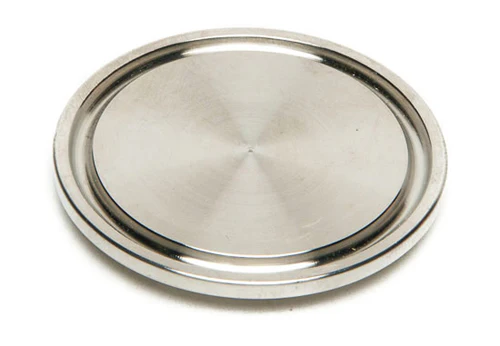
A tri clamp end cap is a solid closure fitting designed to terminate the open end of a sanitary tube or pipe without creating dead space or contamination risk. The fitting mates with a standard ferrule and is held in place by a tri clamp, with a gasket seated between the ferrule face and the cap face to maintain a leak-free seal. Sizing a tri clamp end cap is not simply about matching an outer diameter. It involves aligning the fitting with the correct ferrule size, which in sanitary systems does not always correspond directly to the actual tube outer diameter.
This distinction matters more than it might appear. In sanitary tubing, ferrule sizes are nominal designations that reflect the tube outer diameter for larger sizes but diverge from it at smaller sizes. A fitting labeled as a certain ferrule size is built to connect with that specific ferrule geometry — and using a cap from a different standard or sized for a different ferrule will not seat correctly, regardless of how close the dimensions appear to be. You can explore the full range of available options by reviewing a structured tri clamp end cap catalog organized by ferrule size and material, which clarifies how these distinctions carry through to specific fitting choices.
The Relationship Between Tube OD and Ferrule Size
In practice, the ferrule size printed on a sanitary fitting is the number that matters for ordering purposes. Sanitary tube outer diameters follow a defined progression, and ferrules are manufactured to match those diameters. However, for tubes below a certain size threshold, the ferrule designation and the actual tube outer diameter are not interchangeable numbers. A ferrule sized for a one-inch tube has a clamp seat diameter that is distinct from the tube itself, and a cap must be dimensioned to match that clamp seat, not the tube wall.




This is one of the most common sources of error in the field, particularly when components are being sourced from multiple suppliers. A cap that fits the tube snugly but does not seat correctly against the ferrule face will not form an adequate gasket seal. In high-pressure or high-temperature applications, the result is predictable. In CIP-capable systems, it introduces a site where cleaning solution does not fully contact all surfaces, which undermines the entire sanitation protocol.
US Standard Sizing Conventions for Sanitary Fittings
In the United States, sanitary fittings used in food, beverage, and pharmaceutical applications are manufactured according to specifications established by industry bodies and standards organizations. The most widely referenced standard in this context is the 3-A Sanitary Standards, which is developed and maintained by 3-A SSI, a nonprofit organization whose standards govern the design and fabrication of equipment used in contact with dairy and other food products. These standards are recognized by the USDA and referenced by the FDA, and they define surface finish requirements, material grades, and dimensional criteria that apply across the sanitary fitting category.
End caps that carry a 3-A symbol have been independently certified to meet these criteria. That certification is not cosmetic. It reflects that the fitting has been evaluated against specific requirements for crevice-free geometry, appropriate material composition, and surface finish that supports cleanability. In a regulated production environment, the difference between a 3-A-compliant cap and a standard sanitary cap may determine whether a line passes an audit or requires corrective action.
How 3-A Standards Apply to End Cap Geometry
The 3-A Sanitary Standards place specific requirements on interior surface geometry because dead legs, sharp corners, and pockets that cannot be fully wetted during cleaning are considered contamination risks. An end cap that is otherwise correctly sized but has an interior profile that creates a pocket — whether due to a dimensional variance or a non-conforming weld — fails the functional intent of the standard even if it nominally meets the ferrule specification.
This is why 3-A-certified end caps are designed with smooth internal surfaces that drain fully and present no collection points for product residue. The external geometry must also conform to the clamp seat dimensions so that the gasket is compressed evenly across its full face. Uneven gasket compression, even within a technically acceptable tolerance band, creates micro-gaps that allow biofilm development over time — a risk that is difficult to detect without periodic disassembly and inspection.
Material Grades and Their Practical Significance
In US sanitary fittings, the standard material is 316L stainless steel for wetted components, with 304 stainless steel used in some lower-criticality applications. The distinction between these grades is not simply chemical. In environments where cleaning chemicals, sanitizers, or aggressive product formulations are present, the higher molybdenum content in 316L provides measurably better resistance to pitting and crevice corrosion. For an end cap used in a system that cycles between hot product and cold CIP solution, material selection affects service life in ways that affect maintenance intervals and replacement frequency.
Some tri clamp end cap applications also require PTFE or other non-metallic materials, particularly where electrical isolation or chemical resistance beyond stainless steel capability is needed. These are less common but follow the same ferrule sizing logic as metal caps.
Clamp Compatibility and Gasket Selection
A tri clamp end cap does not function in isolation. Its performance depends on the clamp holding the assembly together and the gasket seated between the cap face and the ferrule. Each of these components must be selected to match not just the ferrule size but also the service conditions of the application. A gasket that is appropriate for water service at ambient temperature is not necessarily appropriate for steam service, and a clamp rated for one pressure range may not maintain adequate seating force at elevated temperatures where metal expands.
This interdependence is often underestimated when end caps are sourced as replacement components. Replacing an end cap without confirming that the existing gasket and clamp remain serviceable is a common oversight. Gaskets compress over time and should be inspected at intervals that reflect the temperature and pressure cycling of the specific application. Clamps that have been overtightened can deform, which changes the load distribution across the gasket face and produces the same micro-gap risk described above.
Gasket Materials and Their Temperature Ranges
Gaskets used with tri clamp fittings are available in several elastomer grades, each suited to a different range of service conditions. EPDM is widely used in dairy and beverage applications for its compatibility with water-based cleaners and moderate temperature ranges. Silicone offers broader temperature tolerance and is common in applications where heat-in-place or high-temperature CIP is used. PTFE envelope gaskets are used where chemical resistance is the primary concern, though they require more precise clamp torque to achieve a reliable seal.
Selecting the wrong gasket material does not always produce an immediate failure. In many cases, a chemically incompatible gasket swells gradually, which can cause it to extrude into the flow path, or it degrades and becomes brittle, which causes it to crack under pressure cycling. Neither failure mode is always caught during routine inspection unless the system is disassembled for a scheduled maintenance review.
Sizing Verification in Replacement and Retrofit Contexts
When an end cap is being selected for a new installation, the ferrule specification is typically defined by the process engineer or equipment supplier and follows directly from the tube schedule in use. The more complex situation arises during replacement or retrofit, where the existing fitting may not have clear documentation and physical measurement becomes necessary.
In this context, the key measurement is the clamp seat outer diameter of the existing ferrule, not the tube itself. This measurement, combined with the number of clamp seat segments on the existing clamp, defines the fitting size required. Attempting to infer the size from the tube outer diameter alone works for larger sizes where the correspondence is direct, but introduces risk for smaller sizes where the offset is significant. When in doubt, measuring the ferrule directly — or cross-referencing the existing equipment build list — is more reliable than estimation.
It is also worth confirming whether the existing system was built to US standard sizing or to a metric or ISO-based standard. In facilities that have imported European processing equipment or integrated components from different supply chains, a mix of dimensional standards is not unusual, and a cap that appears to be the right size may be millimeters off in ways that prevent a proper seal. According to guidance published by the U.S. Food and Drug Administration, equipment used in food contact applications must be maintained to prevent contamination, which includes ensuring that all fittings and closures form complete, cleanable seals.
Conclusion: Sizing as a Reliability Practice
Selecting a tri clamp end cap correctly is not a complex process when the underlying logic is understood. The ferrule size governs the fitting choice, not the tube outer diameter alone. The 3-A standard defines the geometric and material requirements that determine whether a cap is suitable for regulated food, dairy, or pharmaceutical environments. The clamp and gasket must be matched to both the ferrule size and the service conditions of the application. And in replacement situations, physical verification of the ferrule dimension is more reliable than assumption.
What makes this worth treating carefully is that end cap failures — even minor ones — tend to manifest in ways that affect an entire system rather than just a single fitting. A compromised seal at a line termination can introduce contamination that travels upstream, cause pressure irregularities that affect process control, or produce audit findings that require corrective action across a broader section of the installation. Treating sizing as a precision exercise from the start is substantially less costly than identifying the problem after the fact.
For anyone responsible for specifying sanitary fittings in a production or processing environment, maintaining a clear reference framework for sizing — and verifying it against actual ferrule dimensions rather than nominal tube designations — is the most direct way to reduce risk across the fitting selection process.