Pallet selection rarely gets the attention it deserves in warehouse cost conversations. Most operations focus on rack systems, labor efficiency, or transportation rates when reviewing overhead. But the type of pallet moving through a facility every day quietly shapes how fast product moves, how often equipment gets damaged, and how reliably throughput holds up under pressure. When a warehouse is processing thousands of pallet movements per week, the difference between pallet types compounds in ways that don’t always show up cleanly on a single line item.
The comparison between a four-way entry pallet and a two-way entry pallet is one that warehouse managers, logistics coordinators, and procurement teams revisit regularly — especially as facilities push for faster cycle times and tighter floor layouts. What looks like a minor equipment choice at the purchasing stage often becomes a significant operational variable once volume increases and floor constraints tighten.
Table of Contents
What the Entry Configuration Actually Changes on the Floor
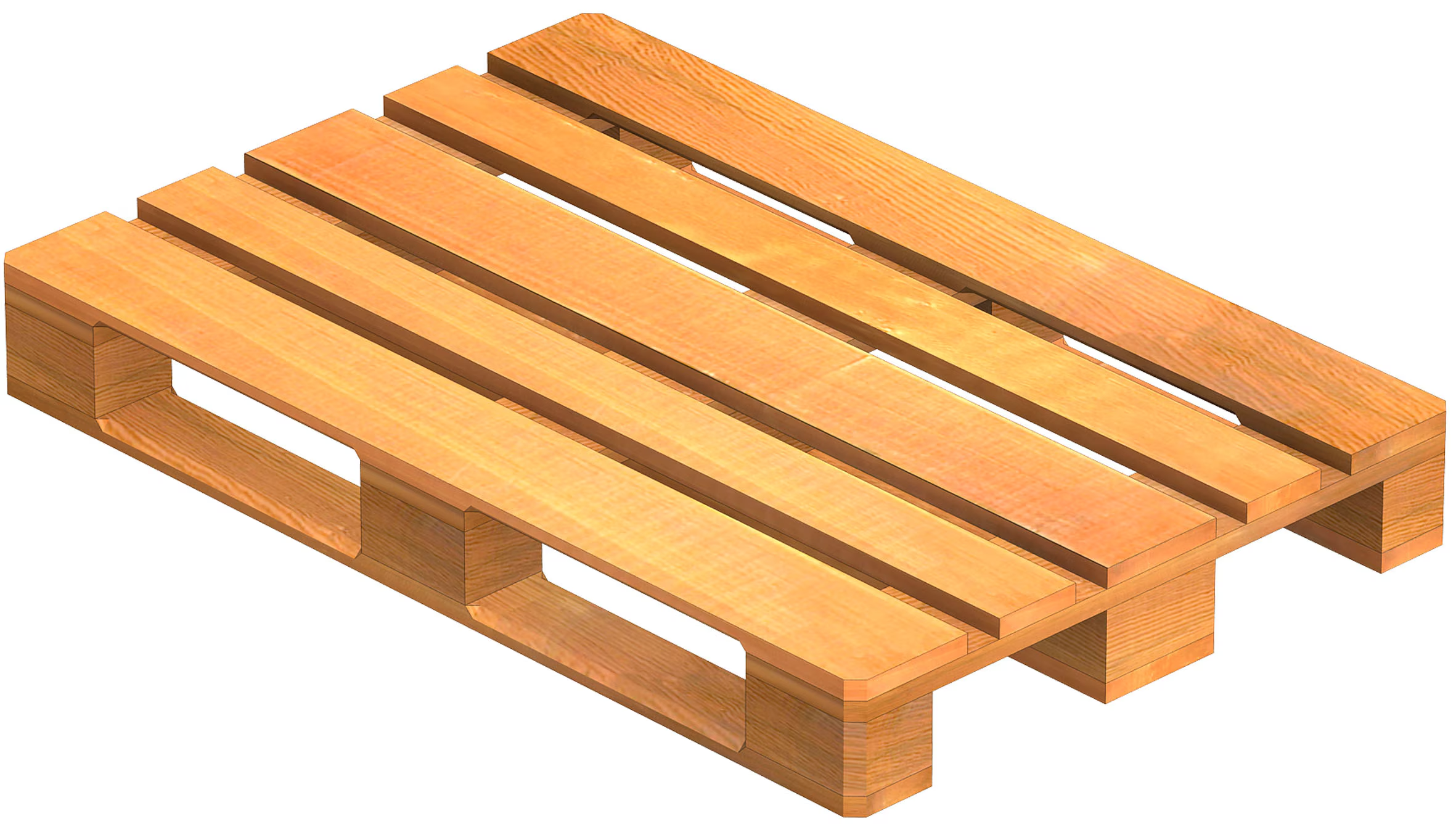
A 4 way pallet allows forklift tines to enter from all four sides of the pallet base, meaning an operator can approach from any direction on the floor. A two-way pallet restricts entry to two parallel sides only, which means the operator must position the forklift along a specific axis before lifting. This constraint may seem minor in theory, but it has measurable consequences in how efficiently floor space is used and how quickly pallets can be staged, pulled, and repositioned throughout a shift.
In open warehouses with wide aisles and consistent product flow in a single direction, two-way pallets often function without issue. The restriction doesn’t introduce friction because the floor layout naturally accommodates it. However, in facilities with tighter aisle configurations, cross-dock operations, or high-density racking, the inability to enter a pallet from all sides creates real delays. Operators maneuver longer, space gets wasted in staging zones, and the incremental time loss per move adds up across a full day of operations.
Forklift Maneuverability and Its Hidden Labor Cost
Every time an operator has to reposition their equipment because a pallet is oriented the wrong way, that movement takes time. It may be seconds per instance, but in a warehouse running several hundred pallet moves per shift, those seconds translate into measurable labor hours by the end of the week. The cost doesn’t appear as a pallet cost — it appears as overtime, reduced picks per hour, or slower dock-to-stock times. Management often attributes the slowdown to labor performance or equipment issues before the pallet configuration gets examined.
Four-way pallets reduce the need for repositioning because the operator has flexibility in approach. This is particularly important in narrow-aisle environments where turning radius is limited and every degree of equipment movement has a cost. It also reduces the likelihood of product damage caused by rushed or forced entries, which adds yet another invisible cost to facilities using two-way configurations in layouts that don’t naturally support them.
Staging Zones and Cross-Dock Efficiency
Cross-dock facilities and high-volume staging areas present one of the strongest arguments in favor of four-way entry pallets. In these environments, pallets arrive, get sorted, and redeploy quickly, often without a fixed rack position to dictate orientation. When pallets can only be entered from two sides, staging flexibility is reduced. Workers and operators have to account for pallet orientation when placing loads, which adds a layer of coordination that slows down high-frequency operations.
With a four-way configuration, pallets can be set down in any orientation and still be accessible from whatever angle the next operator approaches from. This seems like a small logistical convenience, but in cross-dock environments where timing is measured in minutes rather than hours, it directly affects throughput consistency and reduces the risk of bottlenecks during peak periods.
Where Two-Way Pallets Still Make Operational Sense
Two-way pallets are not categorically inferior. They are better suited to specific operational contexts, and using them in those environments is a cost-effective, practical choice. The issue arises when they are used in environments they weren’t designed for, or when procurement decisions prioritize unit cost without considering downstream operational fit.
In straight-line, high-volume conveyor systems, two-way pallets move efficiently because product flows in one consistent direction and pallet orientation is fixed by the system itself. Automated storage and retrieval systems that control pallet movement mechanically also remove the orientation problem entirely — the machine handles alignment, and the two-way restriction never creates friction because human repositioning is not part of the equation.
The Unit Price Difference and What It Overlooks
Two-way pallets are generally less expensive to produce because their design is simpler. They use fewer structural components, which reduces material cost per unit. For procurement teams evaluating pallet spend in isolation, the lower unit price is an obvious advantage. At scale, the cost difference across a large pallet pool looks significant on paper.
However, when that pallet pool operates in a manual or semi-automated warehouse with mixed flow directions and varied product handling requirements, the savings from lower unit cost can be offset — sometimes exceeded — by the operational inefficiencies they introduce. The math only holds up when the pallet is the right fit for the environment. When it isn’t, the savings at purchase become costs in performance.
Product Type and Load Stability Considerations
Two-way pallets tend to offer a more rigid base structure in certain configurations, which can be beneficial when handling very heavy or unevenly distributed loads that need maximum bottom-deck support. Some industrial applications, particularly in manufacturing environments where loads are extremely dense and movement is infrequent, favor the simpler construction of a two-way pallet for exactly this reason.
Four-way pallets, particularly block-style variants, distribute load weight differently across the base. Understanding how a specific product type interacts with pallet structure matters when selecting between the two formats, especially for operations where product integrity is critical and load failure has downstream consequences beyond just the immediate damage.
The Real Cost Accumulates at the System Level
When warehouses analyze pallet-related costs, they typically look at purchase price, replacement frequency, and repair spend. These are tangible and easy to pull from procurement records. What rarely gets measured is the operational overhead — the cumulative labor cost of working around equipment limitations, the throughput gap created by inefficient movement patterns, or the minor product damage that occurs repeatedly at low enough frequency to stay below the damage-reporting threshold.
The Material Handling Industry has long emphasized that pallet standards and configurations should be evaluated in the context of the entire handling system rather than as standalone equipment. This systems-level view is exactly what gets lost when pallet decisions are made purely at the procurement level without input from floor operations or warehouse management.
Replacement Cycles and Long-Term Pool Economics
The durability of a pallet over its service life affects the total cost of the pool more than the purchase price of any single unit. Four-way block pallets, when constructed with structural integrity at the entry points, tend to resist damage from repeated forklift entry better than stringer-based two-way pallets in high-frequency environments. This is because block pallets distribute contact stress across a wider area when tines enter, while stringer pallets absorb impact at a narrower structural point that weakens over repeated use.
Over time, a pool of pallets that degrades faster requires more frequent replacement, more inspection labor, and more inventory of spare units to maintain operational continuity. Facilities that have analyzed their total pallet pool cost — purchase plus replacement plus inspection plus write-off — often find that higher-performing pallets justified a higher unit cost when spread across the actual service life of the equipment.
Rack Compatibility and Storage System Fit
Selective racking, push-back racking, and drive-in rack systems each have different requirements for how pallets interact with the storage structure. Two-way pallets placed incorrectly in a racking system — or used in systems designed around four-way entry — can create unsafe loading conditions or make pallet retrieval cumbersome. Facilities that have mixed pallet types in their pool without clear protocols for which type goes where often discover compatibility problems that were avoidable with upfront standardization.
Standardizing pallet type across a facility or across specific zones reduces the coordination burden on operators and reduces the risk of handling errors that stem from operators treating all pallets as interchangeable when they functionally are not.
Making a Defensible Decision for Your Operation
The choice between a four-way and two-way pallet is not a universal answer — it is a decision that should follow the operational reality of a specific facility. The right starting point is an honest assessment of how pallets actually move through the building: how often they need to be repositioned, which direction forklifts approach from, whether staging zones have fixed or flexible orientations, and how the racking system is configured.
Facilities that run high-volume, mixed-direction manual operations will almost always find that four-way pallets improve operational efficiency enough to justify any unit cost premium. Facilities running fully automated linear systems may find that two-way pallets serve their needs without compromise. The problem is that many operations fall somewhere in between, and that middle ground is where the wrong pallet choice quietly erodes performance over time.
Procurement, operations, and facilities management working from a shared understanding of how pallet type connects to operational cost will make better decisions than any single team making the call in isolation. The cost of a pallet is not what you pay for it. It is what it costs you to use it across its entire working life in your specific environment.
Conclusion
Pallet configuration is one of those operational decisions that sits at the intersection of procurement economics and floor-level performance. Neither the four-way nor the two-way pallet is the default right answer — but each has a context where it performs well and a context where it creates friction and cost. The warehouses that manage pallet cost most effectively are not necessarily the ones buying the cheapest unit. They are the ones that have matched their pallet type to their actual handling environment and measured cost across the full operational picture rather than stopping at the purchase order.
When volume grows, layouts shift, or throughput demands increase, revisiting that match is a legitimate operational review — not an equipment upgrade conversation, but a process alignment one. The distinction matters, because it changes who needs to be involved in the decision and what data they need to make it well.
-

-

-

-

-

-