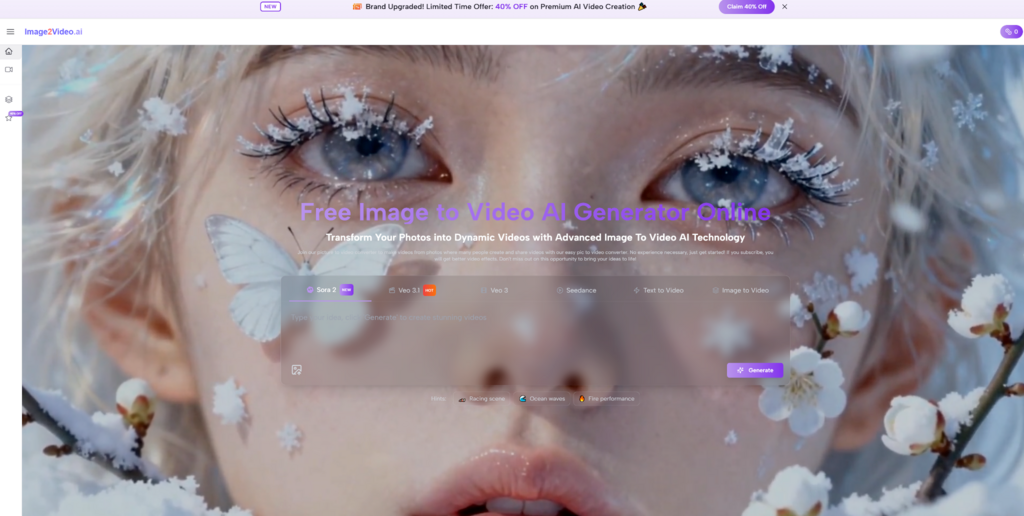
There is a quiet mismatch in how most visual tools are designed and how ideas actually form. People rarely imagine scenes as static compositions. They imagine movement, pacing, and emotional shifts. Yet traditional workflows force those ideas into still frames first, only later rebuilding motion through editing. While working with Image to Video AI, what stood out to me was not just the output, but the inversion of that process.
Instead of starting with frames and building motion, the process begins with motion itself—described, not constructed.
Table of Contents
Why Frame First Thinking Is Becoming Limiting
The conventional pipeline assumes that still images are the foundation.
Static First Workflow Creates Delay
In many creative scenarios:
- ideas are dynamic
- tools are static
- translation becomes necessary
This creates friction before anything is actually produced.
Editing Tools Emphasize Control Over Speed
Traditional systems prioritize:
- precision
- layering
- timeline manipulation
But early-stage ideas often benefit more from:
- speed
- iteration
- flexibility
Shift Toward Motion First Ideation
What becomes clear is that creators increasingly think in:
- movement
- transitions
- atmosphere
This requires a different type of interface.
How Motion Emerges From Descriptive Input
The system does not animate in the traditional sense. It interprets.
From Conceptual Language To Visual Output
Descriptions Replace Technical Instructions
Instead of specifying keyframes, users describe:
- camera behavior
- environmental changes
- emotional tone
This is closer to directing than editing.
Image As Structural Boundary
The base image determines:
- composition
- perspective
- spatial relationships
The generated motion respects these constraints.
Model Variability Affects Interpretation
Different models influence:
- realism
- smoothness
- stylistic bias
These variations suggest different internal priorities.
Understanding The Workflow As A Conceptual Loop
Rather than a linear process, this workflow feels iterative.
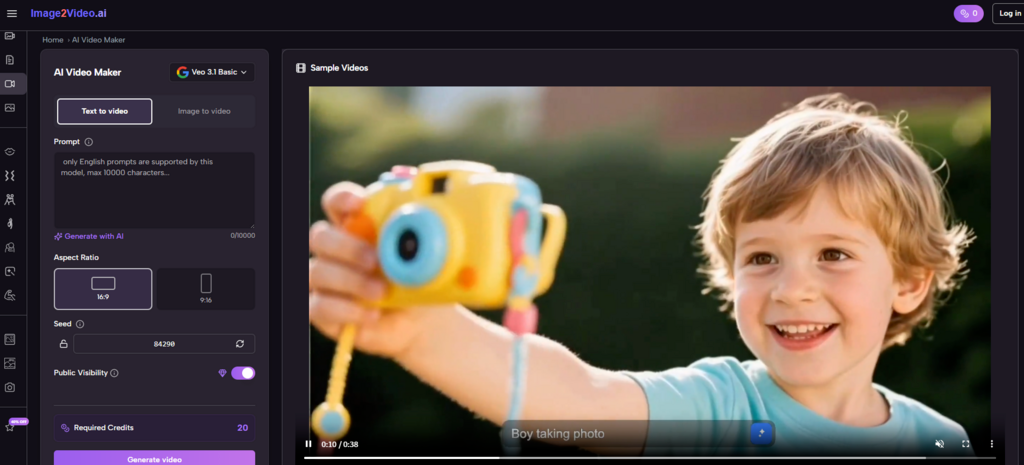
Three Step Execution Based On Platform Flow

Step 1 Upload A Still Image
This defines the visual anchor for generation.
Step 2 Describe Motion And Intent
Prompts provide direction rather than technical detail.
Step 3 Generate And Evaluate Output
The system produces a result that can be accepted or refined.
This loop can repeat quickly.
Comparing Concept Driven And Tool Driven Creation
| Perspective | Concept Driven Workflow | Tool Driven Workflow |
| Starting Point | Idea and motion | Assets and frames |
| Process Type | Interpretive | Constructive |
| Speed | High | Moderate to low |
| Control Detail | Medium | High |
| Iteration Cycle | Fast | Slower |
The distinction lies in how creation begins.
Where Motion First Thinking Feels Natural
Early Stage Creative Exploration
When ideas are not fully defined:
- rapid iteration is valuable
- multiple outputs help clarify direction
Social And Narrative Content
Short-form storytelling benefits from:
- emotional pacing
- quick experimentation
Visual Mood Prototyping
Testing atmosphere and tone becomes easier when motion is immediate.
Recognizing The Boundaries Of This Approach
Interpretation Can Be Imperfect
The system may not always align perfectly with intent.
Detail Control Is Limited
Fine adjustments are not directly accessible.
Iteration Is Required For Precision
Multiple attempts often lead to better results.
These constraints define the current stage of development.
How Photo To Video Reflects A Structural Change
The idea of Photo to Video highlights a deeper transition.
Instead of treating motion as an addition, it becomes:
- an inherent layer
- generated alongside the image
- shaped by description
This removes the need for separate animation steps.
What This Means For Creative Thinking
From Building To Guiding
Creators move from:
- constructing sequences
to:
- guiding outcomes
From Fixed Plans To Adaptive Exploration
The workflow becomes:
- iterative
- flexible
- Responsive

Why This Shift Matters Beyond Tools
This change is not only technical.
It affects:
- how ideas are formed
- how quickly they evolve
- who can participate in creation
The barrier to motion is lowering, and with it, the structure of creative work is changing.
For many creators, the first expression of an idea will no longer be static—it will already be in motion.
-

-

-

-

-

-