When a child or teenager takes up archery, the adults responsible for guiding that process — coaches, parents, program coordinators — face a decision that is more consequential than it might appear at first. Equipment that is poorly matched to a young archer’s physical development does not just limit performance. It creates habits that are difficult to correct later, introduces unnecessary injury risk, and often leads to frustration that ends participation entirely. Unlike many recreational activities where a single beginner setup serves most age groups, archery demands a more deliberate approach. The relationship between equipment weight, draw length, arrow spine, and physical development is tight enough that what works well at one stage of growth will actively work against a young archer at the next.
The decisions made in the first year of a young archer’s training have lasting effects. Coaches frequently report that the most common problems they see in intermediate youth archers — poor anchor point, inconsistent release, shoulder strain — trace back to starter setups that were either too heavy, too long, or simply never adjusted as the archer grew. This checklist addresses each age-appropriate phase honestly, including what is genuinely necessary, what is commonly purchased but rarely useful, and when upgrading is worth the investment versus when it is not.
Table of Contents
Understanding Equipment Fit Before Buying Anything
The most important concept in youth archery equipment selection is physical fit, and it takes precedence over brand, price point, and even bow type. A bow that is too heavy in draw weight forces a young archer to compensate with form breaks — dropping the bow arm, jerking the release, or collapsing the draw shoulder. These compensations become ingrained quickly, and they are far harder to correct than most instructors anticipate. The right starting point is always the archer’s current physical capacity, not the capacity they might grow into.
Selecting archery equipment for youth requires evaluating three physical factors before any purchase: wingspan, which determines draw length; standing height and strength, which informs draw weight tolerance; and hand dominance, which establishes eye dominance requirements. These are not one-time measurements. As children grow, particularly during rapid growth phases in the early and pre-teen years, all three factors shift enough to warrant regular reassessment — ideally every six months for active young archers.
Why Draw Length Matters More Than Draw Weight
Most adults new to guiding youth archers focus on draw weight, assuming lighter is better. That assumption is correct but incomplete. Draw length is equally critical, and in many cases causes more long-term problems when ignored. A bow with a draw length that is too long forces the archer to over-extend, pulling the elbow into a locked and elevated position that places strain on the shoulder joint and creates an inconsistent anchor. A draw length that is too short compresses the draw arm and reduces the natural power stroke, which limits accuracy and encourages the archer to creep forward at full draw.




Recurve bows for beginners offer some forgiveness here because they do not have a hard stop, but compound bows set at the wrong draw length create mechanical problems that affect every shot. For youth programs running group instruction, establishing a simple wingspan-to-draw-length estimation protocol at the beginning of each session year reduces the number of fit-related form problems significantly.
Equipment by Age Group: What Is Actually Necessary
Youth archery equipment needs change in meaningful ways across three general developmental stages: early childhood, middle childhood, and adolescence. These stages are not strictly age-defined — physical development varies considerably — but they reflect common patterns in strength, coordination, and attention span that affect what equipment a young archer can realistically manage and benefit from.
Early Starters: Ages Five Through Eight
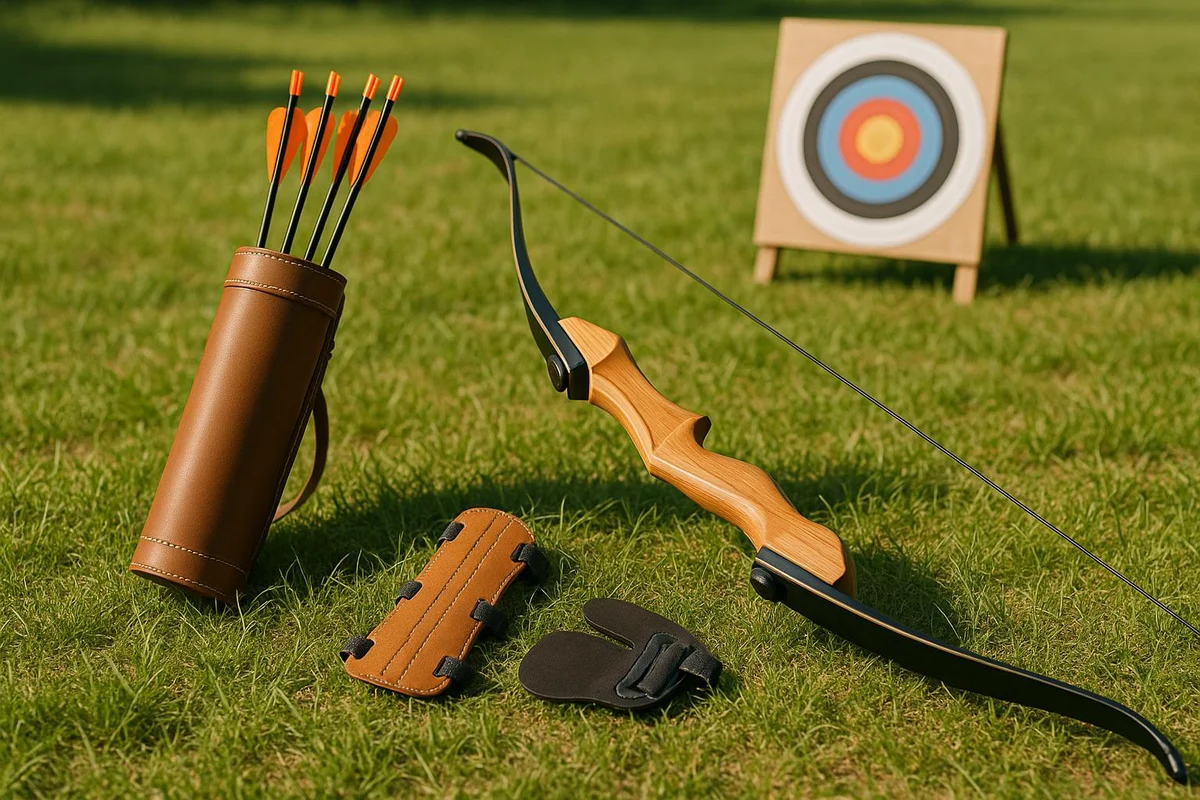
Children in this group are learning motor patterns, not technique. The goal of equipment at this stage is to remove friction from the physical act of drawing and releasing so that attention can go toward form fundamentals. This means very low draw weights, short bows, and arrows that are stiff enough to fly predictably without requiring precise release mechanics. Recurve bows with a simple design are appropriate here. Compound bows at this stage are generally unnecessary and often counterproductive because the more mechanical feedback they provide can confuse young archers who do not yet have the upper body coordination to interpret that feedback.
What to skip at this stage: finger tabs that are sized for adult hands, stabilizers of any kind, and clickers. What to prioritize: arrows with appropriate length for the bow and draw, a basic arm guard that fits the child’s forearm without slipping, and a target system that provides clear, immediate feedback without requiring long shots. According to USA Archery, the national governing body for the sport, establishing proper stance and grip mechanics during early training has the highest long-term impact on development.
Middle Childhood: Ages Nine Through Twelve
This stage is where habits solidify and where the investment in better equipment begins to pay off. Children in this range have enough coordination to start learning consistent anchor points and follow-through, which means equipment that reinforces those mechanics becomes genuinely useful. Draw weights can increase modestly, but only in step with demonstrated strength and form consistency — not as an automatic upgrade tied to age or birthday.
A properly fitted finger tab becomes relevant here, as does a simple recurve sight if the program is moving toward target shooting. Arrow selection becomes more nuanced because the archer is now generating enough force to make spine consistency matter. Mismatched arrows at this stage cause grouping problems that young archers often blame on their form rather than their equipment, which creates unnecessary discouragement. Coaches and parents should verify arrow spine against the bow’s draw weight and draw length before assuming a grouping problem is technique-related.
What to skip at this stage: high-end compound bows, expensive stabilizer systems, and release aids. These are tools for a more advanced mechanical skill set that most archers in this group have not yet developed. Introducing them too early creates dependency on equipment that compensates for form rather than developing form independently.
Adolescent Archers: Ages Thirteen and Up
Teenagers who have progressed through foundational training are genuinely ready for equipment that matches competitive or advanced recreational use. At this stage, the bow type — recurve or compound — should reflect the discipline the archer intends to pursue. If the goal is Olympic-style target archery, a mid-level recurve with a properly fitted riser, limbs matched to draw weight, and a sight system is appropriate. If the interest is in 3D or field archery, a compound with a correctly set draw weight and draw length, a reliable release aid, and sighted arrow rest makes sense.
Adolescence is also the stage where draw weight increases become meaningful in terms of trajectory and range performance, but the same caution applies: increases should follow demonstrated physical readiness, not assumptions about what a teenager should be shooting. Shoulder injuries from premature draw weight increases in adolescence are documented consistently in sports medicine literature and frequently result in extended time away from the sport.
The Equipment Archers Commonly Buy but Rarely Need
Certain products are heavily marketed toward youth archery programs and routinely purchased by well-meaning adults who believe they are investing in development. In practice, several of these items add complexity without adding value at the stages where they are most commonly introduced.
• Mechanical release aids for children under twelve: These require a level of draw consistency and anchor discipline that most young archers have not established. Introducing them early creates timing dependencies that are difficult to remove later.
• Full carbon arrow sets for beginners: Carbon arrows are appropriate for intermediate and advanced archers. For early-stage youth, aluminum or aluminum-carbon hybrid arrows offer more predictable flight patterns with more forgiveness for inconsistent releases.
• Compound bows marketed as “adjustable for growth”: While the adjustability feature is genuinely useful, many of these bows compromise on fit quality at both ends of their adjustment range. A well-fitted, simpler bow often serves a young archer better than a highly adjustable one that never fits quite right at any setting.
• Electronic training aids and laser alignment tools: These are useful for coaches working with advanced students. For foundational stages, they replace kinesthetic feedback with visual feedback in a way that slows the development of feel-based mechanics.
When Upgrading Is Worth the Investment
Upgrades in youth archery equipment are worth pursuing when the archer has physically outgrown the current setup, when form limitations are clearly tied to equipment rather than technique, or when the archer has committed to a specific discipline with defined equipment requirements. Upgrading because a child has become enthusiastic, or because a parent wants to reward progress, does not automatically mean the equipment will accelerate development. A young archer shooting consistent, clean form with a modest setup is better positioned than one shooting a high-spec bow with inconsistent mechanics.
The clearest signal that an upgrade is warranted is when the current bow can no longer be adjusted to match the archer’s draw length. At that point, continuing with the same equipment actively creates form problems, and replacement is necessary rather than optional. The second clearest signal is when draw weight has maxed out at the bow’s upper limit but the archer is physically ready for more — verified by a coach, not by the archer’s preference.
Closing Thoughts on Building a Useful Youth Archery Setup
Putting together the right archery equipment for youth archers is not a one-time purchase decision. It is an ongoing process of reassessment that should track physical development, skill progression, and program goals. The most common mistakes — buying for future growth, adding complexity too early, and skipping the measurement and fitting process — are all avoidable with a structured approach that treats fit as the foundation of every equipment decision.
Programs and parents who approach archery equipment for youth with patience and a willingness to make incremental adjustments tend to produce archers with cleaner mechanics, fewer overuse injuries, and longer participation in the sport. The equipment itself is secondary to the fit. A modest, well-fitted setup will consistently outperform an expensive, poorly matched one — and the young archer using it will progress more steadily, with habits that hold up as the demands of the sport increase.
The checklist framework presented here is not meant to be exhaustive for every context, but it reflects the principles that experienced coaches and program administrators apply consistently: start with the archer’s body, not the equipment catalog, and adjust as the archer grows. That discipline, applied consistently, is the most reliable way to support long-term development in youth archery.