The 10-Step Cleanroom Validation Protocol Every US Pharmaceutical Facility Should Follow in 2025

Pharmaceutical manufacturing in the United States operates under one of the most demanding regulatory environments in the world. Facilities are expected to demonstrate not only that their cleanrooms meet defined environmental standards, but that those standards are met consistently, repeatedly, and under documented conditions that regulators can audit at any time.
What makes this particularly challenging in 2025 is the convergence of stricter FDA enforcement activity, updated ISO classification requirements, and a broader industry shift toward continuous compliance rather than periodic validation. Many facilities that operated comfortably under older protocols are now finding that their validation documentation does not reflect current expectations — and that the gap between what is documented and what is actually occurring on the floor carries significant regulatory risk.
The following protocol outlines the ten steps that form a complete, defensible cleanroom validation process. This is not a theoretical checklist. Each step addresses a real operational decision point, and understanding the reasoning behind the sequence is just as important as completing the steps themselves.
Table of Contents
Step 1: Establishing the Validation Master Plan Before Any Physical Testing Begins
A Validation Master Plan, or VMP, is the governing document that defines the scope, approach, responsibilities, and acceptance criteria for the entire validation effort. Without it, individual tests and measurements exist in isolation — technically collected but strategically disconnected. Regulators expect to see a VMP that was written before testing began, not assembled retroactively to match results.
For facilities working with specialized providers of cleanroom validation services pharmaceutical industry professionals rely on, the VMP typically defines which classifications apply to which zones, what the testing sequence will be, who holds sign-off authority, and what happens when a test fails. This last point matters more than many facilities acknowledge at the planning stage.




A well-constructed VMP does not assume success. It accounts for deviation handling, retest conditions, and escalation paths. Facilities that treat the VMP as a formality tend to encounter the most disruption during actual testing, because decisions that should have been made at the planning stage are instead made under pressure during active operations.
Step 2: Defining Cleanroom Classification and Applicable Standards
Classification determines everything that follows — testing frequency, particle count thresholds, personnel protocols, and equipment qualification requirements. In the US pharmaceutical context, cleanrooms are typically classified according to ISO 14644-1, while the FDA’s current Good Manufacturing Practice regulations establish the operational requirements that sit on top of that classification framework.
The relationship between ISO classification and FDA requirements is not always straightforward. ISO classification describes the physical environment in terms of airborne particulate contamination. FDA cGMP requirements address how that environment is maintained, monitored, and documented in the context of pharmaceutical production. Both frameworks must be satisfied, and they are satisfied in different ways.
Why Classification Errors Create Downstream Problems
Misclassifying a space — either by applying a less stringent classification to reduce testing burden, or by applying an overly strict classification without the supporting infrastructure — creates problems that compound over time. A room classified at a level its HVAC system cannot reliably maintain will consistently fail monitoring data reviews. A room classified more strictly than necessary will create operational constraints that slow down production without providing meaningful contamination control benefit.
Classification should reflect the actual risk profile of the activities conducted in the space, aligned with the product being manufactured and the stage of manufacturing occurring there. This requires input from quality, engineering, and production — not a unilateral decision made during facility design and never revisited.
Step 3: HVAC System Qualification and Air Change Verification
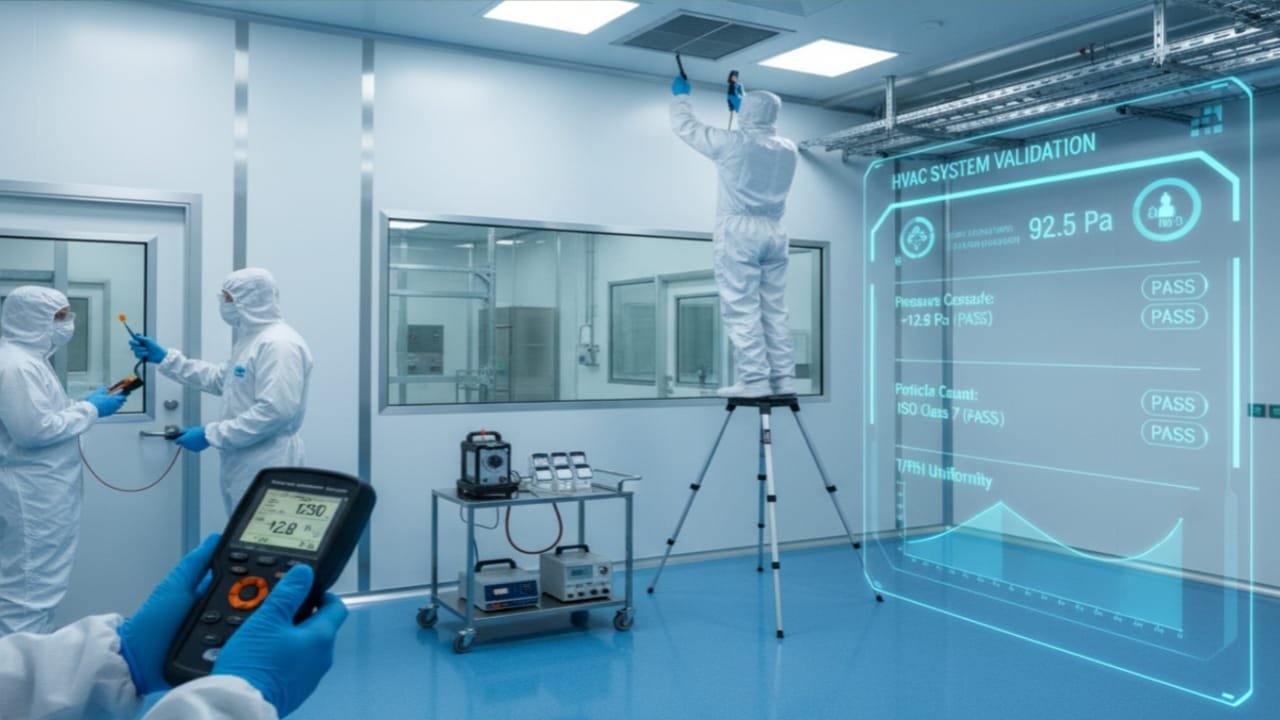
The heating, ventilation, and air conditioning system is the primary mechanism through which a cleanroom maintains its classified environment. Air change rates, pressure differentials, temperature, and humidity are all delivered through the HVAC system, and validation of the cleanroom cannot proceed meaningfully until the system itself has been qualified.
HVAC qualification follows the standard Installation Qualification, Operational Qualification, Performance Qualification sequence. Each phase has a distinct purpose: IQ confirms the system was installed as designed, OQ confirms it operates within specified parameters under controlled conditions, and PQ confirms it performs consistently during representative operating scenarios.
Pressure Differential Mapping as a Critical Sub-Step
Pressure differentials between adjacent spaces are one of the most operationally sensitive aspects of cleanroom HVAC performance. They prevent contamination migration between zones of different classification, and they must be maintained not just when doors are closed but during the realistic conditions of personnel movement, material transfer, and equipment operation.
Facilities that validate pressure differentials only under static conditions frequently discover during operation that dynamic conditions — open doors, simultaneous entries, high traffic periods — cause temporary pressure reversals that their monitoring systems were not configured to detect. Qualification testing should include dynamic conditions that reflect actual operational patterns.
Step 4: Filter Integrity Testing
High-efficiency particulate air filters are the primary barrier between the general building environment and the classified cleanroom space. Filter integrity testing, commonly performed using the DOP or PAO aerosol challenge method, confirms that installed filters have no leaks, bypasses, or installation defects that would allow unfiltered air to enter the cleanroom.
This step must be performed after installation and after any maintenance event that involves filter handling, ceiling grid disturbance, or HVAC system work in the vicinity of filter banks. A filter that tested clean at installation may develop a bypass leak during subsequent maintenance activity, and the validation record must reflect the current installed state, not a historical one.
Step 5: Airflow Visualization Studies
Airflow visualization, typically conducted using smoke or other tracer methods, confirms that air moves through the cleanroom in the patterns that the HVAC design intends. This is particularly important in unidirectional airflow zones where the direction and uniformity of airflow determines the effectiveness of contamination control at the work surface level.
Visualization studies reveal dead zones, recirculation patterns, and areas where airflow disruption occurs due to equipment placement, personnel position, or architectural features. These findings often require operational adjustments — repositioning equipment, changing work practices, or modifying room layouts — that would not have been identified through particulate counting alone.
Step 6: Particle Count Testing in At-Rest and In-Operation Conditions
Particle count testing is the most widely recognized element of cleanroom validation, but its value depends entirely on whether it is conducted under conditions that reflect operational reality. Testing only in the at-rest state — an empty room with HVAC running — provides baseline data but does not predict performance during manufacturing.
In-operation testing, conducted while representative activities are taking place and personnel are present in normal working numbers, reveals the contamination load that the cleanroom must manage during actual production. According to the FDA’s cGMP regulations, environmental monitoring must reflect conditions that are representative of normal production, not idealized scenarios.
Step 7: Viable Particle and Microbial Monitoring Integration
Non-viable particle counting measures the total airborne particulate load, but it does not distinguish between inert particles and viable microorganisms. Microbial monitoring — through active air sampling, surface contact plates, and personnel monitoring — provides the additional layer of data necessary to demonstrate that the cleanroom is not only physically classified but microbiologically controlled.
Setting Alert and Action Limits That Are Operationally Meaningful
Alert and action limits for microbial monitoring must be established based on historical data from the specific facility and cleanroom, not simply copied from regulatory guidance documents or industry benchmarks. Limits that are set too conservatively relative to what the cleanroom can realistically achieve will generate constant alerts without meaningful contamination events. Limits that are set too loosely may miss genuine contamination trends before they reach reportable levels.
The process of establishing meaningful limits requires at least several months of baseline data collection, statistical analysis of that data, and a formal review process that involves quality and microbiology leadership. This is not a one-time calibration — limits should be reviewed periodically as processes, personnel, and environmental conditions change.
Step 8: Personnel Qualification and Behavior Protocol Documentation
Personnel are consistently among the largest sources of contamination in a classified cleanroom environment. Gowning procedure validation, personnel monitoring, and behavior protocol documentation are therefore integral components of cleanroom validation, not supplementary considerations.
Gowning qualification confirms that the donning sequence, garment integrity checks, and transfer procedures are consistently performed in a way that does not introduce contamination from unclassified areas. Personnel monitoring data — fingertip plates, gown surface samples — provides direct evidence of how effectively individuals are executing their gowning procedures.
Step 9: Equipment and Utility Qualification Within the Cleanroom
Cleanroom validation does not exist in isolation from the equipment and utilities operating within the controlled space. Processing equipment, cleaning systems, compressed gases, and purified water systems all interact with the cleanroom environment and must be qualified in a way that accounts for their contribution to contamination risk.
Equipment that generates heat, vibration, or particulates during operation may affect local airflow patterns and particulate counts in ways that are not apparent from the equipment qualification data alone. Integration of equipment performance data with environmental monitoring data provides a more complete picture of how the cleanroom system behaves as a whole during production conditions.
Step 10: Revalidation Triggers and Ongoing Monitoring Programs
Initial validation establishes a baseline, but cleanroom performance changes over time. Filter loading, HVAC component wear, facility modifications, increased production volumes, and changes in personnel all affect the controlled environment. Revalidation triggers must be defined in advance, not evaluated reactively after a monitoring excursion has already occurred.
Common revalidation triggers include significant facility modifications, HVAC system repairs or replacements, changes in production processes or personnel levels, and any monitoring trend that suggests gradual environmental degradation. In addition to event-triggered revalidation, periodic scheduled revalidation — typically annual for critical classified spaces — provides systematic confirmation that the cleanroom continues to perform as originally qualified.
Building a Monitoring Program That Sustains Validation Over Time
Ongoing environmental monitoring is the mechanism through which a facility maintains confidence in its cleanroom between formal revalidation events. A well-designed monitoring program captures data at locations and frequencies that reflect actual risk, uses statistical process control methods to identify trends before they become excursions, and generates records that can be reviewed in context during an FDA inspection.
The monitoring program should be treated as a living system — reviewed and adjusted as operational patterns change, as new data accumulates, and as regulatory expectations evolve. Facilities that run static monitoring programs designed years ago often find that their data no longer supports the risk-based narrative that regulators expect to see in 2025.
Bringing the Protocol Together as a Unified Compliance Framework
Cleanroom validation is not a sequence of independent technical tests. It is a coordinated program in which each step informs and depends on the steps around it. The value of any individual test result is determined by the quality of the planning that preceded it and the monitoring infrastructure that follows it.
Pharmaceutical facilities that approach validation as a unified compliance framework — rather than a series of boxes to check before a regulatory inspection — tend to experience fewer disruptions, more predictable environmental performance, and cleaner inspection outcomes. The ten steps described here represent that framework in its most practical form: grounded in real operational conditions, structured around documented evidence, and designed to hold up under scrutiny over time.
For quality and engineering teams preparing for a validation cycle in 2025, the most important action is not completing the steps quickly — it is completing them in sequence, with the documentation quality and operational realism that regulators now expect as a baseline rather than a differentiator.