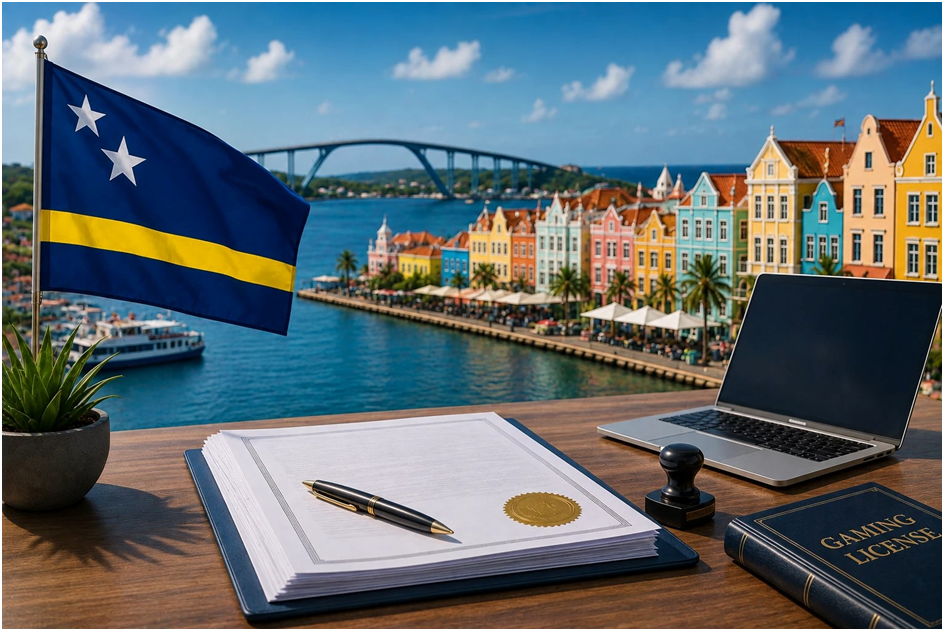
A Curaçao gaming license — issued under the Landsverordening op de Kansspelen (LOK) framework that came into direct force on December 24, 2024 — gives operators a single, unified authorization to offer casino, sports betting, poker, and other verticals across multiple international markets simultaneously. Where the old sub-license model funneled thousands of operators through just four master license holders, the new Curaçao Gaming Authority (CGA) regime grants individual licenses with direct regulatory accountability. For operators aiming to expand quickly, this is practical: a single B2C license covers several gaming verticals and avoids getting separate country-level authorizations for every market you enter. An end-to-end application timeline of 4 to 6 months makes Curaçao one of the quicker regulated entry points worldwide, which matters when regulators such as the MGA or UKGC often take longer and demand more resources.
What the license lets you do depends on your product mix, target markets, and payment setup — factors the next sections cover in detail, starting with the regulatory framework. If you want help with the process, MGL Solutions can assist with entity setup, policy drafting, CGA submission, and ongoing post-license compliance.
What the Curaçao gaming license is in 2026: LOK, CGA, and the unified model
In 2026, a Curaçao gaming license is a CGA-issued approval under the LOK that replaces the old master/sub-license model with one unified regime covering multiple iGaming verticals under direct, centralized supervision.
The LOK (Landsverordening op de Kansspelen) entered into force on December 24, 2024, formally ending the era of four master license holders and thousands of downstream sub-licenses. The former Gaming Control Board (GCB) was redesignated as the Curaçao Gaming Authority (CGA) — now the sole issuing and supervisory body.
One direct license now covers:- Casino (slots, table games, live dealer)- Sportsbook and esports betting– Poker and skill games– Lottery-style products
Because the CGA applies fit-and-proper checks, AML/CFT standards, and lifecycle audits consistently across all applicants, vendors, PSPs, and affiliate partners increasingly recognize CGA credentials as a credible baseline — a shift from the largely unverified sub-license era.
Where a Curaçao license works and how it opens market access
A Curaçao license can be used to offer online gambling internationally except in countries that ban it or require a local license, so operators typically serve gray markets and geo-block ring-fenced jurisdictions like the UK.
Where it works in practice
The CGA/LOK framework is commonly used across Latin America, parts of Southeast Asia, and CIS regions where no mandatory local license exists. Operators rely on geo-IP filtering, local legal opinions per market, and payment routing decisions to define practical reach — there is no single “accepted everywhere” guarantee.
Ring-fenced markets to block
- UK — UKGC license mandatory; Curaçao does not substitute
- Spain, Italy, Sweden — national ring-fencing applies
- Curaçao residents — operators may not serve them under LOK rules
Partner and PSP acceptance
Post-reform, the CGA’s public register, documented AML/KYC controls, and audit letters reduce onboarding friction with game suppliers and affiliates. Many mid-risk PSP corridors accept CGA-licensed brands. However, Tier-1 Visa/Mastercard acquirers and some major affiliate networks apply stricter due diligence — PSP appetite shapes reach as much as licensing jurisdiction does.
License types under CGA: B2C vs B2B and who each suits
CGA issues B2C licenses to operators running player-facing brands and B2B licenses to suppliers (platforms, RGS, studios) that provide services to other operators.
B2C suits online casino and sportsbook brands selling directly to players. B2B applies to platform providers, game studios, and RNG suppliers serving other licensed gaming operators — offering games or critical services to third parties triggers B2B licensing regardless of whether you also run a player-facing product.
Quick archetype guide:
| Business model | License needed |
| Casino/sportsbook brand | B2C |
| Platform or RGS provider | B2B |
| Multi-brand operator | Single B2C covers all brands |
| White-label platform supplying third-party gaming companies | B2B |
Operational flexibility: multiple brands and products under one license
Yes—subject to CGA approval, one operator license can include multiple brand domains and verticals, simplifying expansion.
Under the unified LOK regime, a single B2C license can cover casino, sportsbook, and live dealer verticals simultaneously. Each additional brand domain, however, requires formal CGA notification and approval—not a separate license, but a documented change request.
What that means in practice:
- New skins or market-facing domains trigger a change management process: updated risk assessments and responsible gaming (RG) disclosures per domain
- Vertical additions (e.g., adding sportsbook to an existing casino license) require CGA sign-off before go-live
- Incremental launch friction is lower than securing a second license, but compliance overhead per brand remains real
Curaçao gaming license fees and first-year cost breakdown (2026)
Expect ~EUR 4,592 application plus an annual government licence fee of EUR 47,450 for B2C, with the B2B fee set in the current CGA schedule, and a realistic first-year B2C budget of roughly EUR 68,000 to 90,000 including compliance, hosting, and audits.
| Cost Line | B2C | B2B |
| CGA application fee (non-refundable) | EUR 4,592 | EUR 4,592 |
| Annual government license fee | EUR 47,450 | Per current CGA schedule |
| Company formation (Curaçao entity) | EUR 3,000–6,000 | EUR 3,000–6,000 |
| Key Person appointment | EUR 5,000–12,000 | EUR 5,000–12,000 |
| Compliance setup & documentation | EUR 8,000–20,000 | EUR 8,000–20,000 |
| First-year indicative total | EUR 68,000–90,000 | Lower |
Variable factors that shift your budget include headcount beyond the minimum local staffing requirement, your hosting vendor tier, RNG certification scope, and legal counsel complexity. Operators with leaner vendor stacks sit closer to the lower bound; those layering payment redundancy and multi-brand infrastructure reach the upper range. Note that gaming revenue itself carries no GGR tax under the current framework — a structural advantage that partially offsets these setup costs.
Tax efficiency and corporate structure advantages
Yes—Curaçao applies no tax on GGR and a low effective corporate income tax (often ~2% when conditions are met), with no VAT on cross-border services. For a gaming business, this combination directly widens net margin: revenue that would otherwise fund a GGR levy stays available for player acquisition, content deals, and market expansion. A mid-size operator can see materially higher EBITDA compared to high-tax regimes where GGR taxes alone can reach 15–25%. Caveats matter. These rates apply only if the substance and eligibility rules are met: local economic substance, a proper corporate structure, and CGA compliance. Those are prerequisites, not defaults. This is not tax advice; consult qualified counsel before you structure anything.
Speed and cost-effectiveness: time-to-market and expansion ROI
With complete documentation and hosting in place, many applicants progress from submission to decision in about 4 to 6 months, faster than most tier-1 regimes—and lower fees accelerate time-to-revenue.
The Curaçao Gaming Authority (CGA) runs a two-phase review—fit-and-proper screening, then technical and compliance assessment—each taking 4–8 weeks when your UBO documentation, AML/KYC policies, and in-jurisdiction hosting are ready on day one. Missing any element restarts the clock.
What compresses the timeline:– Pre-certified infrastructure (technical audit clears in 2–4 weeks)- Clean UBO structure with no remediation loops- Complete responsible gaming and AML frameworks submitted upfront
ROI framing: Earlier go-live means earlier revenue capture. However, your actual payback period depends on customer acquisition costs, PSP fee structures, bonus economics, and retention rates—not licensing fees alone.
Crypto-friendly payments and PSP access
Often yes—many Curaçao-licensed operators support crypto, provided robust AML/CTF, KYC, and transaction monitoring controls are in place.
Under the LOK framework, the Curaçao Gaming Authority (CGA) treats crypto like any other payment method: permissible, but subject to source-of-funds verification, travel-rule compliance, and on-chain analysis where applicable. For PSP access in mid-risk corridors where traditional card acquiring is restricted, the license offers a credible regulatory anchor—without guaranteeing universal acceptance.
What this means for you:– Crypto on-ramps and off-ramps are operationally viable, not automatic- Chain analysis tools and wallet screening satisfy CGA transaction monitoring expectations- Fintech partners serving Curaçao operators vary by corridor; due diligence on each relationship remains your responsibility
Compliance framework: AML, KYC, responsible gaming, and hosting
Curaçao requires FATF-aligned AML/KYC, risk-based monitoring, and RG tools such as limits, time-outs, and self-exclusion, plus local hosting for CGA oversight. Gaming regulation under the LOK ties licensing requirements directly to NORUT and NOIS obligations, meaning compliance iGaming teams must build these gaming policies into operations from day one — not retrofit them later.
AML/KYC tiers, transaction monitoring, and responsible gaming controls
Operators must apply risk-based KYC, sanctions/PEP screening, ongoing monitoring, deposit/loss limits, time-outs, and self-exclusion with documented interventions.
Curacao AML/KYC and RG controls — required under CGA:
- Standard KYC: identity and address verification at onboarding
- Enhanced Due Diligence (EDD): triggered by indicators such as rapid high-value deposits from a high-risk jurisdiction — full source-of-funds documentation required
- PEP/sanctions screening: continuous, not only at registration
- Transaction monitoring: real-time flagging aligned with FATF and NORUT obligations
- Responsible gambling tools: mandatory deposit limits, loss limits, session time-outs, and cooling-off periods
- Self-exclusion: portable across all brands operating under the same license
- Proactive interventions: documented responses when harm indicators are detected
Periodic reporting, annual audits, and supervisory reviews
Operators submit periodic operational and RG reports, maintain annual audited financials, and undergo scheduled technical reviews with remediation where needed. Typical KPIs covered include active player counts, responsible gaming (RG) interventions, and chargeback rates. Independent auditors assess platform security, RNG integrity, and AML/KYC protocol effectiveness on an annual cycle. Where findings arise, the CGA may require a formal remediation plan before sign-off. Penetration testing follows a similar periodic cadence.
In-jurisdiction hosting, data retention, and CGA system access
Key systems and data must be hosted in Curaçao to ensure CGA access and oversight, with defined retention and secure logging.
Under the LOK framework, core infrastructure — including the Random Number Generator (RNG) system, transaction databases, and player records — must reside on in-jurisdiction hardware. Cloud components (CDN, frontend delivery) are permissible at the edge, but the master node and primary databases require physical local presence to satisfy CGA data sovereignty rules. The CGA requires real-time audit access to transaction logs and gaming systems. For hosting, operators typically use Tier III facilities.
How to get a Curaçao gaming license in 2026: application steps and ongoing obligations
Set up a Curaçao entity with a resident director, finalize AML/KYC and RG policies, establish local hosting, submit the CGA application with technical documents, address queries, then operate under ongoing reporting and audits.
CGA application steps — checklist:
1. Incorporate a Curaçao legal entity.
2. Appoint at least one Curaçao-resident director.
3. Build AML/KYC, NORUT/NOIS-aligned policies and responsible gaming controls.
4. Configure in-jurisdiction hosting with documented SLA evidence.
5. Assemble technical package — RNG certificates, platform agreements, UBO disclosures.
6. Submit to CGA; Phase 1 (fit-and-proper) runs first, Phase 2 (technical/compliance) follows.
7. Respond promptly to CGA queries. Incomplete ownership documentation causes the most common delays.
8. Go live, then keep up periodic reporting and annual supervisory audits.
What changed under LOK/CGA: regulatory updates and current limitations
The CGA replaced the legacy GCB master/sub-license system with direct, unified licensing and stronger oversight, with legacy permissions sunsetting and stricter limits on targeting restricted markets.
Legacy vs. current oversight — at a glance
| Feature | Legacy GCB model | CGA/LOK (from December 24, 2024) |
| Licensing relationship | Via Master License Holder | Direct with CGA |
| Sub-licenses | Permitted | Abolished |
| Enforcement | Limited, indirect | Risk-based; penalties apply |
Operating through a Master License Holder or sub-licenses is no longer a valid pathway. The Curaçao Gaming Authority now enforces advertising rules, mandatory blocking lists for restricted markets, and graduated penalties for non-compliance — including suspension or revocation for serious breaches.
Curaçao vs MGA, UKGC, Isle of Man, Gibraltar, Anjouan, and Malta B2B
Choose Curaçao for speed, unified coverage, and broad gray-market reach; choose MGA/UKGC for tier-1 market access; consider IOM/Gibraltar for reputation/banking and Anjouan for speed/cost; Malta B2B suits suppliers seeking EU recognition.
| Jurisdiction | Recognition | Speed | Est. First-Year Cost | PSP/Banking Access |
| Curaçao (CGA) | Emerging markets, crypto | 4 to 6 months | EUR 68,000–90,000 | Moderate; crypto-friendly |
| MGA (Malta B2C) | EU, tier-1 | 6 to 12 months | EUR 150,000+ | Strong |
| UKGC | UK only | 4–6 months | GBP 100,000+ | Very strong; geo-restricted |
| Isle of Man | High-reputation global | 6–12 months | USD 100,000+ | Strong |
| Gibraltar | Tier-1 reputation | 6–9 months | GBP 100,000+ | Strong |
| Anjouan | Niche/emerging | 6 to 8 weeks | EUR 23,000–30,000 | Limited |
| Malta B2B | EU supplier recognition | 6–9 months | EUR 100,000+ | Strong for B2B suppliers |
-

-

-

-
-

-