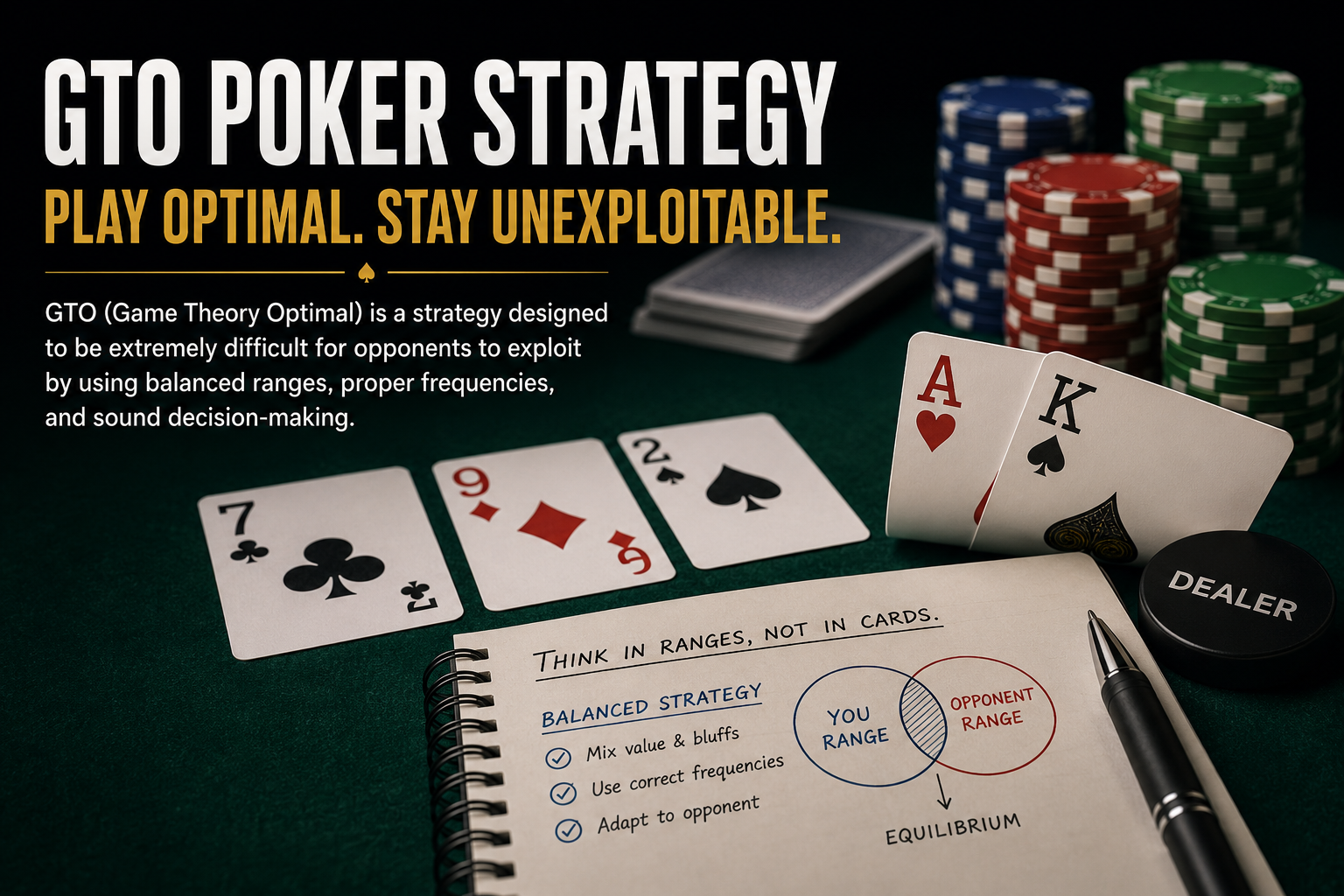
Poker strategy has evolved dramatically over the past decade. Players once relied primarily on experience, intuition, and observations about their opponents. Today, modern poker strategy is heavily influenced by mathematical models, game theory, and advanced software. At the center of this evolution is poker gto, a concept that has changed the way serious players think about decision-making at the tables.
But what does GTO actually mean? Does optimal play require memorizing thousands of charts and frequencies? Is a GTO strategy always the best strategy in a real game? And how can an everyday player use game theory without turning poker into a purely mathematical exercise?
Understanding these questions is essential for anyone who wants to build a strong strategic foundation.
Table of Contents
What Is GTO in Poker?
GTO stands for Game Theory Optimal. In simple terms, GTO describes a strategy designed to be extremely difficult for an opponent to exploit.
The key idea is balance.
Suppose you always bluff when you miss the flop and always bet when you have a strong hand. A good opponent can quickly recognize this pattern. They will call your bluffs more frequently and fold when you show strength. Your strategy becomes exploitable.
GTO approaches the problem differently. Instead of making decisions solely according to your own cards, you construct ranges that contain an appropriate mixture of value hands, bluffs, checks, calls, raises, and folds.
This makes your overall strategy much harder to attack.
For players studying gto in poker, it is important to understand that optimal strategy does not mean every hand has one mandatory action. The correct decision depends on position, stack depth, board texture, bet sizing, ranges, and the actions that have already occurred.
Why Optimal Play Is About Ranges, Not Individual Hands
One of the biggest misunderstandings about GTO is that players often think about individual hands instead of entire ranges.
Imagine you raise from the button and the big blind calls. The flop comes with a relatively dry texture. You may have strong top pairs, overpairs, draws, backdoor draws, and complete misses.
A GTO strategy does not simply ask, “Is my particular hand strong enough to bet?”
Instead, it asks something closer to:
- Which hands should bet?
- Which hands should check?
- How often should each hand take each action?
- What bet size should be used?
- How does the opponent’s range respond?
This range-based thinking is one of the most important skills a poker player can develop.
For example, a hand with medium showdown value might bet some percentage of the time and check the rest. A strong hand might sometimes check to protect the checking range. A weak hand with useful blockers may become a bluff.
The result is a strategy that is much more difficult for an opponent to exploit.
What Does “Optimal” Really Mean?
The word “optimal” can create confusion.
In everyday language, optimal means “the best.” In game theory, however, optimal play has a more specific meaning.
A strategy is considered optimal when it performs extremely well against an opponent who is also playing optimally. In a theoretical equilibrium, neither player can improve their expected result simply by changing their strategy while the other player’s strategy remains unchanged.
This is why GTO is often associated with equilibrium solutions.
However, real poker is not played against a computer-generated opponent that perfectly follows a predefined strategy. Human opponents make mistakes. They overfold, overcall, bluff too much, bluff too little, choose incorrect sizings, and make strategic adjustments based on emotion or incomplete information.
That creates an important distinction between theoretical optimal play and practical exploitation.
GTO vs. Exploitative Poker
A strong poker player needs to understand both GTO and exploitative strategy.
Imagine that you discover an opponent folds far too frequently against river bets. A purely theoretical approach might tell you to maintain a balanced bluffing strategy.
But if your opponent is consistently overfolding, increasing your bluff frequency can be highly profitable.
You are deliberately moving away from equilibrium because the opponent has a weakness.
This does not mean GTO is useless. Quite the opposite. GTO provides the baseline that helps you understand why an exploit works.
Without a strong theoretical foundation, it is easy to make adjustments that feel logical but actually create new weaknesses in your own strategy.
The best players therefore tend to use GTO as a reference point and exploitation as a practical tool.
How GTO Uses Frequencies
Another important concept is frequency.
Poker is a game of probabilities, so many optimal strategies are not based on choosing one action 100% of the time.
For example, a solver may recommend that a particular hand bets 70% of the time and checks 30% of the time. This does not mean that the player must literally randomize every decision with a stopwatch.
The frequency represents the strategic relationship between different actions across a range.
Suppose you have a very strong hand. Betting it every time may seem logical, but doing so could make your checking range too weak. Therefore, some strong hands may be included in the checking range.
The same principle applies to bluffs.
If you bluff too frequently, your opponent can profitably call more often. If you bluff too rarely, your opponent can overfold. The optimal strategy attempts to keep the opponent’s responses from becoming systematically profitable.
GTO and Preflop Strategy
GTO concepts are particularly visible in preflop poker.
Opening ranges, three-betting ranges, calling ranges, blind defense, and four-bet strategies can all be modeled mathematically.
Position is one of the most important factors. A player on the button can profitably play a much wider range than a player under the gun because the button has a positional advantage.
The big blind is another interesting example. Because the player already has money invested in the pot, they can defend with a relatively wide range against certain opens.
But these ranges are not static.
They change according to:
- Effective stack size
- Open size
- Position
- Number of players
- Ante structure
- Tournament or cash-game format
- Rake
- Opponent tendencies
This is why simply memorizing a single chart is not enough to understand GTO.
Using GTO Software for Learning
Modern poker software makes it possible to study situations that would have been almost impossible to analyze manually.
Solvers can calculate strategies for thousands of different scenarios and show how ranges interact across different boards and bet sizes.
However, there is a danger in becoming too dependent on solver outputs.
A player can memorize that a particular hand bets 43% of the time without understanding why. That information may be difficult to apply when the board, stack depth, sizing, or opponent range changes.
The better approach is to use software as a learning tool.
Instead of asking only what the solver does, ask why the solver makes a particular recommendation.
Does the hand have a blocker?
Does it benefit from protection?
Does it unblock the opponent’s folds?
Does it have strong equity when called?
Does it perform well as a bluff?
Does the board favor one range?
These questions turn solver data into strategic understanding.
For players using database analysis alongside solver work, baseanalise.com can also be a useful part of the learning process. Reviewing actual hands and identifying recurring tendencies helps connect theoretical concepts with real decisions made at the tables.
Common GTO Mistakes
One of the biggest mistakes is believing that GTO means never adjusting to opponents.
It does not.
Another mistake is trying to memorize every frequency. Poker contains too many variables for this approach to be practical.
A third mistake is treating solver outputs as absolute rules. Solver solutions are based on assumptions. If the assumptions change, the strategy can change as well.
For example, rake has a major effect on cash-game strategy. Stack depth also changes incentives. A strategy that makes sense at 100 big blinds may not be appropriate at 30 big blinds.
Players should therefore focus on principles rather than isolated numbers.
How to Start Learning GTO Poker
For beginners, the best way to study GTO is to build knowledge progressively.
Start with preflop ranges. Learn why position matters and understand the basic differences between opening, calling, three-betting, and defending.
Then move into simple single-raised pots. Study common flop textures and learn why some boards encourage frequent continuation betting while others encourage more checking.
After that, study turn and river decisions.
At each stage, concentrate on understanding range interaction rather than memorizing every percentage.
Database analysis can also be extremely useful. Reviewing your own hands allows you to compare theoretical principles with your actual playing tendencies. This is especially valuable when you are trying to identify whether your decisions are too aggressive, too passive, too value-heavy, or too bluff-heavy.
Why GTO Knowledge Makes Exploitation Stronger
GTO and exploitative poker are often presented as opposites, but they work best together.
Imagine that you understand what a theoretically balanced river betting range should look like. You then discover that your opponent folds too frequently against large bets.
Because you understand the baseline, you can confidently increase your bluff frequency.
Likewise, if an opponent calls too frequently, you can reduce your bluffs and increase your value betting.
The stronger your understanding of equilibrium strategy, the more accurately you can identify deviations from it.
This is one reason advanced players study GTO even when their primary goal is exploitative poker.
What Does It Mean to Play Optimal Poker?
Ultimately, the goal is to play optimal poker without blindly following a solver.
Optimal thinking means making decisions that maximize your expected value given the information available to you.
Sometimes that means following a balanced strategy. Sometimes it means making a calculated exploit against a specific opponent.
The important part is understanding why the adjustment works.
A strong player knows the theoretical baseline, recognizes when an opponent deviates from that baseline, and then adjusts accordingly.
That is a much more powerful skill than simply memorizing charts.
Final Thoughts
GTO has fundamentally changed modern poker strategy because it provides players with a framework for understanding balance, ranges, frequencies, and incentives.
But GTO should be viewed as a foundation rather than a rigid rulebook.
The real objective is to understand why certain strategies work, how ranges interact, and how opponents can respond. Once those concepts become intuitive, it becomes much easier to make strong decisions even in situations that you have never studied before.
Whether you are learning gto poker for the first time or already working with advanced solver outputs, the most important lesson remains the same: optimal poker is not about memorizing every possible decision. It is about understanding the strategic principles behind those decisions and knowing when the situation calls for balance—and when it calls for an exploit.
-

-

-
-
-
-