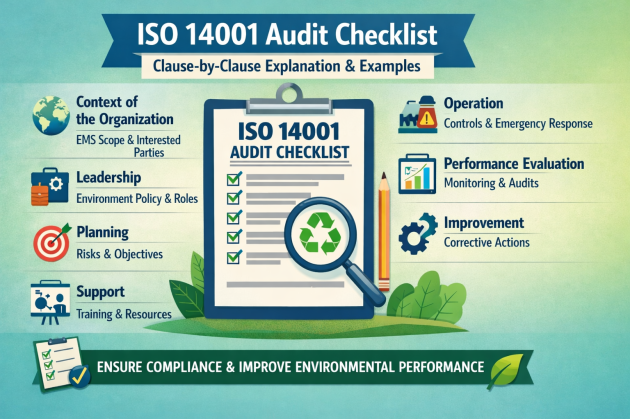
Environmental management has moved from a regulatory checkbox to an operational priority for manufacturing facilities across California’s Central Valley. For Fresno-area manufacturers, maintaining ISO 14001 certification is not simply about compliance documentation. It directly affects supplier relationships, contract eligibility, and how regulatory agencies view the facility during inspections. Yet despite the growing stakes, internal audits at many facilities continue to fall short in ways that are both predictable and preventable.
The internal audit is the foundation of any functioning environmental management system. When it is conducted well, it surfaces problems before they become nonconformities or incidents. When it is conducted poorly, it creates a false sense of compliance that can unravel quickly during a surveillance audit or a regulatory review. The mistakes described here are not rare edge cases. They are patterns that appear consistently across manufacturing environments, and they tend to share a common root: the audit process is treated as an administrative formality rather than an operational discipline.
Table of Contents
Treating the Audit as a Documentation Review Rather Than a System Evaluation
One of the most persistent problems in ISO 14001 internal audit fresno programs is the tendency to equate audit completion with document verification. Auditors check whether records exist, whether forms are filled out, and whether procedures are on file. What they often miss is whether those procedures reflect actual practice on the floor or whether the documented environmental controls are functioning as designed.
ISO 14001 is a management system standard, and the internal audit is meant to evaluate the system itself. That means looking at how environmental objectives are monitored, how significant environmental aspects are controlled in practice, and whether the people responsible for those controls understand their roles. A facility can have complete documentation and still have a management system that is not functioning effectively. When auditors rely on paperwork to confirm conformance rather than going into the process to observe and question, they miss the gap between what is written and what is happening.
The iso 14001 internal audit fresno process should be structured around process-based auditing, where the auditor traces how environmental requirements move through actual operations, not just through files. This means interviewing line supervisors, observing waste handling practices in real time, and verifying that monitoring equipment is being used correctly and consistently.




Why Document-Only Audits Create Long-Term Risk
When audits only confirm that documents exist, facilities build a compliance picture that reflects their record-keeping capability rather than their actual environmental performance. Over time, this creates a growing gap between the management system on paper and the one in operation. When a third-party certification body conducts a surveillance audit, they use both document review and process observation. If the process tells a different story than the documents, that discrepancy becomes a major nonconformity. The internal audit is the best opportunity to find and close that gap before it becomes visible to an external auditor.
Using Auditors Who Are Not Functionally Independent
ISO 14001 requires that internal auditors maintain objectivity and impartiality. In practical terms, this means an auditor should not audit their own work or the processes they directly manage. In smaller facilities, this requirement is frequently handled informally, with environmental managers auditing their own programs or department supervisors signing off on areas they control. The result is an audit that lacks the independence necessary to surface real problems.
Independence is not simply about avoiding obvious conflicts. It is about creating conditions where an auditor can observe a problem and report it without organizational pressure to minimize or overlook it. When audit findings have consequences for the auditor’s own department or professional standing, the natural human tendency is to soften the language, reclassify findings, or skip areas that might produce uncomfortable results. This dynamic is rarely conscious or intentional, but it consistently reduces the usefulness of the audit.
Practical Ways to Build Auditor Independence in Smaller Facilities
Facilities that cannot dedicate separate staff to auditing often resolve this by using cross-functional audit teams, where employees from one department audit another. This approach works when it is structured properly. Auditors need adequate training in the ISO 14001 standard, clear authority to report findings without editorial interference, and a process for escalating observations that might be resisted at the department level. Without these structural protections, the cross-functional approach can produce the same blind spots as self-auditing.
Failing to Audit All Significant Environmental Aspects
Every facility operating under ISO 14001 is required to identify its significant environmental aspects — the activities, products, or services that have or can have a meaningful environmental impact. These aspects should drive the audit program. The processes and controls associated with significant aspects need regular, substantive evaluation. What happens in practice is that audit programs grow around convenience rather than risk, with the same low-risk areas being audited repeatedly while complex or high-impact processes receive less scrutiny.
This pattern is especially visible in facilities that have been certified for several years. Early in certification, the audit program tends to be thorough. Over time, as the process becomes routine, auditors gravitate toward areas where conformance is consistent and findings are minimal. Waste management procedures, emergency preparedness for spills, and energy monitoring for high-consumption equipment may be reviewed briefly or skipped entirely in some audit cycles. If something goes wrong in one of those areas, the gap in the audit record creates both a compliance problem and a liability concern.
Aligning Audit Frequency with Environmental Risk
The ISO 14001 standard, as described by ISO and its technical committees, expects the audit program to be based on the environmental importance of the processes involved and the results of previous audits. That means facilities should be reviewing their audit schedule against their aspect register regularly, not simply rolling over last year’s plan. If a process has changed, if a new chemical is being used, or if a previous audit revealed control gaps, the audit frequency for that area should reflect the elevated attention it requires.
Writing Findings That Are Too Vague to Drive Corrective Action
Audit findings have limited value if they cannot be acted on. A finding that states “waste labeling is inconsistent” tells the facility almost nothing useful. It does not identify where the inconsistency occurs, under what conditions, who is responsible, or what the potential environmental consequence might be. Vague findings tend to produce vague corrective actions, and vague corrective actions rarely change anything at the operational level.
Effective findings describe the specific observation, reference the requirement that is not being met, and connect the gap to its potential impact. They are written in factual, neutral language that does not assign blame but is precise enough to direct a meaningful response. This level of writing requires auditors who understand both the standard and the processes they are auditing. It cannot be achieved by auditors who are filling in forms based on a checklist without a real understanding of what they are evaluating.
Disconnecting the Audit Program from Management Review
The internal audit is part of a larger performance evaluation loop that is supposed to inform management decisions. ISO 14001 requires that audit results be considered during management review, which is where environmental objectives are assessed and resources are allocated. When audit findings are not systematically fed into that process, the management system loses its ability to self-correct. Problems that are identified during audits may generate local corrective actions but never surface as patterns that require systemic attention.
This disconnection is more common than it should be. Audit reports sit in files, corrective actions are closed out individually, and management review meetings draw on summary data that has been filtered several times before it reaches decision-makers. The environmental management representative or the team conducting iso 14001 internal audit fresno evaluations should ensure that recurring findings, audit gaps, and unresolved observations are presented at management review in a form that allows for meaningful discussion and resource decisions.
Relying on Static Checklists That Do Not Reflect Current Operations
Checklists are useful tools for ensuring consistency across audits, but they become a liability when they are not updated to reflect changes in the facility. When a new production line is added, when a chemical or material is substituted, when a regulatory requirement changes, or when a previous corrective action modifies a procedure, the audit checklist should be revised accordingly. Facilities that continue to use the same checklist year after year end up auditing a version of their operations that no longer exists.
This is a particularly relevant issue for iso 14001 internal audit fresno programs in manufacturing environments where processes evolve more frequently than the documentation does. Auditors who rely on an outdated checklist may confirm conformance with requirements that have been superseded, while missing new obligations entirely. Checklist maintenance should be treated as a routine part of audit program management, not a one-time setup task.
Not Closing Corrective Actions Before the Next Audit Cycle
Open corrective actions from previous audits represent unresolved system weaknesses. When a new audit cycle begins without those actions being verified as effective and closed, the facility is auditing on top of known problems rather than a stable baseline. This creates a compounding effect where findings accumulate, root causes are never fully addressed, and the audit program becomes a record of recurring problems rather than a driver of improvement.
Closing a corrective action is not simply a matter of marking it complete. It requires verifying that the action was actually implemented, that it addressed the root cause rather than just the symptom, and that the change has held over time. This verification step is frequently skipped or treated as administrative, which means the same underlying problem reappears in subsequent iso 14001 internal audit fresno cycles under slightly different descriptions.
Building a Corrective Action Tracking Process That Holds
Effective corrective action tracking assigns ownership, sets realistic timelines, and includes a verification step that is separate from the person who implemented the correction. Facilities that manage this well treat open corrective actions as active risk items, not administrative tasks. They are reviewed regularly in team meetings, escalated when timelines are missed, and confirmed closed only when there is objective evidence that the system weakness has been resolved.
Conclusion: Internal Audits Work When They Are Treated as Operational Tools
The mistakes described here share a common thread. In each case, the audit process has drifted away from its original purpose — evaluating whether the environmental management system is functioning as intended and driving real improvement. When audits become administrative routines focused on closing out paperwork, they stop generating the information that facilities need to manage environmental risk effectively.
For Fresno manufacturers operating under ISO 14001, the internal audit program is one of the most direct ways to protect certification status, maintain operational control over environmental aspects, and build credibility with customers and regulators. That outcome depends on auditors who are trained and independent, programs that are built around risk rather than convenience, and findings that are specific enough to produce real corrective action. The standard does not require a perfect environmental record. It requires a management system that identifies problems and addresses them systematically. An internal audit program that is built around that purpose will consistently support that outcome.