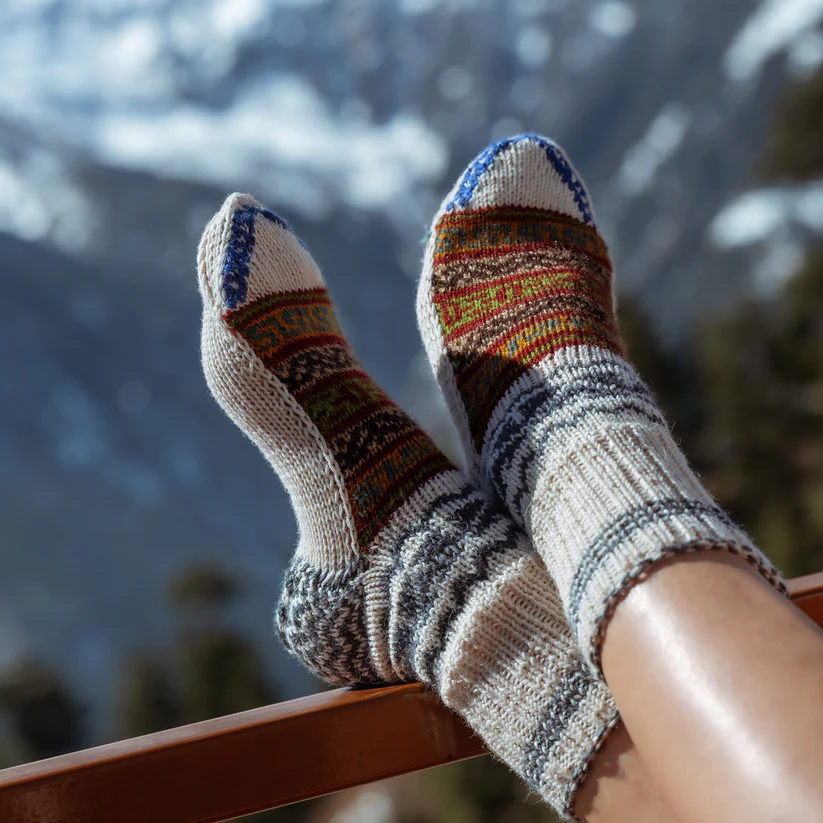
Most conversations about performance clothing focus on outerwear, footwear, or technical layers. Socks rarely make it into that discussion, even though they are the single item of clothing in direct contact with the foot for the entire duration of a workday, hike, or commute. For women who spend long hours on their feet — whether in outdoor environments, physical jobs, or active daily routines — the choice of sock material has real, measurable consequences. Blisters, moisture buildup, temperature swings, and foot fatigue are not abstract concerns. They affect how long someone can stay productive and comfortable before discomfort becomes a problem that demands attention.
Synthetic socks have dominated mainstream retail for years, largely because they are cheaper to produce and easier to market. But cheaper to buy is not the same as better to use. This article examines what separates wool from synthetic across the conditions that matter most, and presents seven of the strongest wool options for women heading into 2025.
Table of Contents
Why Wool Still Holds Its Ground Against Synthetics
When comparing fiber types, the tendency is to focus on individual properties — warmth, durability, moisture management — in isolation. But the real advantage of wool, particularly merino wool, is how those properties work together under real conditions. A sock that wicks moisture but retains odor, or one that insulates but becomes rigid when wet, does not perform well across a full day of variable conditions. Wool addresses multiple problems at once rather than optimizing for a single metric.
The growing interest in wool socks women wear for demanding conditions reflects a shift away from marketing claims and toward material reality. Women in trades, outdoor recreation, and healthcare professions are increasingly choosing wool because synthetic alternatives — despite their lower price point — require more frequent replacement, produce more odor, and offer less adaptability across temperature ranges.
Merino wool, which comes from a specific breed of sheep developed over centuries for fine fiber production, has a significantly finer diameter than standard wool. This makes it comfortable against the skin without the itching or irritation associated with coarser wool grades. Its natural crimp structure gives it elasticity, which means it returns to shape after repeated wear and washing in a way that many synthetic blends do not sustain over time.
The Moisture Problem Synthetics Have Not Solved
Synthetic fibers like polyester and nylon are hydrophobic, meaning they push moisture away from the fiber surface rather than absorbing it. This is often marketed as a benefit, but it creates a specific problem: moisture pooled against the skin or trapped between layers leads to friction, maceration, and — in cold conditions — rapid heat loss as the liquid cools. The sock may feel dry in isolation, but the foot does not experience the same result.
Wool, by contrast, is hygroscopic. It absorbs moisture vapor into its fiber core and holds it there, away from the skin surface. According to fiber research and standards documentation maintained by institutions such as the Woolmark Company, merino wool can absorb up to 35% of its own weight in moisture before it begins to feel wet to the touch. This creates a meaningful buffer during high-output activity, keeping the foot in a more stable microclimate for longer periods.
Temperature Regulation Is Not Just About Warmth
A common misunderstanding is that wool socks are only relevant in cold conditions. In practice, the same hygroscopic property that keeps feet warm in winter also prevents overheating in milder temperatures. As moisture is absorbed, wool releases a small amount of heat through a chemical process called heat of sorption. When conditions reverse and the foot needs to cool down, the evaporation of that stored moisture carries heat away. The result is a fiber that actively participates in thermoregulation rather than simply insulating.
Synthetic fibers do not exhibit this behavior. They remain passive — they neither add nor remove heat through any internal mechanism. A synthetic sock in a warm environment simply traps heat, while a wool sock in the same environment begins to moderate it. This distinction becomes relevant in any situation where activity level or ambient temperature changes throughout the day.
The Seven Wool Sock Options Worth Considering in 2025
The following selections are based on construction quality, fiber composition, and suitability across different use cases. These are not novelty products or seasonal releases — each has demonstrated consistent performance across the conditions women most commonly encounter when they prioritize foot comfort and durability.
1. Full-Cushion Merino for Extended Standing
Designed for women who spend the majority of their workday standing — in healthcare, retail, or food service — this construction uses a dense terry loop on the sole that distributes pressure more evenly across the foot. The cushioning reduces fatigue without adding significant bulk inside a standard shoe.
2. Lightweight Liner Merino for Layering
A thin-profile merino liner works well under heavier socks in cold conditions or as a standalone option in moderate temperatures. The primary purpose is to maintain a dry interface against the skin while a thicker outer layer handles insulation. Women who hike or work in layered clothing systems often find this the most practical solution for variable-temperature days.
3. Mid-Crew Wool for Everyday Wear
The mid-crew height covers the ankle and lower calf without reaching the knee, making it compatible with most boots, work shoes, and casual footwear. This is the most versatile cut for women who want a single option that works across multiple contexts without switching styles throughout the week.
4. Reinforced-Heel Merino for High-Friction Activities
Reinforcement at the heel and toe with a nylon blend extends the lifespan of these socks substantially in situations where friction is unavoidable — hiking, trail running, or jobs that involve repeated movement across hard floors. The reinforcement does not compromise the merino’s thermal or moisture properties in the rest of the sock.
5. Over-the-Calf Wool for Boot Compatibility
Women who regularly wear tall work boots or knee-high outdoor footwear benefit from an over-the-calf cut because it eliminates the bunching and sliding that shorter socks experience inside a high boot. The compression at the top of the sock also provides mild support during extended activity.
6. Merino-Bamboo Blend for Sensitive Skin
Some women find even fine merino mildly irritating, particularly those with reactive or sensitive skin. A merino-bamboo blend addresses this without completely abandoning wool’s natural properties. Bamboo fiber adds a softer hand feel and contributes to moisture management, though it does not replicate the full thermoregulatory behavior of pure merino.
7. Heavyweight Expedition Wool for Cold-Weather Work
For women working in consistently cold environments — outdoor construction, agriculture in winter conditions, or extended backcountry activity — a heavyweight merino construction provides a level of insulation that no thin synthetic alternative can match without adding significant bulk. These socks are not designed for warm conditions but are unmatched when temperatures drop substantially.
Where Synthetic Socks Still Make Sense
A complete picture requires acknowledging where synthetic socks remain a practical choice. In very high-output athletic settings where socks are worn for short durations and laundered immediately after use, the moisture-wicking speed of synthetic fibers can be an advantage. Synthetic socks are also significantly less expensive upfront, making them a practical option when budget constraints are the primary factor.
The difficulty with synthetic socks is not any single failure point but rather the accumulation of small compromises over repeated use. Odor retention, shape loss after washing, and reduced temperature adaptability become more apparent over weeks and months of regular wear. Women who rotate multiple pairs of synthetic socks through high-frequency use often find themselves replacing entire sets more often than they expected when they first made the purchase.
Wool socks carry a higher initial cost, but the cost-per-wear calculation changes significantly when a pair of merino socks lasts three to four times longer than an equivalent synthetic pair. For women who treat their socks as functional equipment rather than disposable accessories, the economics of wool become easier to justify.
Caring for Wool Socks to Preserve Their Performance
The most common reason wool socks degrade prematurely is improper laundering. Wool fiber is protein-based, and it responds poorly to high heat and mechanical agitation. Machine washing on a delicate or wool-specific cycle with cool water is adequate for most merino products. High-spin cycles and hot dryers are the primary causes of shrinkage and felting, which permanently alters the fiber structure and reduces the sock’s effectiveness.
Because merino naturally resists odor — due to the same fiber structure that manages moisture — wool socks for women do not need to be washed after every single use the way synthetic socks typically do. Airing them out between wears is often sufficient for light to moderate activity, which means the total number of wash cycles over a sock’s lifetime is lower than most people expect. Fewer wash cycles at appropriate temperatures extend the functional lifespan considerably.
Conclusion
The case for wool socks — particularly merino — comes down to how the material performs across real conditions rather than controlled lab scenarios. Synthetic socks are built to perform well on specific metrics, but daily life rarely holds a single variable constant. Temperature changes, activity levels shift, and feet are inside footwear for hours at a time. A material that adapts to those changes rather than optimizing for one of them will consistently outperform one that does not.
For women choosing socks based on comfort, durability, and long-term value, merino wool remains the most reliable option in 2025. The variety of constructions now available — from lightweight liners to heavyweight expedition socks — means there is a wool option suited to nearly every context. The higher upfront cost is real, but so is the difference in how the sock performs and how long it lasts. That trade-off, examined honestly, continues to favor wool.
-
-
-
-
-

-