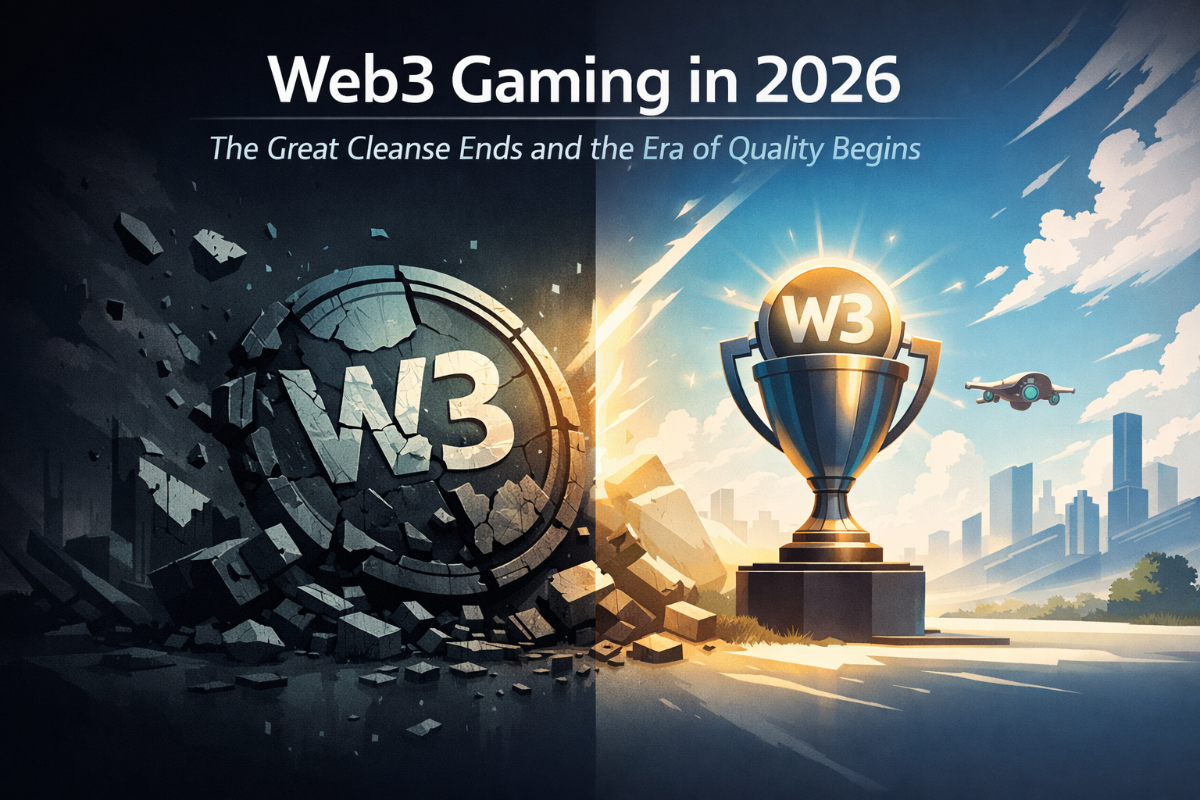
The blockchain gaming industry has undergone a painful but necessary transformation. After the closure of over 300 projects in 2025 and a 93% year-over-year drop in investments, the market has entered a maturity phase where quality gameplay trumps speculative tokenomics. With the market reaching $33.42 billion and daily activity stabilizing at 4.66 million wallets—representing 25% of the entire Web3 ecosystem—the survivors have proven the viability of the “play-and-own” model where blockchain becomes an invisible layer rather than a marketing tool. As Web3 gaming matures and players accumulate crypto rewards from multiple games, the need for unified asset management becomes critical. Platforms like this all in one crypto app are becoming essential for gamers managing portfolios across different blockchains and gaming ecosystems.
Table of Contents
From Hype to Sustainability: What Happened to P2E
The Play-to-Earn era in its classic form has ended. Axie Infinity, once the industry flagship with 2.8 million active players, has contracted to approximately 225,000 DAU. The SLP token collapsed 99% from its all-time high, while AXS trades in the $7-17 range instead of its peak $155. This collapse became a painful lesson for the entire industry: economics built on constant influx of new players inevitably implodes.
2025 will be remembered as “The Great Cleanse.” Ember Sword, Nyan Heroes, Square Enix’s Symbiogenesis, and hundreds of lesser-known projects shut down. 90% of tokens launched last year trade below their listing price. But this painful filtering created space for projects with real value.
The new paradigm—Play-and-Earn—shifts focus from earning to gameplay. Earning remains possible but becomes a pleasant bonus rather than the main reason to play. Realistic expectations for casual players in 2026: $100-500 per monthfrom passive activity (virtual land rental, staking). Hardcore players in top projects like Star Atlas or The Sandbox can earn $500-3,000, but this requires serious time investment and initial capital.
A key 2026 trend is the integration of stablecoins into gaming economies. Projects are moving away from volatile tokens to stable in-game currencies. Sony is considering using stablecoins for the PlayStation ecosystem, and experts predict a 2-3x growth in stablecoin transactions in top Web3 games by year-end.
Top 10 Blockchain Games and Ecosystem Leaders
Despite market turbulence, leading projects show stable growth. The absolute leader by activity is World of Dypians on BNB Chain with approximately 895,000 daily active users and over 3 million monthly. The project has accumulated 135 million active wallets and 390 million on-chain transactions, plus gained an Epic Games Store listing, opening access to 68 million potential players.
Pixels on Ronin takes second place with 500K+ DAU—the farming simulator proved that casual mechanics and social interaction work better than complex P2E schemes. Staking launched in May 2025 added DeFi elements while maintaining entry simplicity.
Gods Unchained on Immutable X demonstrates the sustainability of free-to-play models with optional NFTs. The game held a Pro League with a $250,000 prize pool and maintains 450,000+ registered users. Key advantage: skill-based gameplay where mastery matters more than wallet size.
Among major 2025-2026 releases, Off The Grid by Gunzilla Games stands out—a AAA battle royale with PUBG and Fortnite-level quality, where Web3 elements are optional and don’t affect core gameplay. The July 2025 Steam release attracted a mainstream audience. Axie Infinity is preparing a massive Atia’s Legacy update with guild functionality and land gameplay for Q1 2026. Nexon’s MapleStory Universe launched the Henesys L1 blockchain on Avalanche, attracting the original game’s huge fanbase.
Leading gaming ecosystems:
- Ronin Network: 20M+ wallet downloads, $4.3B+ NFT trading volume. Transition to full Ethereum Layer 2 planned for H1 2026 using Optimism’s OP Stack
- Immutable zkEVM: 500+ games in ecosystem, gas-free transactions via Immutable Passport, ~150 million transactions since launch
- opBNB: Leader in gaming wallet count with 1.05 million daily activity
- Sui: Gaining popularity thanks to parallel transaction processing and dynamic NFTs
NFT Gaming Market and Digital Collectibles State
The NFT market shows recovery signs after prolonged decline. Weekly trading volume in January 2026 reached $126 million—up 112% week-over-week. Gaming NFTs account for 38% of total NFT transaction volume, confirming the tight connection between games and the collectibles segment.
Top gaming-related collection trading leaders:
| Collection | Weekly Volume | Blockchain |
| DMarket | $4.4M (+71%) | Mythos Chain |
| Courtyard | $4M (+71.92%) | Polygon |
| Axie Infinity | $3-4M | Ronin |
| Gods Unchained | $2-3M | Immutable X |
A notable trend is the growth of phygital collections combining physical and digital assets. Marketplaces like Courtyard for tokenized Pokémon TCG collectible cards generate over $1 billion in annual volume. This indicates a new niche: NFTs as digital certificates of ownership for real items.
Dynamic NFTs (dNFTs) are becoming the standard in the gaming sector. Instead of static images, modern gaming NFTs evolve based on player actions—characters gain experience, weapons wear or upgrade, visuals change based on owner achievements. The Sui ecosystem leads this direction thanks to object-based architecture initially optimized for mutable on-chain assets.
Cross-game interoperability remains more promise than reality, but progress is evident: 80+ NFT collections are integrated into Pixels, allowing external NFTs to be used as avatars or decorations. LayerZero and Wormhole process cross-chain transfers worth tens of billions of dollars annually, laying infrastructure for future gaming asset portability.
Technology Revolution: AI, Account Abstraction, and Layer 2
Account Abstraction (ERC-4337) is becoming an industry standard in Q1 2026. The technology transforms crypto wallets into programmable smart contract accounts, eliminating major barriers for new users:
- Gasless transactions: Developers pay fees for players through Paymasters
- Social recovery: Access restoration through trusted contacts instead of seed phrases
- Session keys: Pre-approved transactions for gaming sessions without constant confirmations
- Custom authentication: Login via email, social networks, or biometrics
MetaMask, Phantom, Tonkeeper, and 60+ major Web3 projects have already implemented account abstraction. For gaming, this is critical: a player can start playing via familiar social login and never know that blockchain is under the hood.
AI integration is the second key technology trend. Virtuals Protocol on Base reached a $779 million market cap with 650,000+ token holders. Partnership with Illuvium enables creation of AI-powered NPCs that adapt to specific user playstyles. ElizaOS from ai16z provides open-source tools for creating modular AI agents, already integrated into Discord, Telegram, and gaming environments.
Practical AI applications in Web3 gaming:
- Dynamic NPCs reacting to player behavior and “learning” over time
- Procedural content generation—quests, environments, dialogues
- Automatic game economy balancing based on on-chain data
- Anti-bot systems for exploit protection
Layer 2 solutions continue evolving. Polygon acquired Sequence (gaming infrastructure) for ~$125M+ in January 2026, consolidating developer tools. Immutable is merging X and zkEVM into a unified “Immutable Chain” with gas-free transactions. SKALE Network saved users $8.5 billion in fees thanks to its zero-gas model. Arbitrum deployed a $200M fund for gaming projects and is attracting Ronin Network with sub-second block proposals.
Guild Economics and New Monetization Models
Gaming guilds have transformed from scholarship programs into infrastructure providers. Yield Guild Games (YGG)completed its Guild Advancement Program and launched YGG Play—a platform with 25,000+ players and $4.5M revenue. The YGG token trades around ~$0.065, losing over 93% from its all-time high of $10.37, but the organization shifted focus to long-term infrastructure: YGG Guild Protocol provides tools to other guilds, while Play Launchpad onboards casual Web3 games.
Merit Circle completely transformed into Beam—a gaming-focused blockchain on Avalanche subnet. MC → BEAM token migration occurred (1:100 ratio), 2 billion BEAM burned, 58,000+ Beam Node Tokens created. The Beam ecosystem includes 60+ partner games and plans to launch Beam Ventures with $150M and an accelerator in Abu Dhabi.
Dual-token models remain standard for sustainable economics: governance token for voting and utility token for in-game operations. Axie (AXS + SLP), Illuvium (ILV + sILV), Nyan Heroes ($NYN + $CTNP) demonstrate this approach. However, regulatory risks are growing: MiCA in the EU by Q3 2026 could lead to mass delisting of governance tokens from European exchanges.
Web3 gaming investments hit bottom in Q2 2025 ($73 million—a two-year low, down 93% year-over-year) but began recovering: Q3 brought $129 million. Major rounds include CCP Games (EVE Frontier)—$40M from a16z, SuperGaming—$15M Series B, Shrapnel—over $50M total. Investor focus shifted from game tokens to gaming infrastructure: Layer 2 solutions, developer SDKs, account abstraction tools.
Barriers, Risks, and How to Avoid Scams
Despite technological progress, 53.9% of developers still cite onboarding as the main problem (BGA 2024 data). The need to create a wallet, store seed phrases, and understand gas fees scares away mainstream audiences. The “invisible wallets” solution with email/social authorization (Magic, Sequence, Immutable Passport) is being widely implemented, but complete friction elimination will take another 1-2 years.
Scams remain a serious threat. In July 2025, a network of 1,200+ fake gaming sites was discovered promising $2,500 bonuses and requiring a $100 “verification deposit.” The 2021 Squid Game Token rug pull stole $3.3M—and similar schemes continue to appear.
Red flags for identifying scams:
- Anonymous team without verified LinkedIn profiles or video presence
- Aggressive marketing with buzzwords (“revolutionary DeFi gaming ecosystem”)
- Guaranteed returns without risk disclosure
- Requests to connect wallets with broad permissions on unknown sites
- Recently created domain (check via archive.org)
- Absence of public smart contract audits
For protection, use hardware wallets for main funds, verify smart contracts via blockchain explorer, and never make “verification deposits”—legitimate platforms don’t require them.
The regulatory landscape is stabilizing. MiCA in the EU fully came into force on December 30, 2024, with a transition period until July 2026. In the US, the GENIUS Act was signed (July 18, 2025)—the first federal crypto law creating a framework for stablecoins. The SEC dropped cases against Coinbase and Binance. Singapore, Hong Kong, and Japan remain the most favorable jurisdictions for Web3 gaming.
AAA Studios and Mainstream: Cautious Integration
Major publishers continue experiments despite backlash from core gaming audiences. Ubisoft launched Champions Tactics: Grimoria Chronicles in December 2024 and announced Might & Magic: Fates in April 2025—a mobile card game with Immutable where Web3 elements are optional. The company’s strategy spans 5-10 years: from dedicated Web3 projects to mainstream appeal and finally integration into flagship IPs.
Square Enix created a Blockchain Entertainment Business Division and sold the Tomb Raider IP to finance blockchain/AI R&D. Sega remains a node validator on Oasys despite rumors of exiting Web3. 29 of the 40 largest gaming companies invest in blockchain initiatives according to CoinGecko data.
The key lesson for AAA: blockchain must be invisible. Mainstream gamers reject explicit NFT integrations as “cash grabs” but accept digital ownership when it improves gameplay without imposing crypto terminology. Off The Grid by Gunzilla demonstrates the right approach: quality AAA shooter where you can play completely free, with Web3 functionality available to those interested.
2026-2027 Forecast: What Awaits the Industry
Expert consensus: Web3 gaming is at a critical transition point from speculative phase to mature industry. Market forecasts range from $65 billion (MarketsandMarkets) to $301 billion (Grand View Research) by 2030 with a 69.4% CAGR. More conservative estimates place it at $35.2 billion by 2030 with 19.6% CAGR.
Key trends for the next 18 months:
Blockchain becomes “invisible.” Users won’t know they’re playing a Web3 game—authentication via familiar methods, no gas fees, automatic wallet creation in the background.
AI + Blockchain convergence. AI agents will manage on-chain assets, create personalized content, and provide “intelligent” NPCs that evolve over time.
Mobile-first dominance. 50%+ of the metaverse gaming market comes from mobile platforms. Telegram integrations via TON ecosystem open access to 950 million potential users.
Cross-game interoperability. NFT assets will become portable between games in the same ecosystem. 30% of dApps may work cross-chain by default by end of 2026.
Indie renaissance. 70% of active Web3 gamers by end of 2026 will be in indie projects. Low budgets ($500K vs $50M for AAA), flexibility, and absence of corporate backlash make indie studios innovation drivers.
Conclusion: Time to Build, Not Speculate
Web3 gaming has gone through the necessary pain of consolidation. Speculative projects built on hype and empty earning promises are gone—teams remain focused on quality gameplay and sustainable economics. Technologies have matured: account abstraction eliminates entry barriers, Layer 2 solutions provide scalability, AI opens new content creation possibilities.
For players, this means higher quality products with real digital ownership, without needing to understand crypto terminology. For investors—shifting focus to infrastructure plays and projects with proven retention metrics instead of speculating on new tokens. For developers—the need to prioritize “fun first,” where blockchain is an invisible tool, not a marketing slogan.
An industry with potential for $65-300 billion by decade’s end is at the beginning of its mature phase. Time to build, not speculate.
-

-

-
-

-
-