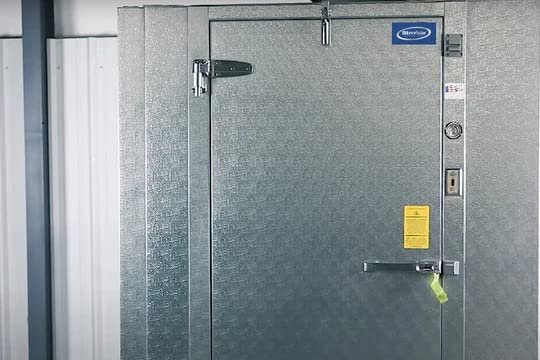
Walk-in cooler doors are among the most mechanically stressed components in any cold storage environment. They open and close dozens of times per day in commercial kitchens, grocery distribution centers, food processing facilities, and restaurant supply operations. Over time, the cumulative wear on seals, hinges, frames, and panels compromises the door’s ability to hold temperature — and that degradation rarely announces itself clearly before it starts costing money.
The challenge for operators is not identifying that a door is failing. Most facility managers can see the signs: frosting along the frame, condensation pooling on the floor, motors running longer than usual, or staff reporting that the door no longer latches cleanly. The real challenge is quantifying what the delay costs, and understanding why the instinct to “wait and see” consistently produces worse outcomes than the decision to act early.
This breakdown addresses that gap. It draws on patterns observed across US food service and cold storage operations to explain what actually happens — operationally and financially — when door replacement is deferred past the point of early intervention.
Table of Contents
What Operators Are Actually Deferring When They Delay Door Replacement
When a walk-in cooler door begins to fail, the decision to delay replacement is rarely about ignoring the problem. It is usually framed as a budget decision, a timing decision, or a prioritization decision. The door still opens. Product is still being stored. Nothing has broken catastrophically. From that perspective, deferral seems rational.
But what operators are actually deferring is the point at which the system stops compensating for the door’s inefficiency. A degraded door does not stop working overnight — it creates a slow, cumulative drag on refrigeration performance that the compressor and evaporator unit absorb by running longer and harder. The door is no longer failing in isolation. It is causing the entire refrigeration system to work against itself.
For operators researching replacement walk in cooler doors, the decision point is rarely whether to replace — it is how long a delay is acceptable before secondary damage accelerates the cost. Industry data consistently shows that operators who defer replacement by more than one full operating cycle past identified failure signs spend significantly more on compressor service, refrigerant top-ups, and emergency labor than the cost of early-stage door replacement.
Understanding this pattern requires looking at what happens inside the system during the delay period — not just at the door itself.
The Compressor Burden Created by a Failing Door
A walk-in cooler door in good condition maintains a sealed thermal barrier between the conditioned interior and the ambient environment outside. When that seal begins to break down — through warped gaskets, deteriorating panel insulation, misaligned frames, or damaged closing mechanisms — warm air enters the cooler continuously rather than only during intentional access.
The refrigeration system reads this as an ongoing thermal load and responds by running the compressor more frequently and for longer durations. This is the first measurable cost of a failing door: elevated compressor runtime that increases electricity consumption and accelerates mechanical wear on components that are designed for intermittent, load-responsive operation, not sustained high-cycle demand.
Over weeks and months, this elevated demand contributes to compressor overheating, premature bearing failure, and in some cases, refrigerant loss due to stress on the system’s pressure management components. These are not theoretical risks. They are documented maintenance patterns in facilities where door replacement was deferred after signs of seal failure were first observed.
Energy Consumption as a Measurable Indicator
One of the most practical ways to identify when a walk-in door has moved from normal wear into active system degradation is to monitor utility consumption over time. Facilities that track energy use at the equipment level will often see a gradual but consistent rise in cooler-specific electricity draw that correlates with the deterioration timeline of the door’s thermal seal.
This consumption increase is not dramatic in the early stages, which is part of why it is easy to overlook. But when calculated across a full billing cycle, the additional cost becomes significant — and it continues to grow as the seal degrades further. Operators who compare their utility bills against industry benchmarks for similarly sized cold storage units often find that a failing door accounts for a measurable portion of the gap between their actual consumption and what an efficient system should require.
Product Safety Risk and Regulatory Exposure
Beyond the mechanical and energy costs, a failing walk-in cooler door introduces food safety risk that carries its own category of financial consequence. The US Food and Drug Administration’s Food Safety Modernization Act establishes clear temperature control requirements for food storage, and facilities operating under FSMA compliance frameworks are expected to maintain consistent cold chain integrity throughout their operations.
A door that cannot hold temperature reliably creates intervals — sometimes brief, sometimes extended — during which internal temperatures drift above safe holding ranges. These intervals may not be caught immediately if temperature monitoring is not continuous or if logging is done manually at fixed intervals. The gap between when a temperature deviation occurs and when it is detected is where product loss and regulatory exposure accumulate.
The Compound Cost of a Single Temperature Excursion
When a temperature excursion is identified — whether through internal monitoring, a staff observation, or an external inspection — the resulting response involves multiple cost categories simultaneously. Product may need to be evaluated, quarantined, or discarded depending on the duration and severity of the deviation. Documentation must be updated. In regulated environments, incidents may need to be reported or made available for audit review.
If the excursion is attributed to equipment failure rather than procedural error, the facility may face pressure to demonstrate corrective action. A door that was already known to be deteriorating becomes a liability in this context, because the question shifts from “what happened” to “why was a known deficiency left unaddressed.” That distinction matters significantly in regulatory and insurance conversations.
Insurance and Liability Considerations That Often Go Unaccounted
Commercial cold storage facilities carry product liability coverage that typically includes coverage for spoilage resulting from equipment failure. However, most policies include provisions that exclude coverage when failure results from deferred maintenance or known pre-existing conditions that were not addressed in a timely manner.
Operators who have documented that a door was failing — through maintenance logs, temperature alarms, or technician notes — and then experienced a product loss event may find that their coverage is limited or contested based on the timeline of the failure relative to when corrective action was taken. This is not a hypothetical scenario. It is a documented pattern in commercial food storage claims, and it represents a category of financial exposure that is entirely avoidable with earlier intervention.
Staff Behavior and Operational Friction as Hidden Costs
Walk-in cooler doors that malfunction change how staff interact with the space, and those behavioral adaptations carry their own operational cost. When a door is difficult to close, does not seal properly, or requires extra effort to operate, staff begin to work around it rather than through it. These workarounds are often invisible to management until they become embedded in daily practice.
Common adaptations include propping the door open during heavy use periods, reducing the frequency of cooler access to avoid dealing with the door, or routing product differently to minimize how often the failing door needs to be used. Each of these changes introduces inefficiency into workflows that were designed around a functioning door — and some of them introduce additional temperature management problems that compound the original issue.
Workflow Disruption During Emergency Replacement
Operators who defer replacement until the door fails completely face a significantly more disruptive replacement process than those who schedule the work proactively. Emergency replacement involves sourcing a compatible door on short notice, coordinating installation around existing operational schedules with less lead time, and managing the transition without the ability to pre-position product or adjust staffing.
In contrast, planned replacement walk in cooler doors projects allow facilities to schedule installation during low-volume periods, communicate timing to staff in advance, and manage product inventory levels to reduce the amount of stored goods affected during the brief installation window. The operational difference between these two scenarios is significant, and it is entirely determined by when the replacement decision is made relative to when the failure was first identified.
The Compounding Math of Delayed Action
The costs outlined here do not operate in sequence — they operate simultaneously. A facility deferring door replacement for six months may be absorbing elevated energy costs, accelerated compressor wear, increased product risk, reduced staff efficiency, and potential insurance exposure all at once. Each of these costs is smaller than the cost of replacement in isolation, but their sum across a delay period routinely exceeds the replacement cost by a material margin.
This is the core finding that challenges the intuitive logic of deferral. Operators assume that delaying a capital expenditure saves money in the short term. In most cases with walk-in cooler doors, it does not — because the system does not hold steady while the decision is being deferred. It continues to degrade, and the degradation compounds.
Why Early-Stage Replacement Has a Better Cost Profile
When replacement is initiated at the first signs of meaningful deterioration — rather than at the point of complete failure — several cost categories are either reduced or eliminated entirely. The compressor has not yet sustained stress-related wear. Product has not been exposed to sustained temperature variance. Staff workflows have not been reorganized around a broken door. The replacement is scheduled, not reactive.
Sourcing replacement walk in cooler doors through established supply channels also becomes less constrained when there is lead time available. Operators can compare options, ensure compatibility with existing frames and hardware configurations, and schedule installation at a time that minimizes operational disruption. None of these advantages are available when the door has already failed and the facility is operating in emergency mode.
Closing Perspective: The Decision That Determines the Cost
The financial case for timely walk-in cooler door replacement is not built on dramatic failure scenarios. It is built on the quiet, consistent accumulation of costs that occur when a degrading door is left in place past the point where early intervention would have been both less expensive and less disruptive.
US operators managing commercial cold storage at any scale — from single-unit restaurant coolers to multi-door distribution environments — benefit from treating walk-in cooler doors as active components with a defined service life rather than as fixed infrastructure. The signs of deterioration are observable. The cost of delay is calculable. And the decision to act at the right stage of the failure curve, rather than at the end of it, consistently produces better outcomes across every cost category that matters to a facility’s bottom line.
The data does not support waiting. It supports early, scheduled, informed action — and that distinction is what separates operators who manage cold storage costs effectively from those who consistently absorb them.
-
-

-

-
-
-