Picture this: you’ve loaded your bike’s rear rack with groceries, swung a pannier over the side, and now you’re standing there, one leg awkwardly suspended in the air, trying to clear a frame that suddenly feels like a hurdle. It’s an all-too-familiar struggle for anyone who relies on a traditional bicycle for daily errands, deliveries, or family transport. Add cargo weight into the equation, and what should be a simple mount becomes a genuine balancing act — sometimes a dangerous one.
Step-through e-bikes are rewriting that experience entirely. By eliminating the high top tube that defines conventional bicycle design, these bikes let riders simply walk forward and sit down, no gymnastics required. For utility users — whether you’re a city commuter hauling work supplies, a parent managing school runs, or a small business owner making local deliveries — this design shift is nothing short of transformative.
This article digs into why step-through e-bikes have become the go-to choice for cargo-focused riders. We’ll explore their structural advantages, examine how robust frames handle demanding loads, and walk through practical steps to configure your bike for maximum utility. At the heart of it all is one central challenge: finding a ride that balances genuine carrying capacity with effortless, everyday comfort.
Table of Contents
Understanding Step-Through E-Bikes: A Foundation for Utility
The step-through e-bike isn’t a new invention — its roots trace back to the classic “ladies’ bicycle” of the late 19th century, designed to accommodate long skirts and allow graceful mounting without straddling a high frame. What’s changed is the context. Today, that same low or absent top tube has been reimagined as a practical asset for anyone prioritizing function over form, regardless of gender or age.
At its core, a step-through e-bike features a frame geometry where the top tube is dramatically lowered or removed entirely, creating an open space between the handlebars and seat. Riders simply step forward into the frame and sit down — no leg-lifting, no balancing act. Add an electric motor to that equation, and you get a machine that handles hills, headwinds, and heavy loads with minimal physical effort from the rider.
This design resonates strongly with utility-focused cyclists. Whether you’re making multiple delivery stops throughout the day, loading up after a farmers’ market run, or simply navigating a busy urban environment with a bag on each shoulder, the step-through e-bike removes friction from every interaction with your ride. The growing popularity of the step-through e-bike reflects a broader shift in how people think about cycling — less as sport, more as practical, everyday transportation that should work as smoothly as possible for the widest range of people.
The Cargo Advantage: Why Step-Through E-Bikes Excel in Utility
For anyone using a bicycle as a genuine workhorse, carry capacity isn’t a bonus feature — it’s the whole point. A bike that can handle a week’s worth of groceries, a stack of delivery parcels, or a child’s school bag alongside your own commuter gear transforms from a leisure item into essential infrastructure. This is where cargo step-through e-bikes carve out a distinct category of their own, purpose-built for the demands of real-world utility rather than weekend recreation.

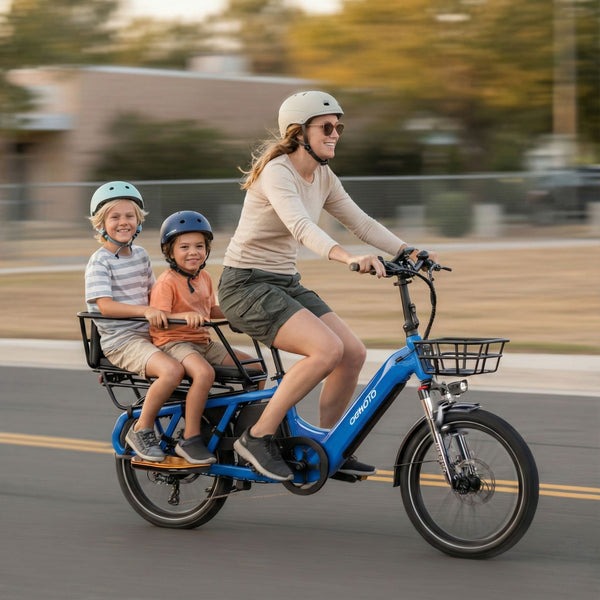
What separates these bikes from standard e-bikes is a deliberate engineering focus on load management. Manufacturers reinforce the rear triangle and chainstays to handle rear rack payloads that can reach 50 to 100 pounds on premium models. Front racks add further capacity without creating the handling instability you’d expect, because the low center of gravity inherent in step-through geometry actually works in the rider’s favor when weight is distributed across the frame. The result is a surprisingly stable ride even when fully loaded.
Integrated mounting points are another hallmark of well-designed cargo step-through e-bikes. Rather than retrofitting standard accessories onto a frame that wasn’t designed for them, these bikes ship with purpose-built attachment systems for panniers, cargo nets, and platform racks. This integration matters because improvised solutions shift weight unpredictably, while factory-designed systems keep loads centered and secure. Brands like Cemotobike have built their cargo-focused lineup around exactly this principle — pairing purpose-engineered mounting systems with motors sized to handle real utility loads. Pair that with a mid-drive or rear-hub motor that compensates for the added resistance of a heavy load, and you have a machine that genuinely earns its place in daily utility cycling.
Maximizing Carry Capacity: Practical Features and Accessories
Expanding your cargo footprint starts with understanding what your bike’s frame was designed to accept. Front baskets mounted low on a sturdy fork add accessible storage without raising the center of gravity. Ortlieb-style waterproof panniers clip onto rear racks and protect contents through any weather. For families, certified child seats bolt directly to reinforced rear platforms, while a trailer hitch attachment — available on many cargo-focused models — lets you tow an additional 100-plus pounds when the occasion demands it. These additions collectively turn a single bike into a genuinely versatile daily transport solution.
Robust Frames: Engineering for Durability and Load-Bearing
A step-through e-bike’s accessibility means nothing if the frame buckles under real-world demands. This is why frame engineering sits at the center of any serious conversation about utility e-bikes — and why the best cargo-focused models are built to standards far beyond what recreational cycling requires.
Most quality step-through e-bikes use either aluminum alloy or chromoly steel as their primary frame material, and each brings distinct trade-offs. Aluminum alloy — specifically 6061 or 7005 grades — delivers an excellent strength-to-weight ratio, resisting corrosion while keeping the overall bike light enough to maneuver in tight urban spaces. Chromoly steel, by contrast, offers superior flex resistance and absorbs road vibration more naturally, making it the preferred choice for riders who prioritize ride feel and long-term fatigue resistance over weight savings. Some premium manufacturers layer in hydroforming techniques, shaping tubes into complex profiles that add structural rigidity precisely where load stress concentrates — around the bottom bracket, rear dropouts, and rack mounts.
The absence of a top tube in step-through geometry raises a legitimate engineering question: without that structural member, how does the frame maintain rigidity under load? The answer lies in reinforced down tubes, oversized head tubes, and strategically gusseted joints that redirect stress through alternative load paths. Well-engineered frames compensate fully for the missing top tube, achieving torsional stiffness that matches or exceeds traditional diamond-frame designs. For riders carrying 50 to 80 pounds of cargo regularly, this structural integrity isn’t just a comfort — it’s a safety requirement that separates purpose-built utility frames from entry-level alternatives.
Ease of Access and Comfort: The Step-Through Design in Action
Consider a postal worker making forty delivery stops in a single shift, or a parent dropping off two kids at different schools before heading to work. Every mount and dismount adds up — and with a loaded bike, each one carries real risk. The step-through frame eliminates that friction entirely. There’s no leg-swinging, no awkward hop, no moment of imbalance while a heavy rear rack shifts your center of gravity. You simply step forward and sit down, then step off when you arrive. For utility e-bikes, this isn’t a stylistic choice — it’s a functional necessity.
The ergonomic benefits extend well beyond mounting. Step-through geometry naturally encourages a more upright riding position, which reduces strain on the lower back, shoulders, and wrists during longer hauls. Riders carrying front baskets can see their cargo clearly without hunching forward. The lower standover height also means confident footing at traffic stops — particularly valuable when a loaded bike demands a firm, stable pause before moving again. Older riders, those recovering from injury, or anyone with limited hip flexibility find this design removes barriers that would otherwise make utility cycling impractical.
Real-world scenarios consistently validate the design. Food delivery riders report faster stop-to-stop times when mounting requires zero effort. Farmers’ market regulars note that stepping off a loaded bike onto uneven ground feels dramatically safer than swinging a leg over a packed rear rack. In dense urban environments where frequent stops are unavoidable, that cumulative ease translates directly into less fatigue and a more sustainable daily routine.
Practical Solutions: Implementing Your Step-Through E-Bike for Cargo Needs
Owning the right bike is only half the equation — putting it to work effectively requires a deliberate approach. Follow these four steps to get the most from your step-through e-bike as a genuine utility vehicle.
Step 1: Assess your cargo requirements. Before anything else, calculate what you’ll actually carry. Grocery runs typically involve 20 to 40 pounds of shifting, irregularly shaped loads. Delivery work demands secure, weather-resistant storage for parcels of varying sizes. Family transport adds child seat weight plus school bags. Write down your heaviest realistic load, your most frequent route distance, and whether you’ll need waterproofing — these numbers directly determine which bike specifications matter most to you.
Step 2: Select the right model based on capacity and frame. Match your assessed load to a bike’s stated payload rating, which should appear on the manufacturer’s spec sheet for both the rear rack and total system. Prioritize models with reinforced rear triangles if you’re regularly hitting the upper end of that range. Motor placement matters too — mid-drive motors handle steep grades with heavy loads more efficiently than hub motors, making them the smarter choice for hilly urban terrain.
Step 3: Customize with purpose-built accessories. Resist generic add-ons. Choose rack systems rated for your specific load weight, clip-on panniers designed for your rack standard, and lighting solutions integrated into the frame rather than clamped on. Cargo nets with anchor points keep loose items stable over rough pavement.
Step 4: Maintain for sustained performance. Inspect tire pressure weekly — underinflated tires under heavy loads wear unevenly and increase rolling resistance dramatically. Clean and lubricate the drivetrain every 150 to 200 miles of loaded riding, and check rack mounting bolts monthly for loosening caused by vibration. Battery care is equally critical: avoid full discharge cycles and store the bike in temperatures above freezing to preserve long-term range. These habits keep a utility e-bike performing reliably for years rather than months.
Choosing the Right Step-Through E-Bike: A Buyer’s Guide
With a growing market of options, narrowing down the right step-through e-bike for cargo use requires evaluating a handful of criteria that directly affect daily performance. Start with carry capacity: check the manufacturer’s stated payload rating for both the rear rack and the total system weight limit, not just the frame. A bike rated for 300 pounds total system weight gives you meaningful headroom when you factor in your own weight plus a fully loaded rear rack.
Motor power and placement deserve equal attention. A 500W to 750W motor handles urban cargo loads comfortably, while anything below 350W may struggle on inclines with a heavy load. Mid-drive motors distribute weight centrally and manage steep grades more efficiently; rear-hub motors are quieter and lower-maintenance for flat-terrain commuters. Battery range matters too — aim for a minimum of 40 miles per charge under load, understanding that cargo weight and hills will reduce that figure from the advertised maximum.
Frame robustness should be verified, not assumed. Look for reinforced rear triangles, integrated rack mounts rated to your target load, and welded gussets at high-stress joints. Before committing, a test ride fully loaded — even with a weighted bag — reveals handling quirks that spec sheets never will. Finally, balance your budget against long-term value: a purpose-built cargo step-through e-bike at a higher upfront cost typically outperforms a cheaper general-purpose model that’s been accessorized to compensate, both in durability and in the riding experience it delivers every single day.
The Case for Step-Through E-Bikes in Everyday Utility Cycling
Step-through e-bikes represent more than a design preference — they’re a practical answer to the real demands of utility cycling. From the effortless mount-and-dismount that makes forty delivery stops feel manageable, to the reinforced frames and integrated rack systems that handle serious cargo loads without compromising stability, these bikes deliver where conventional designs fall short. The combination of accessible geometry, robust engineering, and electric assist creates something genuinely useful: a daily transport tool that works as hard as you do, without fighting you in the process.
For utility users — commuters, delivery riders, parents, and small business owners — the step-through e-bike removes the friction that turns cycling into a chore. Configure it correctly, maintain it consistently, and choose a model matched to your actual load requirements, and you have infrastructure that replaces car trips, reduces physical strain, and scales to whatever your day demands.
Urban mobility is shifting. As cities grow denser and the cost of car ownership climbs, purpose-built utility cycling solutions are moving from niche to mainstream. The step-through e-bike sits at the center of that shift — practical, inclusive, and ready for whatever you need to carry. If you haven’t yet explored this category seriously, the evidence is clear: it’s worth the ride.
-

-

-

-

-

-