Most procurement decisions around pallets are made quickly and on price alone. When a warehouse manager or operations supervisor needs pallets, the default move is to find whatever is available at the lowest cost per unit. This approach makes sense on paper, but it regularly produces consequences that do not show up until weeks or months later — during a product recall, a shipping claim, or an internal audit of damaged inventory.
Pennsylvania has a dense and diverse industrial base. From food processors in Lancaster County to manufacturers in the Pittsburgh corridor and distributors serving the Port of Philadelphia, businesses across the state rely on pallets every day. The pallet is often treated as a commodity, something interchangeable and unimportant. What many operations discover — sometimes at significant expense — is that the choice of pallet type directly affects workflow, product safety, compliance standing, and long-term costs in ways that were never anticipated when the original purchase order was signed.
Table of Contents
Why Generic Pallets Create Operational Risk That Accumulates Quietly
When businesses source new custom wood pallets in pa, they are making a decision that accounts for their specific load types, storage conditions, and handling requirements. Generic pallets, by contrast, are built to a general standard that does not reflect any particular application. They are sized and constructed for average conditions, which means they perform acceptably in many situations and poorly in the ones that matter most.
The risk is not always visible immediately. A standard pallet may hold a load adequately for the first few cycles before stress fractures begin to form. It may fit a racking system well enough until a load shift creates instability. Over time, the cumulative effect of marginal fit and inconsistent construction leads to failures that are difficult to trace back to their origin. By the time a business identifies pallets as the source of a problem, the losses from damaged goods, downtime, and labor inefficiency have already compounded.
The Mismatch Between Standard Dimensions and Real-World Applications
Standard pallet dimensions exist because they accommodate the most common shipping configurations in general commerce. They are not designed around the actual dimensions of any specific product, crate, or container. When a product footprint does not align well with a standard pallet, the result is overhang, unstable stacking, and increased packaging waste as businesses compensate with additional wrapping or bracing.
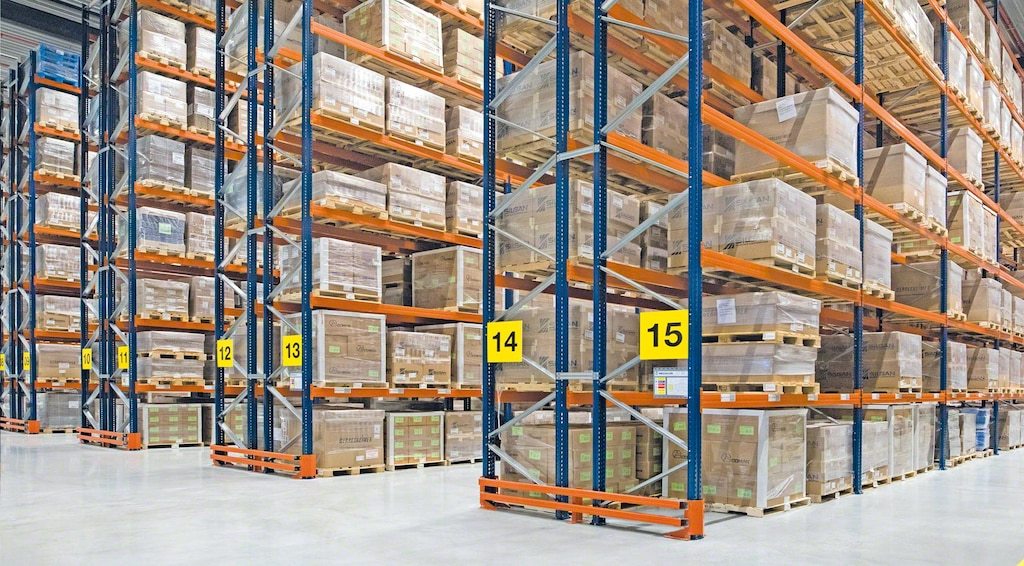
In racked storage environments, this mismatch is more serious. Pallet racks are designed with specific load tolerances and beam spacing. When a pallet extends beyond its beam supports or sits unevenly across them, structural stress on both the pallet and the rack increases. This is not a theoretical concern — it is a documented cause of racking collapse that occurs regularly in warehouses across the country. The cost of a racking failure includes not just the damaged goods and equipment, but also injury liability, regulatory review, and the operational disruption of shutting down a portion of the warehouse for inspection and repair.
Inconsistent Construction Introduces Variability That Automation Cannot Tolerate
Many Pennsylvania operations have invested in some level of automated or semi-automated material handling. Conveyor systems, stretch wrappers, and pallet jacks with guided pathways all depend on consistent pallet geometry. When generic pallets vary in height, deck board spacing, or structural integrity from one unit to the next, those systems either jam, misread, or require repeated manual intervention to function correctly.
This is a cost that rarely gets attributed to the pallet purchase. It shows up as maintenance labor, reduced throughput, and unexplained downtime. When operations teams investigate these issues, the root cause is often traced to inconsistent pallet dimensions or weak boards that shift under load during automated handling. The pallets themselves were never evaluated as a variable because they were assumed to be uniform.
Compliance and Industry Standards That Generic Pallets Often Fail to Meet
Pallet compliance is not a single standard. It varies by industry, by customer requirement, and by the type of goods being handled. Food and beverage operations, pharmaceutical distributors, and exporters all face different requirements around wood treatment, construction, and documentation. Generic pallets sourced from commodity suppliers frequently lack the traceability or certification needed to satisfy these requirements.
The International Plant Protection Convention, which governs the movement of wood packaging materials across international borders, requires that wood pallets used in export shipments be heat-treated or fumigated and marked accordingly under what is known as ISPM 15 standards. A business that sources untreated or improperly marked pallets and ships internationally faces rejected shipments, quarantine delays, and potential fines from customs authorities. These are not edge-case scenarios. They are routine compliance failures that occur when pallet procurement is treated as a low-priority purchasing decision.
Customer and Retailer Requirements That Override General Standards
Beyond regulatory compliance, many large retailers and distribution partners impose their own pallet specifications. These requirements cover dimensions, wood species, stringer configuration, and maximum moisture content. A supplier that consistently delivers product on pallets that do not meet a retailer’s specifications risks chargebacks, refused shipments, and ultimately the loss of that customer relationship.
These requirements are often buried in vendor compliance manuals that procurement teams reviewed at onboarding and have not revisited since. When a shipment is rejected or a chargeback notice arrives, the reaction is typically to investigate packaging, labeling, or scheduling. The pallet is rarely the first place anyone looks. By the time the issue is identified, the business has absorbed the chargeback, strained a customer relationship, and may have sent multiple non-compliant shipments before anyone caught the pattern.
The True Cost Calculation That Most Businesses Skip
Price-per-unit is the dominant metric in pallet procurement. It is the number that appears on the invoice and the one that purchasing departments report against their budget. It is also the least complete way to evaluate pallet cost over the full cycle of use. The actual cost of a pallet includes what it costs to handle, repair, replace, and work around its limitations across its entire service life.
Generic pallets typically have a shorter usable life than pallets built to meet specific load and handling conditions. They break down faster, require more frequent replacement, and generate more waste that must be managed or disposed of. In operations that run pallets through multiple cycles — receiving, storage, shipping, return — the frequency of replacement adds up to a significantly higher annual cost than the per-unit price would suggest.
Labor Costs Tied to Pallet Failure and Workaround Activity
Every broken pallet on a receiving dock or in a storage bay requires someone to deal with it. That may mean transferring the load to a replacement pallet, disposing of the damaged unit, or filing documentation for a damage claim. None of this activity is planned, and all of it pulls labor away from productive work.
In operations where pallet failures are common, workers develop informal workarounds. They learn to check pallets before loading them onto racks. They keep a stock of replacement pallets in reserve. They route around sections of racking they consider unreliable. These adaptations become invisible costs embedded in daily operations, accepted as normal when they are actually symptoms of a recurring procurement problem that has never been addressed directly.
When Businesses in Pennsylvania Switch to Custom-Built Pallets
The decision to source new custom wood pallets in pa typically follows a specific kind of event. It may be a significant product damage claim, a rejected export shipment, a racking inspection that reveals structural stress, or a new customer contract with explicit pallet specifications. In most cases, businesses do not proactively evaluate their pallet choices against their actual operational requirements. They wait until something fails.
When that switch does happen, the improvements are rarely dramatic in isolation. Custom-built pallets do not transform an operation overnight. What they do is remove a persistent source of friction, inconsistency, and avoidable cost. Load integrity improves because the pallet fits the product. Racking stability improves because the pallet fits the storage system. Automated handling runs more smoothly because pallet geometry is consistent from unit to unit. These are incremental gains, but they accumulate over time in the same way that pallet failures did — quietly, and in ways that eventually become significant.
Businesses that source new custom wood pallets in pa also gain better control over their compliance documentation. When pallets are built to specification and supplied with consistent certification, the compliance conversation with customers and regulators becomes straightforward rather than reactive. The traceability that custom sourcing provides is itself a form of operational protection that generic pallet procurement cannot offer.
Closing Thoughts
Generic pallets are not inherently bad products. They serve a legitimate purpose in low-stakes, short-cycle applications where load type, storage conditions, and compliance requirements are minimal. The problem arises when they are treated as an acceptable default across all applications, regardless of what those applications actually demand.
For Pennsylvania businesses operating in regulated industries, automated facilities, or demanding distribution networks, the pallet is not a trivial input. It is a structural component of the supply chain that influences product safety, operational efficiency, and customer relationships. The cost of getting that choice wrong does not appear on a single invoice. It accumulates across damage claims, compliance failures, labor inefficiencies, and customer chargebacks over months and years.
Understanding what new custom wood pallets in pa actually provide — and what generic alternatives cost in practice — is the kind of operational clarity that most businesses arrive at only after absorbing losses they did not anticipate. The more useful time to reach that clarity is before the first shipment is rejected, not after. The decision about which pallets to source is ultimately a decision about how much variability and risk an operation is willing to absorb in one of its most foundational logistics inputs.
-
-
-

-

-

-