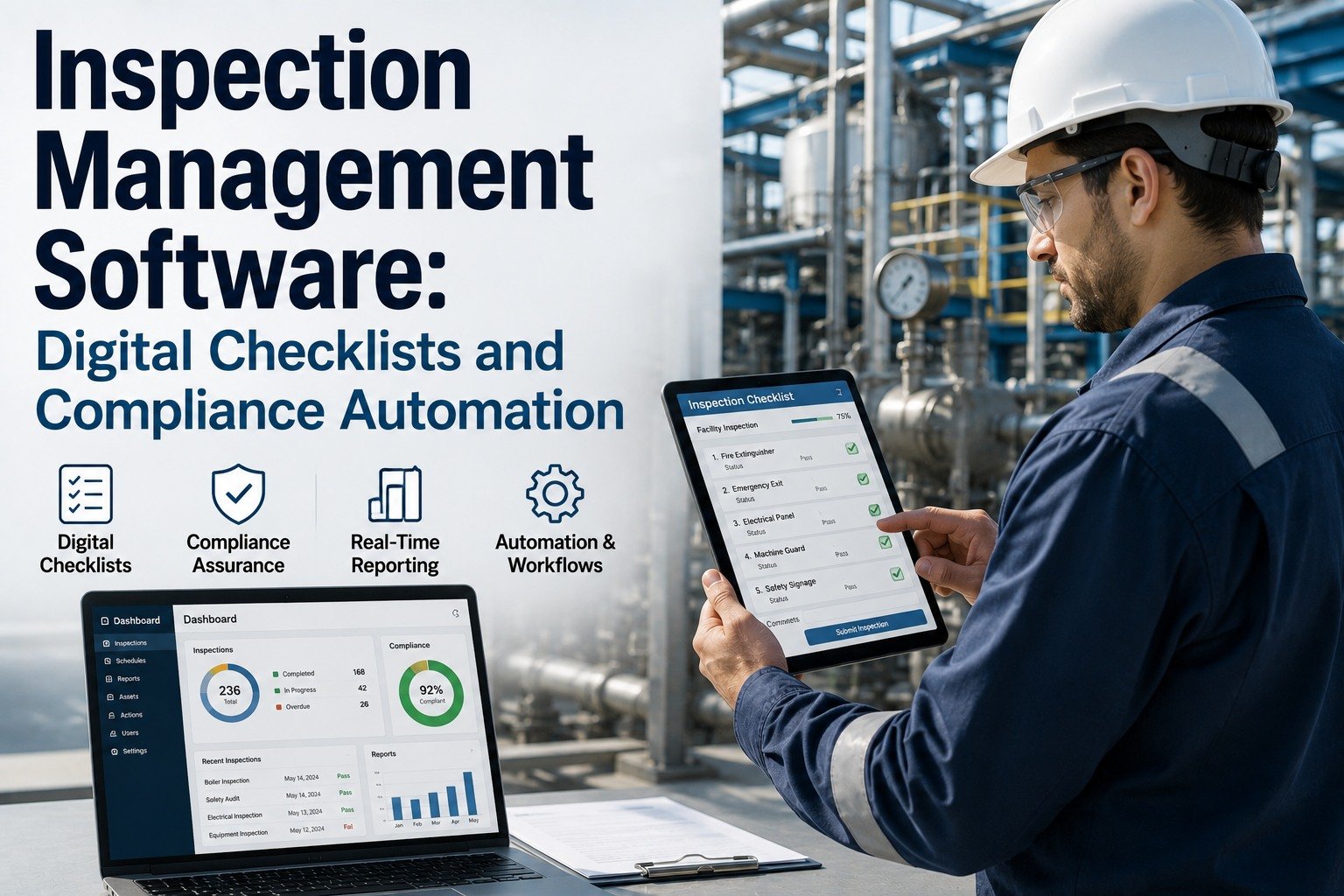
Across US manufacturing plants, warehouses, food processing facilities, and industrial campuses, inspection programs are often one of the most labor-intensive parts of daily operations. Technicians walk routes with paper checklists. Supervisors chase down completed forms. Compliance records get filed in binders that no one reviews until an auditor arrives. The work gets done, but the data rarely gets used.
This is not a technology problem. It is a process design problem that technology can either solve or worsen, depending on how a system is chosen and deployed. As regulatory requirements tighten across OSHA, FDA, EPA, and industry-specific standards, and as facilities face increasing pressure to reduce unplanned downtime and demonstrate due diligence, the question of how inspections are managed has real financial and operational consequences.
This guide is written for operations managers, facility directors, quality assurance leads, and maintenance supervisors who are evaluating whether their current inspection approach is still adequate — and what a structured, digital system would actually change about how their teams work.
Table of Contents
What Inspection Management Systems Actually Do
An inspection management system is a structured digital platform that standardizes how inspections are assigned, conducted, recorded, reviewed, and acted upon across a facility or group of facilities. Unlike generic task management tools or spreadsheet-based tracking, these systems are purpose-built to connect field observations with operational workflows — meaning that when an inspector identifies a deficiency, that finding can automatically trigger a corrective action, notify a supervisor, or be flagged for compliance review without manual intervention.
For anyone evaluating options in this category, a reliable Inspection Management Systems guide can help clarify the functional differences between platforms and what capabilities actually matter at scale across industrial and facilities environments.
The core value of these systems is not speed or automation for its own sake. It is consistency. A paper-based inspection program depends entirely on individual discipline — whether the inspector asked every question, whether they recorded findings accurately, whether the form made it back to the right person. A digital system removes that dependency by structuring the process itself.
The Difference Between Data Collection and Process Control
Many facilities have moved to mobile forms or digital checklists and mistakenly believe they have an inspection management system. Collecting data on a tablet is not the same as managing inspections as a process. A true system governs what happens after data is collected — routing findings, enforcing response timelines, escalating unresolved issues, and maintaining an auditable record of every action taken.
This distinction matters operationally because data without workflow integration tends to create the same problems as paper, just in a different format. Findings get logged but not addressed. Supervisors receive notifications they cannot act on quickly. Compliance records exist but cannot be queried or exported during an audit. The system creates a record of activity without creating accountability for outcomes.
Core Functional Requirements Worth Evaluating
When a manufacturing or facilities organization begins evaluating inspection management platforms, the initial conversation often focuses on features — mobile compatibility, offline mode, reporting dashboards. These are relevant, but they are secondary to understanding whether the system can support the inspection types, team structures, and regulatory requirements specific to the facility’s operations.
Inspection Template Flexibility and Standardization
Different inspection types require fundamentally different structures. A pre-shift equipment check involves different logic than a safety walk, a quality audit, or a regulatory compliance inspection. A system that only supports one template format will force teams to adapt their processes to the software rather than the other way around.
The ability to build conditional logic into inspection forms — where certain answers prompt follow-up questions or mandatory photo documentation — is particularly important in manufacturing environments where an inspector’s finding can have immediate production implications. Conditional logic reduces the chance that a critical observation gets recorded as a single checkbox with no supporting detail.
Corrective Action Workflow Integration
An inspection that identifies a deficiency has no operational value unless that finding reaches the person responsible for correcting it, with enough context to act. Systems that treat inspection data and corrective action management as separate modules create handoff problems — someone has to manually translate a finding into a task, assign it, and follow up.
Integrated corrective action workflows allow a finding to automatically generate a work order, assign it based on asset type or location, set a resolution deadline, and track completion status. This closes the loop between inspection and outcome in a way that disconnected tools cannot. For facilities subject to regulatory oversight, this traceability is often the difference between passing an audit and receiving a citation.
Reporting Structure and Compliance Documentation
Regulatory frameworks such as those governed by OSHA require facilities to maintain documented records of inspections, findings, and corrective actions in formats that can be reviewed by compliance officers. A system that cannot export structured reports, filter by date range or asset, or generate inspection summaries on demand creates administrative burden at exactly the moment when that burden is most costly.
Beyond external compliance, internal reporting requirements matter as well. Maintenance managers need to see inspection trends by equipment type. Quality teams need to track defect rates over time. Facility directors need visibility across sites. If a system’s reporting capability requires custom development or data exports to a separate analytics tool, that friction will limit how often the data actually gets used.
Deployment Considerations in Industrial Environments
Choosing a system based on a software demonstration in a conference room is different from understanding how it performs in a facility with limited connectivity, multiple shifts, aging equipment, and a workforce that ranges from highly tech-comfortable to deeply skeptical of new tools. Deployment realities should be part of the evaluation, not an afterthought.
Connectivity and Offline Functionality
Many manufacturing and warehouse environments have inconsistent wireless coverage — particularly in older buildings, cold storage areas, outdoor yards, or facilities with significant metal infrastructure. A system that requires continuous internet connectivity will fail in these environments, which means inspectors either skip sections, defer recording until they return to a connected area, or revert to paper as a workaround.
Offline functionality — where the application stores data locally on the device and syncs when connectivity is restored — is not a premium feature. It is a baseline requirement for most industrial deployment scenarios. Evaluating how a system handles offline data capture, including photos and form logic, should be part of the technical review before any contract is signed.
User Adoption and Workforce Considerations
The most capable inspection management system will underperform if the people conducting inspections do not use it consistently. This is not a training problem alone. It is a design and change management problem. Systems with complex navigation, slow load times, or unintuitive interfaces add friction to a task that already competes with other job responsibilities.
For facilities with mixed digital literacy across their workforce, the interface needs to be straightforward enough that an inspector can complete a form without referring to instructions. This often means simpler is better — clear question formats, minimal required fields beyond what is operationally necessary, and visual cues that guide the user through the inspection sequence without confusion.
Integration with Existing Maintenance and ERP Systems
Most established manufacturing facilities already operate within a broader software environment — a CMMS for maintenance, an ERP for operations, or a quality management system for compliance tracking. An inspection management platform that cannot share data with these systems creates parallel records that need to be reconciled manually.
Integration capability varies significantly across vendors. Some platforms offer native connectors to common systems. Others require API development. Understanding integration requirements early in the evaluation process prevents situations where a system is purchased based on its inspection features but then proves difficult or expensive to connect to the operational infrastructure already in place.
Evaluating Vendors Without Getting Lost in the Sales Process
The inspection management software market includes a wide range of vendors — from large enterprise platforms that bundle inspection functionality into broader operational suites, to purpose-built tools designed specifically for field inspection workflows. Neither category is inherently better. What matters is whether the system fits the facility’s actual scale, team structure, and operational complexity.
A useful evaluation approach is to begin with two or three specific inspection workflows that currently cause the most operational friction — missed findings, delayed corrective actions, audit preparation challenges — and ask vendors to demonstrate exactly how their system handles those workflows. This moves the conversation away from feature lists and toward practical fit.
It is also worth requesting references from facilities in comparable industries or of comparable size. A system that performs well in a small property management company may not scale effectively across a multi-site manufacturing operation with dozens of asset types and regulatory inspection schedules running simultaneously.
Concluding Thoughts
Selecting an inspection management system is not primarily a technology decision. It is an operational decision about how a facility structures accountability, manages risk, and maintains the documentation required to demonstrate due diligence across safety, quality, and compliance obligations.
The right system makes inspection data useful rather than just collected. It connects field observations to corrective workflows. It gives supervisors visibility without requiring them to chase paper. And it creates the kind of consistent, auditable record that protects an organization when a regulatory review or incident investigation requires detailed documentation of what was inspected, when, by whom, and what was done about what was found.
For facilities currently relying on paper-based processes or disconnected digital tools, the transition to a purpose-built system is rarely as disruptive as anticipated — but the evaluation process deserves the same rigor applied to any other operational infrastructure investment. The goal is not to adopt software. It is to build an inspection process that actually supports the operational standards the facility is responsible for maintaining.
-

-
-

-

-

-