Table of Contents
Introduction
An SEO Guide for Beginners & Complete SEO Guide 2026 & SEO Tips for Higher Rankings is a practical roadmap for understanding search engine optimization and improving search rankings in Google.
It explains how:
- Search engines crawl and index a website
- Keyword research connects users to your content
- On-page SEO, off-page SEO, and technical SEO work together
- Link building improves Domain Authority
- Content marketing increases organic traffic
This guide follows the structure of The Beginner’s Guide to SEO and expands it into The Complete SEO Guide for 2026. It reflects modern Google ranking factors, AI-driven search behavior, mobile SEO, user experience, and E-E-A-T signals.
If you want better website traffic and stronger search visibility, this guide shows how it works step by step.
If you are starting your SEO learning journey, access to professional tools can help you understand keyword research, backlinks profile, and SEO rankings more clearly. Platforms like Group Buy SEO Tools providers such as SEO Tools Group Buy give affordable access to premium SEO tools used for technical SEO, competitor analysis, and website optimization.

Welcome to your SEO learning journey!
SEO can feel technical at first. There are terms like Metadata, Schema.org Markup, Technical SEO, backlinks profile, and SEO strategy.
You do not need advanced skills to start. You need clarity and action.
This guide organizes everything into simple chapters so beginners and website clients can follow it easily.
Chapter 0: Quick Start Guide to SEO
This is the fast track.
You learn:
- What search engine optimization means
- How Google discovers pages
- Why SEO rankings change
- Simple SEO tips you can apply immediately
This mirrors the structure of a professional Quick Start Guide to SEO.
Chapter 1: SEO 101
This chapter builds your foundation.
You learn:
- How search engine algorithms work
- What affects search rankings
- The difference between organic search and paid ads
- How keyword targeting supports website optimization
Without SEO 101, strategy becomes guesswork.
Chapter 4: On-Page SEO
On-page SEO focuses on what you control on your website:
- Title tags
- Description Metadata
- Keyword Metadata
- Header structure
- Content experience
- Internal links
This is the starting point for higher rankings.
Chapter 5: Technical SEO
Technical SEO supports the structure behind the website.
It includes:
- Page speed
- Mobile optimization
- ADA accessibility
- Crawl errors
- Structured data using Schema Markup
- Indexing control
If Google cannot properly read your site, rankings drop.
Chapter 6: Link Building & Establishing Authority
Link building strengthens website authority.
This chapter covers:
- Off-Page SEO
- Backlinks profile
- Domain Authority
- SEO Branding
- Authority signals
Backlinks still influence SEO rankings in 2026.
Chapter 7: Measuring, Prioritizing, & Executing SEO Success
SEO requires tracking.
This chapter explains:
- SEO audit process
- Measuring organic traffic
- Tracking website traffic
- Creating an SEO Optimization Strategy
- Prioritizing improvements
Data helps you rank higher.
Chapter 8: SEO Glossary of Terms
SEO uses many technical terms.
This glossary covers:
- Metadata
- Technical SEO
- Content Marketing
- Mobile SEO
- Local SEO
- E-commerce SEO
- User experience
- Page speed
Clarity removes confusion.
Moz Academy SEO Essentials Certification
If you want formal training, Moz Academy offers the SEO Essentials Certification.
Tools like Moz Pro and other Free SEO Tools support:
- Keyword research
- SEO rankings tracking
- Competitive research
- Reporting
Many professionals in Web Marketing, Web Development, Web Design, and University Marketing and Communications teams use these tools.
How much of this guide do I need to read?
If you are new to SEO for beginners, start with:
- Chapter 0: Quick Start Guide to SEO
- Chapter 1: SEO 101
If you already manage a Website, focus on:
- On-Page SEO
- Technical SEO
- Link Building & Establishing Authority
If you work in Web Hosting & Support, Content Marketing, or manage website clients, read everything.
Writing Style Used:
Practical Advisory Style (clear instructions users can apply immediately)
Help Google find your content
Search engines cannot rank what they cannot see. Your first job in SEO is making sure Google can crawl and index your Website correctly.
Use these basics:
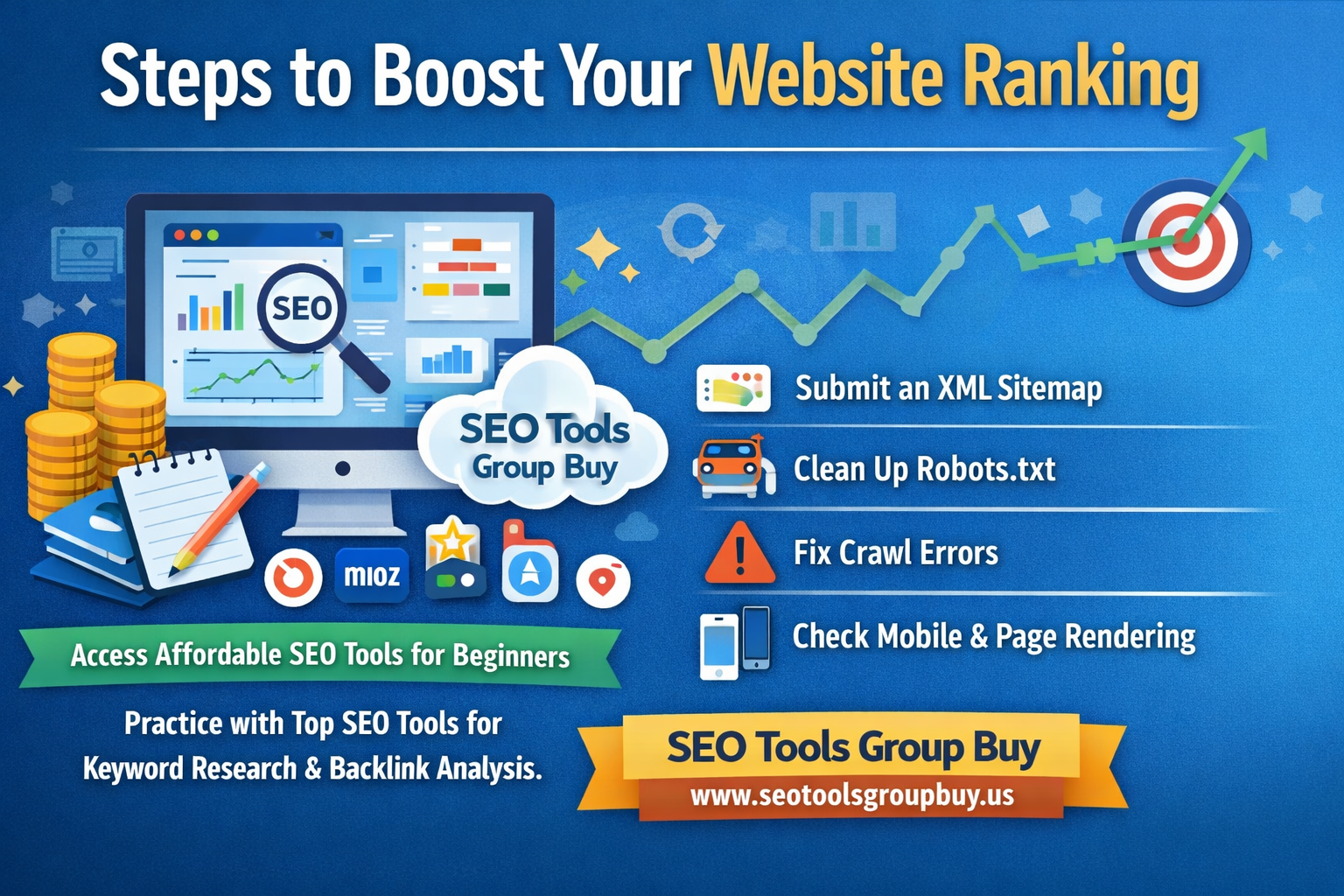
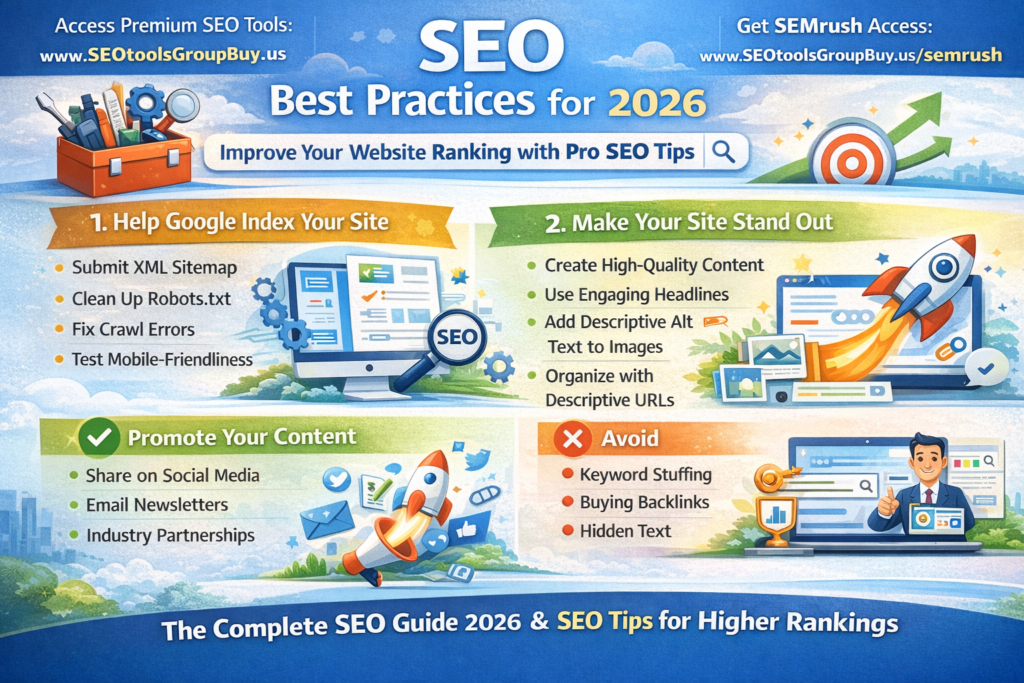
- Submit an XML sitemap
- Keep your robots.txt clean
- Avoid blocking important pages
- Fix crawl errors in Google Search Console
Search engine optimization starts with accessibility. If Google cannot access your pages, even strong content marketing will not improve SEO rankings.
Check if Google can see your page the same way a user does
Use tools like:
- URL inspection in Google Search Console
- Page rendering tests
- Mobile-friendly testing
Make sure:
- CSS and JavaScript are not blocked
- Images load properly
- Structured data like Schema.org Markup is visible
Google evaluates Mobile experience first. Mobile SEO is not optional in 2026.
Organize your site
A clear structure improves user experience and website optimization.
Think of your site like folders in a computer. Organized content ranks better.
Use descriptive URLs
Bad URL: website.com/page?id=123
Good URL: website.com/seo-guide-for-beginners
Descriptive URLs support keyword targeting and search visibility.
Keep them:
- Short
- Clear
- Focused on main keyword
Group topically similar pages in directories
Example:
/seo/on-page-seo/ /seo/technical-seo/ /seo/link-building/
This structure helps Google understand relationships between pages. It also strengthens internal linking.
Clear hierarchy improves SEO strategy and helps search engine algorithms categorize content.
Reduce duplicate content
Duplicate content confuses search engines.
Avoid:
- Copying product descriptions
- Publishing the same blog on multiple URLs
- Repeating similar pages for slight keyword variations
If needed, use canonical tags.
Duplicate content weakens SEO rankings and wastes crawl budget.
Make your site interesting and useful
Search engine optimization is not just technical SEO. It depends on value.
Strong content experience increases organic traffic and website traffic.
Avoid distracting advertisements
Too many ads reduce trust and hurt user experience.
Google values helpful content. Intrusive ads lower engagement and may affect rankings.
Keep layout clean.
Link to relevant resources
Linking to helpful sources improves credibility.
This includes:
- Industry reports
- Official documentation
- Educational platforms
Good outbound links support E-E-A-T.
Write good link text
Avoid:
“click here”
Use:
“technical SEO checklist” “keyword research tools”
Clear anchor text improves on-page optimization and link building clarity.
Link when you need to
Do not over-link.
Link only when it helps the reader. Natural internal linking strengthens website authority.
Influence your title links
Your Title Metadata controls what users see in search results.
Keep titles:
- Under 60 characters
- Keyword-focused
- Clear and specific
Example:
“SEO Guide for Beginners – Complete SEO Guide 2026”
Title Metadata impacts click-through rate and SEO rankings.
Control your snippets
Description Metadata influences clicks.
Keep it:
- 150–160 characters
- Clear
- Action-focused
Keyword Metadata is no longer a ranking factor, but proper metadata organization still helps structure.
Add images to your site, and optimize them
Images support content marketing and improve engagement.
Add high-quality images near relevant text
Images should:
- Match the topic
- Load fast
- Be compressed
Large images slow page speed and hurt technical SEO.
Add descriptive alt text to the image
Alt text helps:
- Accessibility (ADA compliance)
- Search engine understanding
- Image search visibility
Describe what the image shows in simple language.
Optimize your videos
Video content increases time on page.
For video SEO:
- Add transcripts
- Use descriptive titles
- Embed videos properly
- Include structured data
This improves website optimization and organic search exposure.
Promote your website
SEO and Web Marketing work together.
Share content via:
- Email newsletters
- Social media
- Industry forums
- Partnerships
Promotion supports link building and strengthens Domain Authority.
Things we believe you shouldn’t focus on
Do not waste time on:
- Keyword stuffing
- Buying backlinks
- Exact match domain tricks
- Hidden text
Search engine algorithms are smarter in 2026. AI systems detect manipulation.
Focus on long-term SEO strategy instead.


Next steps
SEO is ongoing work.
Keep improving:
- Technical SEO
- Content Marketing
- User experience
- Mobile optimization
Stay informed and ask questions
Follow trusted sources. Monitor algorithm updates. Continue learning.
Get support
If your team lacks experience in Web Development, Web Design, or Web Hosting & Support, consider working with professionals.
Website clients often benefit from structured SEO audits and guidance.
Writing Style Used:
Strategic + Action-Oriented Guide Style (clear execution steps with practical structure)
Steps to Boost Your Website Ranking
Strong SEO Rankings do not happen by accident. You need a clear SEO Optimization Strategy, consistent Content Marketing, and solid Technical SEO.
Advanced tools like SEMrush group buy access help analyze competitor keywords, backlinks profile, search volume, and SEO rankings in detail.

Below are six structured steps based on modern 2026 search engine algorithms.
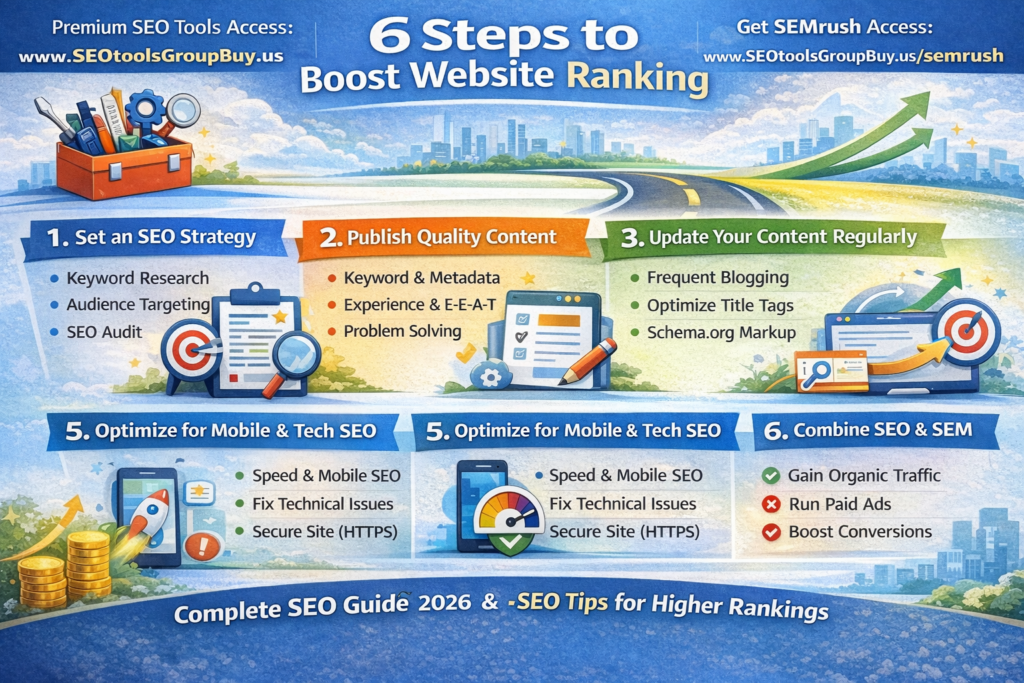
1. Set an SEO Optimization Strategy
Start with a plan.
A proper SEO strategy answers:
- Who is your audience?
- What keywords are they searching?
- What type of content do they expect?
- What problems are you solving?
Use keyword research tools to find:
- High-intent keywords
- Long-tail keyword targeting opportunities
- Search volume trends
Then build content around real search demand.
An SEO audit helps identify:
- Technical SEO issues
- Weak on-page optimization
- Backlinks profile gaps
- Slow page speed
Without strategy, SEO becomes random effort.
2. Publish Relevant, Authoritative Content
Google ranks useful content.
If your Website does not provide value, rankings drop.
Content must show:
- Experience
- Expertise
- Authority
- Trust
This connects directly to E-E-A-T.
Keywords
Keyword research is the base of SEO for beginners and advanced users.
Target:
- Primary keyword
- Supporting keyword phrases
- Related semantic terms
Avoid stuffing. Instead, place keywords naturally.
Multiple Keyword Phrases
Use variations such as:
- SEO guide
- Complete SEO Guide
- SEO tips
- Higher rankings
- On-page SEO
- Technical SEO
This supports broader search visibility.
Placing Keywords
Place keywords in:
- Title Metadata
- Description Metadata
- Headers
- First 100 words
- Image alt tags
But keep it natural. Overuse hurts SEO Rankings.
Content
Content must solve problems.
Use clear sections. Use simple language. Focus on user experience.
Google measures engagement signals. If users leave fast, rankings suffer.
Experience and Expertise
Show proof:
- Case studies
- Real examples
- Data
- Author credentials
This builds website authority.
University Marketing and Communications teams often highlight expertise clearly. You should too.
SEO Formatting
Formatting supports readability.
Use:
- Short paragraphs
- Bullet points
- Clear headings
- Internal linking
Well-structured content improves on-page SEO.
3. Update Your Content Regularly
Fresh content performs better in competitive niches.
Search engine algorithms prefer updated pages.
Blogging
Blogging increases organic traffic.
Each article targets new keyword research opportunities.
Consistent blogging supports:
- Website traffic growth
- Link building
- Domain Authority
Metadata
Metadata influences click-through rate and rankings.
Title Metadata
Keep under 60 characters. Include your primary keyword. Make it clear.
Example: Complete SEO Guide 2026 – SEO Tips for Higher Rankings
Description Metadata
Keep under 160 characters. Summarize value clearly.
Description Metadata does not directly rank pages but improves clicks.
Keyword Metadata
Keyword Metadata is outdated for Google ranking factors. Still, structured internal tagging helps content organization.
Use alt tags
Alt text supports:
- ADA accessibility
- Image search visibility
- Technical SEO
Describe images clearly.
Use Schema.org Markup
Schema.org Markup helps search engines understand content structure.
Use it for:
- FAQs
- Articles
- Products
- Business Hours
- Our Locations
Structured data increases search visibility.
4. Have a Link-Worthy Site
Links remain powerful.
Backlinks influence SEO Rankings and Domain Authority.
SEO Rankings
A strong backlinks profile signals trust.
Quality matters more than quantity.
Avoid buying links. Focus on:
- Guest contributions
- Industry mentions
- Research reports
- Partnerships
Why Prioritize Content Creation Over Off-Page SEO?
Content creates natural links.
If your content is helpful, other sites link without asking.
Content Marketing drives sustainable Off-Page SEO.
5. Optimize for Mobile and Execute Technical SEO
Mobile traffic dominates in 2026.
Mobile SEO affects rankings directly.
Ensure:
- Fast loading speed
- Responsive design
- Clean code
- No crawl errors
- Secure HTTPS
Technical SEO supports everything else.
If your Web Development team ignores technical structure, rankings drop.
6. SEM, SEOx, and More
SEM means paid search marketing.
SEO focuses on organic traffic.
SEOx refers to integrated search strategy combining:
- SEO
- SEM
- Content Marketing
- Conversion optimization
Web Marketing teams often combine both for maximum reach.
SEO builds long-term visibility. SEM provides immediate traffic.
Use both wisely.
What On-Page Optimization Strategies Actually Move Rankings?
Focus on:
- Clear keyword targeting
- Strong internal linking
- Helpful content
- Optimized Title Metadata
- Clean URL structure
- Fast page speed
On-page SEO gives you direct control.
Why Are Backlinks and Domain Authority Still Critical Ranking Factors?
Backlinks signal authority.
A strong Domain Authority improves search rankings.
Quality links show:
- Trust
- Relevance
- Industry recognition
Link Building & Establishing Authority remains part of modern search engine optimization.
What Role Does E-E-A-T Play in Modern SEO Success?
E-E-A-T stands for:
- Experience
- Expertise
- Authority
- Trust
Google uses E-E-A-T to evaluate content quality.
In 2026, AI systems analyze:
- Author credibility
- Brand mentions
- Website authority
- User engagement
Weak trust signals lower rankings.
The Four Components of E-E-A-T
- Experience – Real-world proof
- Expertise – Knowledge depth
- Authority – Recognition in the industry
- Trustworthiness – Transparency and accuracy
Building Expertise and Authority Signals
Build authority through:
- Detailed guides
- Research-based content
- Expert authors
- Consistent publishing
SEO Branding helps strengthen recognition.
Trustworthiness as a Ranking Foundation
Trust signals include:
- Secure website
- Clear contact details
- Business Hours visibility
- Our Locations page
- Transparent policies
Trust supports long-term organic search growth.
-

-
-

-

-

-