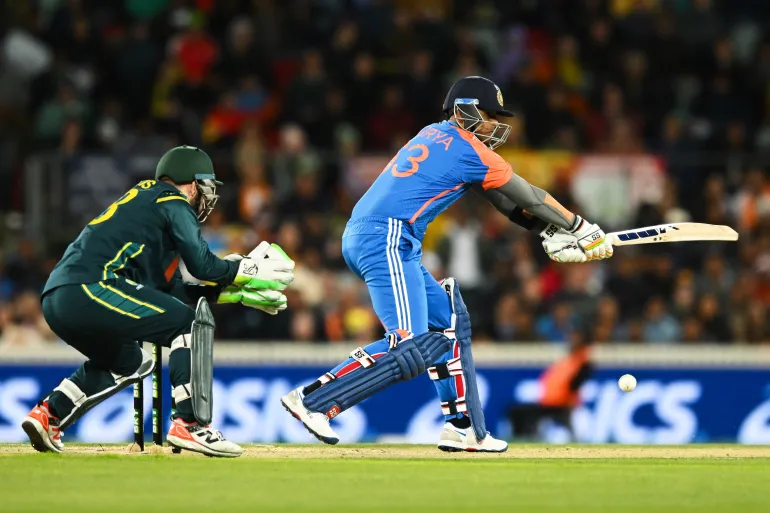
India and Australia have played 304 men’s international matches across Tests, ODIs and T20Is, with Australia winning 146 and India winning 114 as of 8 November 2025. The remaining 44 matches were draws or no-results. Australia held the overall advantage in Tests and ODIs, while India led the T20I head-to-head, making this one of cricket’s most closely followed multi-format rivalries.
Table of Contents
Overall India vs Australia record
The first Test between the sides took place from 28 November to 4 December 1947, when Australia won by an innings and 226 runs. Their first ODI came on 6 December 1980, with India winning by 66 runs. The first T20I was played on 22 September 2007, and India won that match by 15 runs.
According to Wikipedia’s Australia–India rivalry summary, the 304 meetings through 8 November 2025 were divided across 112 Tests, 155 ODIs and 37 T20Is. Australia’s strongest numerical advantage came in the two longer-established formats, whereas India’s superior T20I return reflected its success in the shortest international format.
| Format | Matches | India wins | Australia wins | Draws/No results |
| Tests | 112 | 33 | 48 | 31 |
| ODIs | 155 | 59 | 86 | 10 |
| T20Is | 37 | 22 | 12 | 3 |
| Total | 304 | 114 | 146 | 44 |
These figures are useful as a broad historical guide, but format, venue and tournament stage can change the meaning of a head-to-head number. A Test record includes drawn matches and series played over decades, while limited-overs contests are more immediately affected by conditions, tactical changes and squad composition.
Test record: Australia ahead in the longest format
In men’s Tests through 8 November 2025, Australia had won 48 of 112 matches against India. India had won 33, while 31 matches were drawn. The scale of the drawn-match total shows why a simple wins comparison cannot fully describe this fixture in Test cricket: many contests have extended over five days without a result.
The latest Test meeting listed in the rivalry summary was played from 3 to 5 January 2025, when Australia won by six wickets. Australia’s overall 15-win lead illustrates its historical strength in the format, but India’s 33 victories also underline that the contest has had many competitive phases rather than being a one-sided record.
Test statistics also require careful reading because conditions differ sharply between India and Australia. A match in India and one in Australia can demand contrasting methods from batters and bowlers. For that reason, an all-time Test total is most helpful as context; it cannot by itself explain how a particular series or match may unfold.
ODI record: Australia lead 86-59
ODIs are the most frequently played format in the India-Australia rivalry. The teams had met 155 times in men’s ODIs through 25 October 2025, with Australia winning 86 matches and India winning 59. Ten games ended without a result, while neither side had a tie in this head-to-head record.
The ODI home-and-away split adds further perspective. India had 33 home wins, 15 away wins and 11 neutral-venue wins against Australia. Australia had 40 home wins, 34 away wins and 12 neutral-venue wins. Australia therefore led in each of the three location categories within the overall ODI record.
Recent ODI results showed that the contest could shift quickly across a short series. In the three matches listed from October 2025, Australia won the first two before India won the third. Australia won the first ODI on 19 October by seven wickets under the DLS Method, chasing India’s 136/9 after scoring 131/3. Australia then won the second ODI by two wickets on 23 October after India made 264/9 and Australia reached 265/8.
India responded in the third ODI on 25 October 2025, winning by nine wickets. Australia made 236, and India reached 237/1. Such results show why a historical ODI lead is only one part of judging a forthcoming meeting. Recent performances, the match location and the format-specific context remain important alongside the long-term numbers.
For readers comparing historical records with fixture-specific considerations, factors such as venue, recent results and match format can be weighed alongside today match prediction 100 sure material rather than treating the overall head-to-head total as a standalone answer.
T20I record: India hold the advantage
India had the better men’s T20I record against Australia as of 8 November 2025. In 37 matches, India won 22 and Australia won 12, with three no-results. It is the only one of the three principal formats in which India held a clear overall head-to-head advantage.
The most recent T20I listed was on 8 November 2025 and ended with no result. That outcome contributed to the three no-results in the T20I column. Although the sample is much smaller than the ODI record, India’s 10-win advantage was substantial within the available set of matches.
T20I head-to-head records can change faster than Test or ODI records because teams play fewer matches in a bilateral series and results are often decided by short bursts of batting, bowling or fielding. Still, India’s 22 victories offer a meaningful historical contrast to Australia’s leads in the other two formats. For upcoming T20I meetings, fantasy players often pair this history with recent form through dream11 prediction resources.
Results in major ICC events
The rivalry has also produced important results in global tournaments. Across 26 head-to-head meetings in the Cricket World Cup, T20 World Cup, Champions Trophy and World Test Championship final, Australia won 13 matches and India won 12, with one no-result. That near-even total differs from Australia’s larger advantage across all formats.
Australia held the edge in Cricket World Cup meetings, winning nine of 14 against India. India won five. The 2023 Cricket World Cup included two India-Australia matches: India won the group-stage contest in Chennai by six wickets, while Australia won the final in Ahmedabad by six wickets.
Australia also beat India in the 2003 Cricket World Cup final by 125 runs and won their 2015 semi-final meeting by 95 runs. India’s notable World Cup victories over Australia included the 2011 quarter-final in Ahmedabad, won by five wickets, and the 2019 group-stage match at The Oval, won by 36 runs.
India had the stronger record in the ICC Men’s T20 World Cup, winning four of six meetings. India won the 2007 semi-final in Durban by 15 runs and also defeated Australia in the 2014 Super 10 stage by 73 runs. Australia won the 2010 and 2012 encounters, while the split demonstrates that this format has often been more balanced in major events.
In the Champions Trophy, India won three of the four matches that produced a result, while one match ended without a result. Australia, meanwhile, won the one-off 2023 ICC World Test Championship final by 208 runs. The distribution of these results helps explain why the rivalry remains significant across different competition structures.
What the numbers say about the rivalry
The headline pattern is straightforward: Australia led the overall men’s record, Test record and ODI record through 8 November 2025, while India led in T20Is. Yet the ICC-event split was much tighter, with Australia ahead by only one win across 26 meetings in the major competitions listed.
The historical record is therefore best read format by format. Tests carry Australia’s longest-running advantage, ODIs show Australia’s most extensive match-winning lead, and T20Is show India’s success in the shortest format. Tournament fixtures add a separate layer, where individual knockout matches can become defining moments.
India and Australia’s head-to-head record contains a clear overall Australian advantage, but it is not a uniform story. India’s T20I lead and closely contested ICC-event record show that format and occasion matter greatly, while the long history of matches ensures every new contest adds another meaningful chapter.
-

-

-
-

-

-