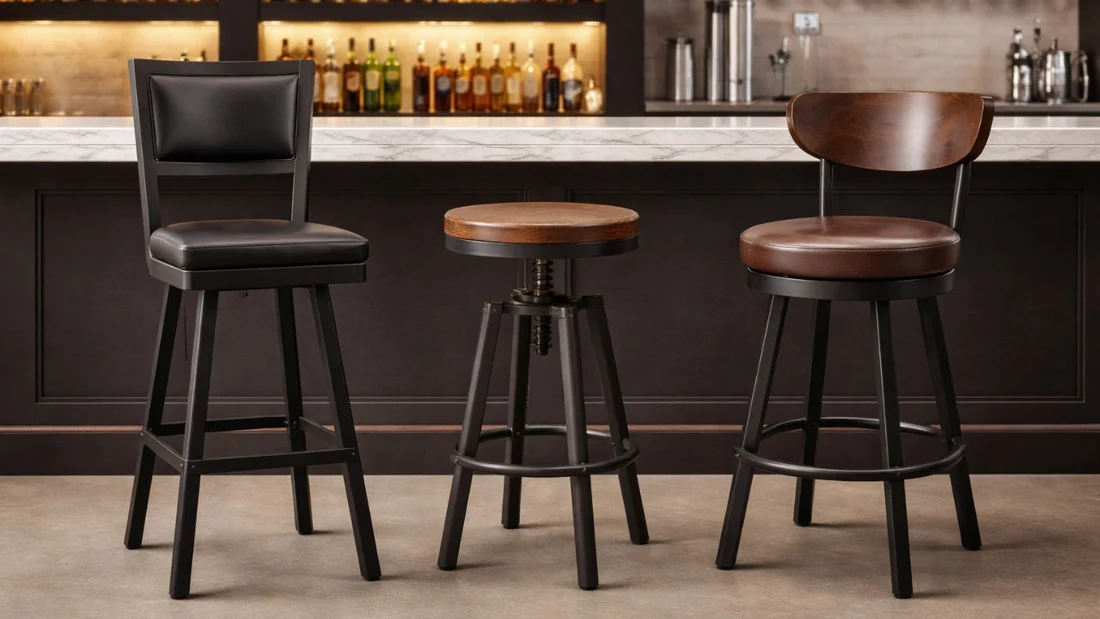
Most buying guides treat bar stools as decor with legs. This one treats them as what they are in any commercial setting: load-bearing equipment on a duty cycle, expected to hold strangers safely, nightly, for the length of a lease. Buy to that standard and the purchase disappears from your problems list for a decade.
The market makes the search harder than it should, because “heavy duty” has become a marketing seasoning sprinkled on everything. Genuinely heavy duty bar stools are identifiable by specification, not adjectives, and this guide walks the checklist a professional buyer runs: frame, rating, joinery, footrest, finish, and the paper behind them.
Table of Contents
Start With the Stated Weight Rating
Rule one filters most of the catalog: no published weight rating, no purchase. Commercial-duty stools state their capacity plainly, 300 pounds as the working floor, 350 to 500 for true heavy-duty class, and the number refers to sustained daily service rather than a one-time test.
Treat silence as an answer. A listing that describes “sturdy construction” while omitting the one number that would prove it has told you exactly what an engineer never wrote down.
Read the Frame Like a Materials Inspector
The rating comes from somewhere, and that somewhere is the frame. For metal stools, the spec to find is gauge: 16-gauge steel tubing is the commercial benchmark, and the scale runs backward, so 18-gauge is thinner, lighter, and weaker. For wood, look for named dense hardwoods, beech, oak, maple, and the phrase kiln-dried, which is the difference between joints that hold and joints that breathe with the seasons.
Shipping weight is the sanity check hiding in plain sight. Thick tubing and real hardwood are heavy; a “heavy-duty” stool that ships feather-light has already confessed.
Joinery: Where Stools Actually Die
Stools rarely snap; they loosen, quietly, one service at a time. The failure point is almost always the junction rather than the member, which makes joinery the highest-value line on the whole sheet.
- Metal frames: full welds at every joint, never bolt-together connections that service will shake loose.
- Wood frames: mortise-and-tenon joints backed by corner blocks, glued and screwed.
- Swivels: sealed, rated mechanisms, because a gritty swivel is a countdown timer.
Flip any candidate stool over in the showroom or in the sample box. The underside tells the truth the product photo was hired to hide.
The Footrest Is a Load-Bearing Feature
This is the spec that casual buyers skip and veterans look at first. All night, with their full mechanical zeal, every guest on a tall stool plants their feet on the footrest. On a poor product, it’s a decorative rung that bends, loosens, and scars. On real commercial stools, it’s structural, welded or through-bolted, and typically steel-clad right where shoe traffic hits.
A worn footrest also announces itself visibly within a year. Chrome flaking at ankle height is a bar’s way of telling its guests the fit-out was optimistic.
Match the Height, Then the Finish
Even indestructible stools fail if they’re the wrong size. The pairing rules are fixed: 30-inch seats for 42-inch bar tops, 24 to 26-inch seats for 36-inch counters, with roughly 10 to 12 inches between seat and surface. Measure the actual bar before ordering, because “standard” is a rumor in older buildings.
Finish is the durability decision’s final layer. Powder-coated metal shrugs off nightly cleaning chemicals; catalyzed lacquer does the same for wood; and commercial vinyl upholstery outlives fashion-fabric alternatives several times over in heavy-duty service. Choose finishes for the closing crew’s spray bottle, not the opening day photo.
Demand the Paper Trail
The last checkpoint costs one email: ask for the commercial warranty conditions and any test criteria specified. The legitimate vendors answer with documentation; the costume-grade market answers with adjectives. The only endorsement that truly matters is the manufacturer putting its own money on the line, in the form of a warranty covering business use for years.
Keep the paperwork with the lease documents. If a stool fails in year three, the claim process starts with the file you kept, and ends much better than the version where it starts with a shrug. Note the purchase date and supplier contact on the same page, because future-you will be busy running a bar and grateful for past-you’s filing.
The Lease-Length Test
Run the final decision through one question: will this stool, at this spec, still be in service when the lease renews? Rated frame, real joinery, structural footrest, correct height, chemical-proof finish, warranty on file. Six checks, and the answer becomes yes on paper before it has to be yes in practice.
Furniture bought this way gets boring, in the best commercial sense: it holds every guest, survives every season, and never interrupts a Friday. The flashy alternative is always available, one click cheaper, and one year from its first wobble. Choose the boring champion. Your lease is long, and gravity is patient.
-

-
-

-

-

-