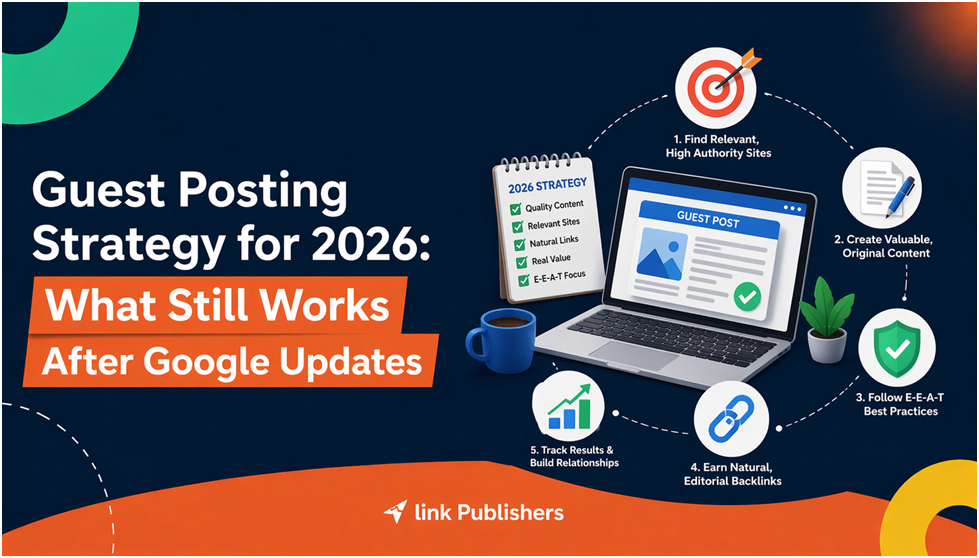
There is a point where every content marketer stops and asks: is guest posting still worth it? That question has become louder after the series of Google updates that have reshaped how the search engine evaluates links, authority, and content quality. And yes – the rules have changed. But that does not mean guest blogging strategy is dead. It just means the old shortcuts are gone.
People who used to spin 500-word articles and blast them across low-quality directories are not seeing results anymore. That era is done. What is working now is smarter, more selective, and built on actual editorial standards. The good news? If you get it right, backlinks from guest posts still carry real weight in 2026.
This guide covers exactly what is working, what is not, and how you can build a guest posting strategy that holds up – even when the next update rolls out. Let us get into it.
Table of Contents
1. Why Guest Posting Still Matters in 2026
Let us clear the air on something. Google did not kill guest posting for SEO. It killed lazy guest posting. There is a difference – and understanding that difference is the starting point of any advanced guest posting technique worth following.
When you publish a well-researched piece on a site that your target audience already trusts, you are doing three things at once. You are earning a backlink, getting in front of a new audience, and building brand credibility. That combination is hard to replace with any other strategy. Not only that, but Google has repeatedly confirmed that links from editorially-relevant, high-authority sites still influence rankings.
The difference now is that Google is far better at detecting whether a guest post is genuinely editorial or purely manipulative. Sites that exist only to host guest posts – sometimes called link farms – have been heavily discounted or penalized. This way, only the genuine placements count.
| Guest Posting Factor | Old Approach (Pre-2023) | Current Approach (2026) |
| Volume vs Quality | High volume, low quality | Low volume, high quality only |
| Target Sites | Any DA 20+ site | Topically relevant, editorial sites |
| Anchor Text | Exact match, aggressive | Branded, natural, mixed |
| Content Length | 500-800 words | 1,200+ words, well-researched |
| Link Placement | Forced, first paragraph | Contextual, reader-first |
| Relationship | Transactional, one-off | Long-term editorial partnership |
2. What Google’s Updates Actually Targeted
To understand what works now, you need to know what Google was targeting. The Helpful Content Update, the Spam Update, and the various link spam signals Google rolled out between 2022 and 2024 had one thing in common. They went after content that existed for search engines, not for readers.
Sites that accepted guest posts without any editorial review took the biggest hits. Pages that had no topical depth, no author credibility, and no real audience suffered ranking drops. The guest posting after Google updates conversation largely started there – because those who relied on volume-based guest blogging strategy saw their results collapse almost overnight.
What survived? Publications with real editorial standards. Sites where a guest author’s credibility was evaluated. Blogs where the content matched the site’s niche in a meaningful way. Those backlinks from guest posts are still working. Therefore, your job in 2026 is to earn placements on sites that look nothing like a link farm.
The Google Spam Policy – A Quick Reference
Here is a simplified breakdown of what Google’s spam policies flag when it comes to guest posting SEO:
- Paid links without a rel=sponsored tag
- Large-scale article campaigns with keyword-stuffed anchor text
- Content clearly produced to manipulate PageRank, not to inform readers
- Sites with thin editorial standards accepting any submission
- Author bios linking to unrelated sites with exact-match anchors
This does not mean you cannot use guest posting tips from two years ago. It means you have to filter them through this lens: is this placement genuinely editorial? If not, skip it.
3. Building a Guest Posting Strategy That Holds Up
A solid guest posting strategy 2026 starts with picking the right targets. That sounds obvious. In practice, most people still get it wrong because they are chasing metrics – domain authority, traffic estimates, and link counts – rather than relevance and editorial fit.
Here is the honest truth. A contextually relevant link from a site with a Domain Rating of 40 in your exact niche is worth more than a generic link from a DR 70 site that covers everything from finance to pet care. Relevance is the new authority. That shift is central to guest posting for SEO growth in 2026.
So before you pitch anywhere, run through this checklist:
- Does this site’s audience match the audience I want to reach?
- Does this site have real editorial standards – an editor, a review process?
- Is the site’s content updated regularly and written by real people?
- Does the site have organic traffic – not just a high DA?
- Are the existing guest posts on this site actually good?
If you can answer yes to all five, you have a target worth pursuing. This way, your backlinks from guest posts carry actual signal rather than just existing.
4. How to Find the Right Sites
Finding quality sites for guest posting is one of the more time-consuming parts of the process. There is no shortcut that does not come with risk. The good news is that there are reliable methods – and they are not complicated.
Start with your competitors. Use a tool like Ahrefs or SEMrush to pull the referring domains linking to competing pages. Look through those domains. The sites that have linked to your competitors editorially – not through sponsored placements – are sites that accept real guest posts. That list alone can fill your outreach pipeline for months.
Next, use search operators. These are genuinely useful for guest posting strategy research and have not lost their effectiveness. Here are the ones you should be using:
// Guest post prospecting search operators “write for us” + [your niche] “guest post guidelines” + [your niche] “submit a post” + [your niche] “become a contributor” + [your niche] inurl:guest-post + [topic keyword] intitle:”guest post by” + [relevant keyword]
Combine these with your competitor backlink research. That combination gives you a shortlist of sites that are both relevant and already open to guest contributions. Therein lies the foundation of a guest posting strategy 2026 that produces real results.
5. Crafting a Pitch That Actually Gets a Yes
Most pitches fail – not because the writer is bad, but because the pitch is generic. Editors at high-quality publications receive dozens of guest post submissions every week. Yours needs to feel different from the first line. Personalization is not optional. It is the barrier between your email being read and it being deleted.
Here is what a strong pitch does. It shows you know the site. It proposes a specific topic – not a vague category. And it explains why that topic is relevant for that audience right now. And it includes proof of your writing quality – links to published work, not just a portfolio homepage.
Below is a pitch framework that works across most niches. Adapt it for each site you approach. The more specific you make it, the better your response rate:
Subject: Guest Post Idea for [Site Name] – [Specific Topic] Hi [Editor’s Name], I have been reading [Site Name] for a while – particularly enjoyed your recent piece on [specific article]. It gave me an idea for a piece that I think would fit your audience well. Topic: [Specific, Descriptive Title] Here is why this angle works for your readers: – [Reason 1 tied to their audience] – [Reason 2 tied to a current trend or gap] I have covered similar ground in [Link to Published Work], which reached [outcome if available]. Happy to send a full outline if this sounds like a fit. [Your Name]
One more thing. Follow up. A single follow-up email sent 5-7 days after your first pitch can double your response rate. Editors are busy. A polite nudge reminds them without being annoying. This is one of the most underrated guest posting tips that gets consistently ignored.
6. Writing Content That Earns Its Place
Once a site says yes, the real work begins. The content you submit has to be genuinely good – not just good enough to get published. There is a reason for this that goes beyond impressing the editor. Google’s Helpful Content guidelines now look at the quality of content on a site at a page level. A weak guest post can hurt the host site’s authority. Editors know this. That means they are more selective than ever about what they approve.
Your guest post should hit a few non-negotiable marks. It needs to be specific – not a broad overview that says nothing new. Also, It needs to reflect first-hand perspective or expertise. It needs to be well-structured with a clear flow from intro to conclusion. Likewise, it needs to cite credible sources and link to them.
On the guest posting SEO side, your keyword placement needs to look natural. Primary keywords like guest posting strategy or guest blogging strategy should appear in the title, one or two subheadings, and scattered through the body – but only where they fit naturally. Keyword density of 1-2% across the whole piece is a practical target. Anything higher starts to look manipulative.
| Content Element | What to Do | What to Avoid |
| Title | Specific, benefit-driven, keyword-inclusive | Vague, clickbait-heavy titles |
| Introduction | Hook with a real insight or stat | Starting with a generic definition |
| Subheadings | Use H2/H3 with natural keyword inclusion | Stuffing every heading with keywords |
| Body Content | Specific examples, data, first-hand insight | Broad claims with no evidence |
| Links | 2-3 outbound to credible sources + 1 author link | Multiple keyword-stuffed self-links |
| Author Bio | Genuine bio with branded anchor, not keyword | Keyword-stuffed bio with spammy link |
| Word Count | 1,200 – 2,000 words minimum for most niches | Sub-700 word thin content |
7. Anchor Text – The Detail Most People Get Wrong
Anchor text strategy is where many guest posting SEO campaigns fall apart – even when the content itself is solid. Over-optimized anchor text is one of the clearest spam signals Google can detect. If all your backlinks from guest posts point back to your site with exact-match anchors, that pattern raises a flag.
A natural anchor text profile looks like this: a mix of branded anchors, partial-match anchors, generic anchors like ‘read more here’ or ‘this guide’, and occasionally – not always – an exact-match anchor when it fits naturally in context. The key word is natural. If you have to force the anchor into the sentence, it is wrong for that placement.
Here is a practical anchor text distribution to aim for across your guest posting strategy:
| Anchor Type | Example | Target Share |
| Branded | Your Company Name | 35-40% |
| Partial Match | content writing services for SaaS | 20-25% |
| Exact Match | guest posting strategy | 5-10% |
| Generic / Naked URL | ‘this article’, yoursite.com | 25-30% |
| Long-tail | how to build backlinks through guest posts | 5-10% |
Stick close to these ranges across your guest blogging strategy and your link profile will look organic to both Google and manual reviewers. Deviate too far in any direction and you are taking an unnecessary risk.
8. Advanced Guest Posting Techniques Worth Using in 2026
Beyond the basics, there are advanced guest posting techniques that give you an edge – especially in competitive niches where everyone is chasing the same handful of publications.
The Reverse Guest Post
Instead of pitching to write on someone else’s site, you invite a well-known contributor in your niche to write on yours. This builds relationships with people who have their own networks. Quite often, they will return the favor – or introduce you to editors at their regular publications. Not only that, but it builds your own site’s authority at the same time.
The Data-Led Pitch
Original research or data is the strongest pitch asset you can have. When you collect proprietary data – even from a small survey – you give editors something no one else can offer. Publications love guest posts built around original data because it gives their readers content they cannot find anywhere else. This approach works especially well for guest posting for SEO growth in B2B niches.
The Serial Contributor Model
Rather than doing one-off guest posts on a dozen sites, pick five or six publications and become a regular contributor. This way, you build author authority at those sites over time. Repeat contributors are trusted more by editors, linked internally more often, and their content tends to rank better because the site already has a history of their work performing well.
Reclaiming Unlinked Mentions
Search for places where your brand or name is mentioned without a link. Use Google Alerts or a monitoring tool. When you find an unlinked mention, reach out to the site and offer a relevant guest post in exchange for adding the link. This is one of the most underused guest posting tips with a very high success rate – because the relationship already exists in some form.
9. Measuring the Real ROI of Guest Posting
One of the reasons people abandon guest posting strategy too early is because they are measuring the wrong things. If you are only tracking direct referral traffic from a guest post, you are missing most of the value. The real ROI shows up in three places: ranking improvements for your target keywords, brand search volume growth, and domain authority gains over time.
Track your rankings for target keywords on a monthly basis – before and after your guest posting campaign ramps up. Compare brand search volume in Google Search Console over the same period. And monitor your referring domain count and quality in a tool like Ahrefs or Moz. These three data points together give you a clear picture of whether your guest posting for SEO growth is working.
Here is a simple tracking structure you can set up:
// Guest Post ROI Tracking – Monthly Review Template [Month] Guest Posting Report: 1. Posts Published: [number] 2. Target Sites (DR/DA range): [range] 3. New Referring Domains Added: [number] 4. Target Keyword Rankings (before vs after): – Keyword 1: [position before] → [position after] – Keyword 2: [position before] → [position after] 5. Brand Search Volume: [Google Search Console data] 6. Referral Traffic from Guest Posts: [GA4 sessions] 7. Leads or Sign-ups Attributed: [if trackable] 8. Notes: [anything notable – penalties, wins, editor feedback]
Running this report every month keeps you honest about what is working. It also helps you spot which guest posting strategy elements to double down on and which targets are not delivering enough value for the effort.
10. What to Completely Avoid in 2026
Some guest posting tips that circulated heavily a few years ago are now outright dangerous. Using them puts your domain at risk. Here is a clear list of what you should stay away from – no exceptions:
- Paid link placements without rel=sponsored (Google’s spam policies classify this as link buying)
- Guest post submission on sites with no real audience – if their traffic is near zero, the link is near worthless
- AI-generated content submitted as guest posts without human editing and original insight added
- Reciprocal link schemes disguised as guest blogging strategy (I will post on yours if you post on mine)
- Submitting the same article – or close variants of it – to multiple sites
- Using content mills or agencies that guarantee placements on a list of sites you cannot vet
The pattern across all of these is the same. They prioritize quantity or shortcuts over genuine editorial value. Google is specifically looking for that pattern now. Avoiding these keeps your guest posting after Google updates work safe – and keeps the links you earn actually working.
Closing Thoughts: Guest Posting Is Not Over – It Grew Up
Here is the honest take. Guest posting is not easier in 2026 than it was in 2018. It requires more effort per placement, more research, and more genuine relationship-building. What you get in return – when you do it right – is link equity that holds. Rankings that do not collapse with the next update. And brand authority that compounds over time.
The sites that are winning with guest posting for SEO growth right now are not the ones publishing 50 posts a month on random directories. They are the ones publishing 8 to 10 highly targeted pieces on genuinely relevant publications – with real content, real author profiles, and natural anchor text. That is the guest blogging strategy that survives algorithm updates.
Take the advanced guest posting techniques in this guide – the data-led pitches, the serial contributor model, the anchor text distribution – and build your outreach around them. That is the guest posting strategy 2026 version of the game. It is more selective. It is more sustainable. And it works.
-

-

-

-

-

-