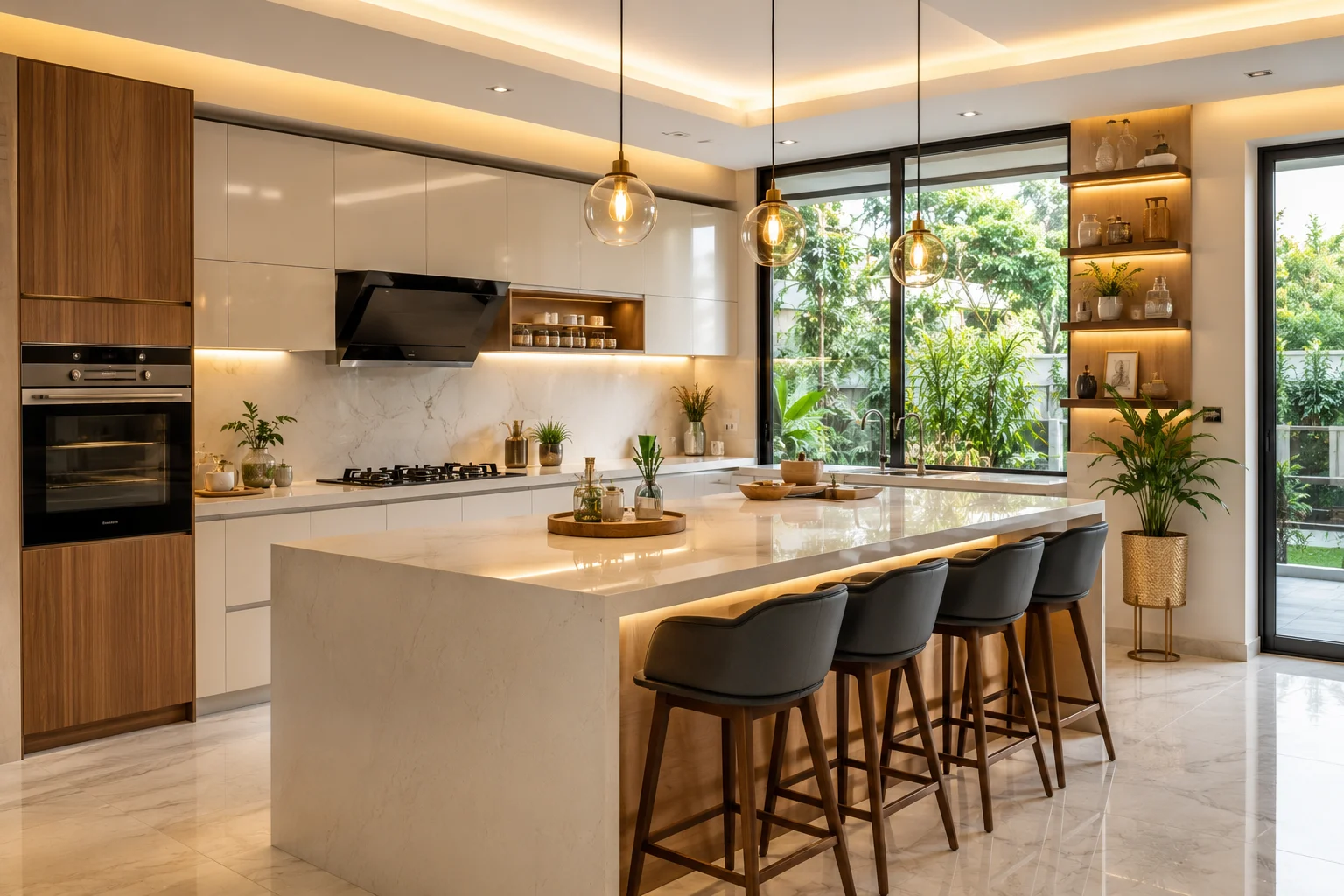
Homeowners in Pacific Palisades are approaching kitchen remodeling with more caution than they did five years ago. Material costs have shifted, contractor availability has tightened, and the gap between an initial estimate and a final invoice has widened on projects across Los Angeles County. For a neighborhood where homes carry significant value and kitchens are often central to both daily living and resale positioning, making an uninformed decision about scope and budget can have real financial consequences. This article addresses what drives cost in a custom kitchen remodel, how Pacific Palisades specifically affects those variables, and what homeowners should understand before committing to a project in 2025.
Table of Contents
Why Cost Transparency Matters in Custom Kitchen Remodeling
Custom kitchen remodeling is not a commodity service. Unlike a bathroom refresh or exterior paint job, a kitchen remodel involves structural decisions, mechanical system coordination, cabinet fabrication timelines, and material lead times that all interact with one another. When any one of these variables is underestimated, the project cost and duration shift accordingly. For a detailed breakdown of what this process involves in the local context, the Custom Kitchen Remodeling Pacific Palisades Ca overview outlines the scope and considerations specific to this area.
Cost transparency in this type of project matters because homeowners are often comparing bids that are not structured the same way. One contractor may include demolition and hauling in their base quote. Another may list those as line items added after contract signing. A third may use allowance figures for cabinetry and appliances that bear no relationship to what the homeowner actually selects. None of these approaches is inherently dishonest, but the result is that a homeowner comparing three quotes may be comparing three entirely different scopes of work without realizing it.
The Role of Allowances in Budget Accuracy
Allowances are placeholder figures used in project estimates to account for selections the homeowner has not yet made. They are common in custom kitchen remodeling because cabinetry, countertops, fixtures, and appliances vary enormously in price depending on brand, finish, and configuration. The problem is that allowance figures in a bid are often set conservatively low to make the overall estimate appear competitive. When the homeowner reaches the selection phase and chooses products that reflect the actual quality level of the remodel, the allowances are exceeded and the contract is adjusted upward. Understanding how allowances are set, and whether they reflect realistic selections for the project’s intended quality tier, is one of the most important questions a homeowner can ask before signing any agreement.
What Drives Cost in Pacific Palisades Specifically
Pacific Palisades is not a uniform market. The neighborhood spans hillside properties, canyon roads with limited access, older homes with original plumbing and electrical systems, and newer builds with modern infrastructure. Each of these conditions affects what a custom kitchen remodel actually costs to execute. A kitchen in a 1960s ranch home near Sunset Boulevard will present different structural and logistical challenges than one in a newer construction near the bluffs, even if the two projects are comparable in square footage and material selection.
Access and Site Logistics
Delivery and material staging are more complicated in Pacific Palisades than in flat, grid-structured neighborhoods. Narrow canyon roads, steep driveways, and limited street parking affect how crews move materials onto a job site and how efficiently they can work. Some properties require a crane or specialized delivery vehicle to bring large appliances or prefabricated cabinet units into position. These logistics are real costs that experienced contractors account for in their estimates. When a bid comes in unusually low on a hillside property, it is often because the site challenges were not fully evaluated during the estimate visit.
Permit and Inspection Requirements
Los Angeles County permit requirements apply to custom kitchen remodeling projects that involve changes to plumbing, electrical, gas lines, or structural walls. Pacific Palisades falls within this jurisdiction, and the permitting process adds time and cost to a project. Permits are not optional when the work requires them, and skipping them creates liability for the homeowner at the time of resale or insurance claim. The permit timeline in Los Angeles has varied significantly over the past several years, and in 2025 it remains a factor that can add weeks to a project’s start date. Homeowners should ask their contractor directly whether permits are included in the scope and timeline provided.
Older Home Infrastructure
A significant portion of homes in Pacific Palisades were built before modern electrical and plumbing standards were established. When a kitchen remodel opens up walls and exposes existing infrastructure, contractors frequently discover wiring, pipes, or venting that does not meet current code. Addressing these conditions is not optional, and the cost to bring systems up to standard is typically not included in an original estimate because the extent of the work cannot be determined until demolition begins. This is one of the most common sources of budget overruns in custom kitchen remodeling in older neighborhoods. Homeowners with homes built before the 1980s should factor a contingency into their budget specifically to address this possibility.
How Scope Decisions Shape the Final Number
The total cost of a custom kitchen remodel is determined more by scope decisions than by material price differences. Two kitchens of similar size using similar quality materials can have dramatically different final costs depending on whether the layout changes, whether walls are removed, whether plumbing is relocated, and whether the project integrates new mechanical systems. Custom kitchen remodeling in Pacific Palisades often involves at least some level of layout reconfiguration because many homes in the area were designed with kitchens that are closed off from living spaces, and homeowners are increasingly opening those plans to accommodate how modern households actually use the space.
Layout Changes and Their Downstream Effects
Moving a kitchen’s layout is not simply a matter of repositioning cabinets. When a sink, range, or refrigerator moves to a different location, the plumbing supply lines, drain lines, gas lines, and ventilation paths must be relocated accordingly. Each of these changes involves licensed trade work, inspections, and time. A project that begins as a cosmetic update can expand into a full mechanical reconfiguration once the homeowner decides the original layout no longer suits the household. The scope of a remodel and its associated cost are directly linked, and decisions made at the design stage have compounding effects on every trade involved in the project.
Cabinetry as a Cost Driver
Cabinetry typically represents the largest single line item in a custom kitchen remodel. The difference between stock cabinetry, semi-custom cabinetry, and fully custom-fabricated cabinetry is not merely aesthetic. It affects lead time, installation complexity, and how well the finished kitchen accommodates the specific dimensions and quirks of the space. In Pacific Palisades, where kitchens often have non-standard dimensions or design features that reflect the character of the home, fully custom cabinetry is frequently the appropriate choice. The trade-off is that custom fabrication takes longer and costs more. Homeowners who choose stock cabinetry to reduce cost sometimes find that the savings are offset by the need for filler pieces, modified installation, or a result that reads as inconsistent with the rest of the home.
Understanding Contractor Selection in a Competitive Market
Pacific Palisades attracts a range of contractors, from local specialists with established relationships in the neighborhood to larger firms that operate across the greater Los Angeles area. The difference in how these contractors price and manage work is real. According to the U.S. Bureau of Labor Statistics, construction management complexity increases significantly when projects involve custom fabrication and licensed trade coordination, which is precisely what custom kitchen remodeling in Pacific Palisades requires.
Homeowners evaluating contractors should focus less on the headline number in a bid and more on how the bid is structured. A detailed proposal that breaks out demolition, trade work, cabinetry, countertops, installation labor, and contingency separately is more useful than a single project total. It allows for real comparison between bids and gives the homeowner a clearer picture of where money is being allocated.
Realistic Cost Ranges for 2025
Providing a single number for custom kitchen remodeling in Pacific Palisades, CA is not meaningful because the variables are too wide. A project focused on replacing surfaces, fixtures, and appliances without changing the layout will cost significantly less than one that removes walls, relocates plumbing, and installs fully custom cabinetry. What is useful is understanding the factors that push a project toward the higher end of any range: layout changes, older infrastructure, hillside access, premium appliance packages, and fully custom cabinetry are the primary contributors. A project that involves several of these factors simultaneously will reflect those costs in the final invoice regardless of what the initial estimate suggested.
Homeowners who approach custom kitchen remodeling in Pacific Palisades with a clear scope, realistic allowances, a defined contingency, and a contractor who communicates transparently about how costs are structured will have a more predictable experience than those who select based on the lowest bid without examining what is and is not included.
Closing Perspective
Custom kitchen remodeling in Pacific Palisades, CA in 2025 is a significant financial commitment that rewards careful planning more than almost any other home improvement project. The neighborhood’s combination of older housing stock, access challenges, strong permitting requirements, and high baseline property values creates a context where the difference between a well-managed project and a poorly planned one is measured not just in dollars but in months of disruption. Homeowners who take time to understand the full scope of their project, ask direct questions about how bids are constructed, and work with contractors who are familiar with the specific conditions of the area will consistently arrive at better outcomes than those who treat this as a simple purchasing decision. The cost of a kitchen remodel is not a fixed number. It is the result of decisions made at every stage of the process, and understanding that relationship is the most practical preparation a homeowner can do before work begins.
-

-

-

-

-

-