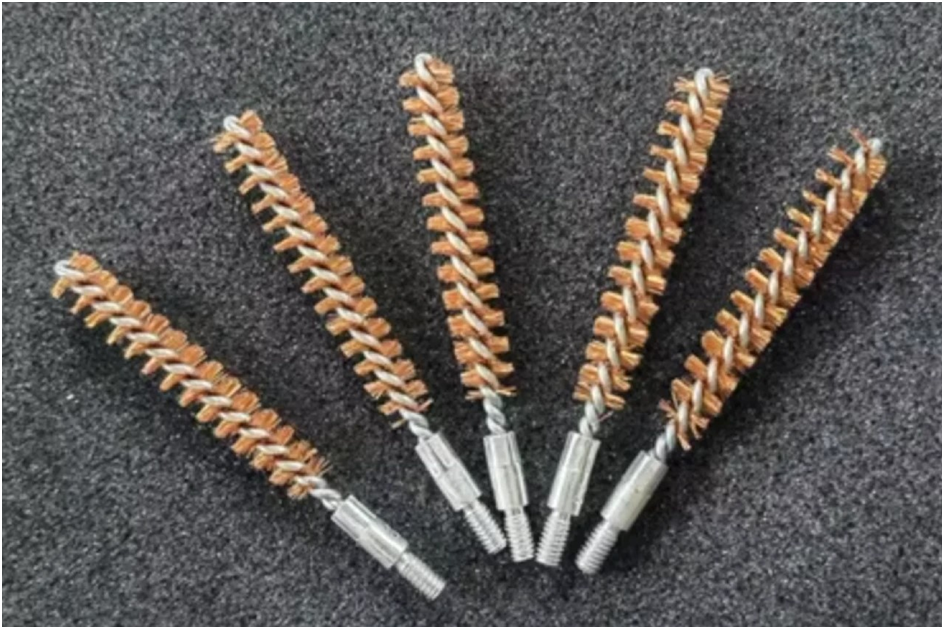
When purchasing gun care supplies, owners often look first at the price and material, and check the attachment’s caliber last. Meanwhile, a difference of a fraction of a millimeter determines whether the bristles will clean the entire surface of the bore or simply slide over it. In catalogs, this type of attachment is called a bore brush, and it is manufactured for a specific bore diameter, not for a specific type of firearm. The range typically covers calibers from .17 to 12 GA, and just looking at the range makes it clear why this parameter should be taken seriously.
Table of Contents
How Do Bronze Bristles Clean the Metal
Phosphor bronze, from which the bristles are made, is softer than barrel steel but harder than carbon, lead and copper deposits. As it passes through, each bristle bends slightly and presses against the wall with a certain amount of force. It is precisely this pressure that scrapes away the fouling: the more evenly it is distributed around the circumference, the cleaner the surface will be after a few passes.
A core made of twisted brass wire holds the bristles in place and also does not damage the bore. But this entire design works only under one condition: the diameter of the attachment must match the diameter of the barrel. Otherwise, the force is distributed unevenly, and part of the surface remains uncleaned.
What Happens When the Bristles Fall Short of the Walls
An undersized attachment moves loosely inside the barrel. The bristles touch the walls on only one side, while the bottom of the grooves and the opposite wall remain almost untouched. It takes twice as many passes, but copper still remains in the corners of the rifling.
From the outside, the barrel appears clean, since the patch comes out light-colored after a few passes. However, accuracy drops again at the next range session because old deposits remain beneath a thin layer of clean metal.
What Is the Downside of a Size With Extra Room
An attachment larger than the caliber enters the bore with difficulty. The bristles bend sharply backward, and the cleaning rod bows into an arc and presses against the wall. In small calibers, it is sometimes impossible to push it all the way through, and attempting to pull it back from the middle of the barrel results in broken bristles.
The equipment also suffers. The excess load is placed on the threads, which eventually become loose, and the brass core may bend. If this happens in a small caliber, the attachment sometimes gets stuck so tightly that it can no longer be removed without a gunsmith.
Why Doesn’t the Attachment Caliber Match the Cartridge Name
The confusion often stems from the markings on the ammunition. The cartridge name is tied to the manufacturer’s history and traditions, while the cleaning tool is selected based on the actual bore diameter. Several common cartridges show the difference clearly:
- .223 Remington and 5.56 NATO – .22 size;
- 9mm Luger and .38 Special – .357/9mm size;
- .308 Winchester, .30-06 and 7.62 NATO – .30 size;
- .243 Winchester and 6mm Remington – .243 size.
Therefore, a single .30 caliber brush can be used for several rifles at once, and the owner of a .223 carbine does not need a separate one for 5.56. If there is any doubt about the caliber, the bore diameter is always listed in the firearm’s manual. Manufacturers’ catalogs are usually organized the same way, by diameter rather than by cartridge name.

What Sizes Are Needed for Smoothbore Firearms
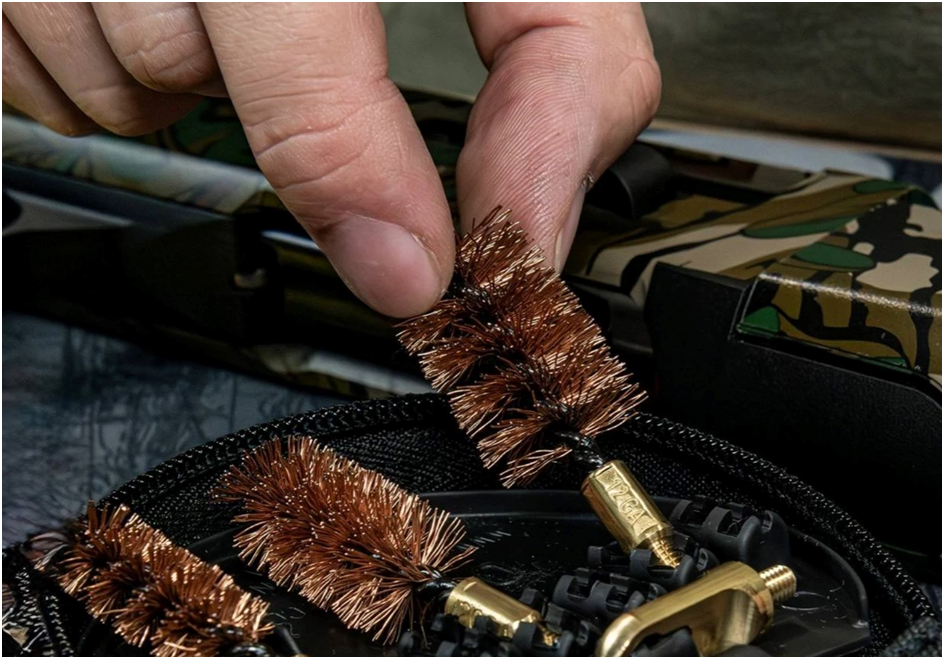
Shotguns have their own range: 12, 16 and 20 gauge, as well as .410. The differences between them are significant, and a 12 gauge attachment simply won’t fit into a 20 gauge barrel. The thread size is also important for these barrels: shotgun brushes come with a 5/16-27 thread, not the 8-32 thread used on rifles and pistols.
In a smoothbore barrel, the bristles must remove plastic wad residue and lead. These deposits are dense and uneven, so an exact diameter match is just as important here as it is in a rifled barrel.
When Does the Size Change on Its Own
Even a properly sized attachment shrinks over time. The bristles become compressed, some break off, and the effective diameter decreases. After a season of active shooting, it functions as an undersized one, even though it is still marked with the correct caliber.
This is easy to check: a worn-out attachment passes through the bore with almost no resistance, and the bristles look sparse and pressed against the core when held up to the light. Brushes are inexpensive and sold individually, so they’re replaced before the bristles flatten out completely.
How to Put Together a Set of Cleaning Tools for a Gun Collection
The easiest way is to start with a list of firearms and write down the bore diameter next to each barrel, rather than the cartridge name. It often turns out that three rifles can be cleaned with a single .30 caliber attachment, while a pistol and a revolver can share a single .357. After that, the shopping list is cut nearly in half.
It’s a good idea to keep a spare for each caliber on hand. The bristles wear out at the worst possible moment, usually right before the season or a competition, and having a spare removes the need to rush. It’s best to store the attachments in separate, labeled tubes, which keeps the bristles from getting crushed and prevents the calibers from getting mixed up.

How Can a Proper Fit Be Checked by Feel
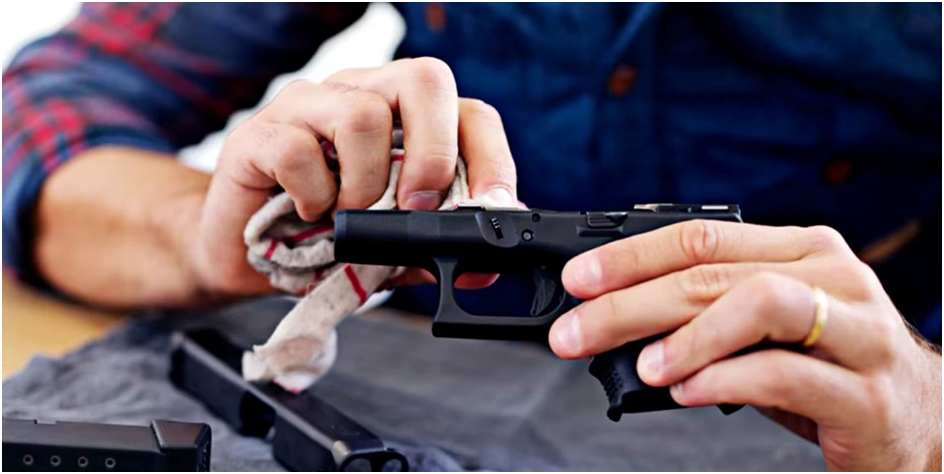
A proper caliber match can be felt by hand. The attachment enters the bore with noticeable but even resistance, without any jerks or jamming. It is pushed all the way through until it exits the muzzle, and only then pulled back. If the resistance changes along the way or the attachment gets stuck, the diameter or condition of the bristles isn’t suitable for that barrel.
The size of the brush may seem like a minor detail, but it determines how many passes it will take to clean the barrel and how much fouling will remain inside the bore. Having several attachments for different calibers and replacing worn-out ones in a timely manner saves time and preserves the barrel’s accuracy for years to come.
-

-

-

-

-

-