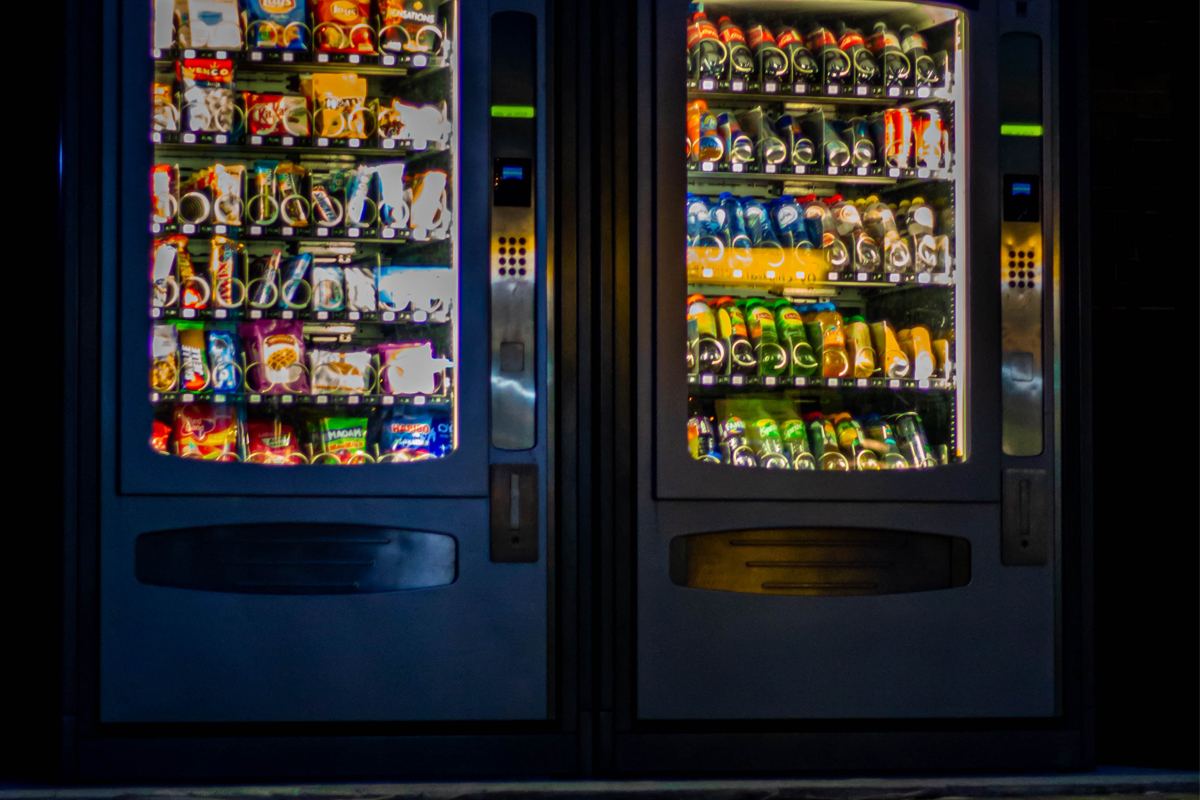
Across Derby’s manufacturing sites, office parks, logistics hubs, and healthcare facilities, something practical is changing in how staff access refreshments and everyday essentials during working hours. Vending machines have been a workplace fixture for decades, but the mechanics of how people pay for what comes out of them has shifted considerably. Cash use in the UK has been declining steadily for several years, and that shift is not simply a consumer trend — it is reshaping how businesses manage vending operations, reconcile income, and keep facilities running without interruption.
For facility managers, operations directors, and procurement leads, the question is no longer whether cashless payment is relevant to on-site vending. The question is whether continuing with cash-dependent machines is worth the operational friction it introduces. In Derby specifically, a number of converging factors — workforce demographics, the pace of contactless payment adoption, and pressure on facilities budgets — have made 2025 a natural turning point. This article examines the seven most grounded reasons why that switch is happening and what it means operationally for businesses making the decision.
Table of Contents
1. The Shift Away from Cash Is Already Reflected in How Derby Workers Pay
Businesses exploring cashless vending machines derby are responding to a behavioural reality, not a theoretical one. According to UK Finance, contactless payments now account for the majority of in-person transactions across the country, and that includes everyday low-value purchases. Workers in Derby, whether on a factory floor or in a shared office, are increasingly less likely to carry coins or notes. When a vending machine only accepts cash, it does not simply inconvenience the user — it removes the machine from consideration entirely. For facilities teams, that translates directly into lower machine utilisation and reduced revenue from an asset that is already in place and running.
The practical consequence is that cash-only vending machines are underperforming not because of product selection or machine placement, but because the payment method does not match how people actually carry and spend money in 2025. Switching to cashless removes that barrier without requiring any change to what the machine stocks or where it sits.
Contactless Adoption Is Not Uniform Across Demographics
It is worth noting that younger workers in particular are driving the decline in cash use, but this is not exclusively a generational issue. Across most age groups, contactless card and mobile payment has become the default, particularly for purchases under a certain threshold. In workplaces with mixed demographics, a cashless vending machine serves the entire workforce more consistently than a cash-only unit, which tends to serve a narrowing proportion of users over time.
2. Reduced Cash Handling Removes a Persistent Administrative Burden
Cash vending machines require regular coin collection, counting, and reconciliation. For businesses that manage their own machines, this process takes time and introduces the risk of discrepancy between what the machine records and what is physically counted. For those using a managed vending service, it adds complexity to the service visit schedule and increases the time engineers spend on-site handling cash rather than checking machine condition and restocking product.
When cashless terminals are in use, all transaction data is recorded digitally and automatically. Reconciliation becomes a reporting function rather than a manual counting task. This matters particularly for businesses with multiple machines across a site, where the cumulative administrative load of cash collection and audit becomes significant over a financial year.
Audit Trails and Financial Transparency
Digital payment systems generate itemised transaction records that cash cannot replicate. Every sale, refund, and machine error is logged with a time stamp and a value. This level of detail supports internal auditing, supports any disputes with service providers, and gives procurement teams genuine visibility into machine performance. For businesses subject to financial controls or governance requirements, this kind of traceability has real operational value that goes beyond convenience.
3. Machine Downtime Related to Cash Mechanisms Is Eliminated
Coin mechanisms are among the most mechanically complex components in a vending machine. They are subject to jamming, miscalibration, and wear from high volume use. When a coin mechanism fails, the machine effectively goes offline — users cannot complete a purchase even if the machine is fully stocked and otherwise operational. In high-traffic locations, this kind of downtime is noticed immediately and generates complaints that fall to facilities staff to manage.
Cashless systems remove the coin mechanism entirely. Card readers and contactless terminals are simpler in mechanical terms and are not subject to the same wear patterns. When faults do occur, they tend to be software or connectivity related and can often be diagnosed and resolved remotely, without requiring an immediate engineer visit.
Service Scheduling Becomes More Predictable
One of the less visible advantages of cashless machines is the impact on service visit frequency and purpose. Without the need to empty coin hoppers or address coin-jam faults, service visits can focus on restocking and routine maintenance rather than reactive problem-solving. For businesses paying for a managed vending service, this often means fewer emergency callouts and more consistent machine availability across the working week.
4. Hygiene Considerations Have Become a Practical Factor in Workplace Environments
Following the increased focus on workplace hygiene in recent years, many businesses have reviewed which surfaces and objects employees come into frequent contact with. Coins and banknotes are among the most handled objects in any shared environment, and their role in transmitting bacteria and other pathogens is well documented in public health literature. While the risk from any single transaction is low, the cumulative contact across a busy workplace over a working week is a legitimate consideration for health and safety leads.
Cashless vending removes the handling of physical currency from the transaction entirely. Users tap a card or device, and the interaction is complete. For businesses in healthcare, food production, or education settings — all of which have a notable presence in Derby — this aligns with broader infection control policies and reduces one variable in the management of shared facilities.
5. Real-Time Usage Data Supports Better Product and Placement Decisions
One of the practical advantages of cashless vending infrastructure is the data it generates as a byproduct of normal operation. Because every transaction is recorded digitally, it becomes straightforward to identify which products sell consistently, which time periods see the heaviest use, and which machines in a multi-unit estate are underperforming relative to their location.
This information allows facilities managers and service providers to make stocking decisions based on actual consumption patterns rather than assumptions or periodic manual review. It also supports decisions about machine placement — if data shows that one unit consistently outperforms another in a different area of the same site, that is useful information for planning any future changes to the vending layout.
Inventory Management Becomes Proactive Rather Than Reactive
In a traditionally managed cash vending operation, restocking decisions are typically made during scheduled service visits, often after products have already run out. With real-time sales data available through a cashless system, low stock can be identified before a product runs out completely. This means fewer empty slots, fewer user complaints, and a more consistent experience for everyone using the machine throughout the working day.
6. Cashless Vending Supports the Broader Shift Toward Contactless Workplace Services
Many businesses in Derby are already investing in contactless access control, digital signing-in systems, and app-based workplace tools. Vending is one of the last areas in many facilities where cash remains a requirement, and that inconsistency becomes more apparent as other systems move away from physical interaction. Bringing vending in line with the contactless approach that governs the rest of the workplace is a reasonable and coherent step, not a cosmetic one.
For larger employers managing a visitor experience alongside an employee one, cashless vending also removes the awkward situation where a visitor without UK coins cannot use the refreshment facilities. A card-enabled machine is accessible to anyone carrying a standard payment method, regardless of whether they happen to have the right change.
Integration with Workplace Apps and Digital Accounts
Some cashless vending platforms now support integration with broader digital workplace tools, allowing purchases to be linked to employee accounts, loyalty schemes, or staff benefit programmes. While this level of integration is not universal, it reflects where the technology is heading and represents an additional reason for businesses planning for the medium term to consider cashless infrastructure now rather than managing a second transition later.
7. The Commercial Case Is More Straightforward Than It Appears
There is sometimes an assumption that upgrading to cashless vending involves a significant capital outlay that is difficult to justify for what is effectively a staff amenity. In practice, the commercial picture is more balanced. Many vending operators offer cashless as a standard feature rather than a premium one, and for businesses using a managed vending model, the cost of the cashless terminal is typically absorbed within the service arrangement rather than passed on directly.
Even for businesses that own their machines outright, the cost of retrofitting a cashless reader is often offset within a reasonable period by the improvement in machine utilisation, the reduction in coin collection visits, and the reduction in downtime from coin mechanism faults. When these factors are considered together, the financial case for cashless vending is not a stretch — it is a straightforward operational improvement with measurable returns.
Reduced Revenue Leakage from Underperforming Machines
Cash-only machines that go unused because staff do not carry coins are not neutral in financial terms — they represent a fixed cost (floor space, electricity, service contract) without corresponding income. A cashless machine in the same position that is used regularly converts that cost into genuine return. For businesses accounting carefully for their facilities spend, this distinction matters more than it might initially appear.
Conclusion: A Practical Decision with Lasting Operational Impact
The move toward cashless vending in Derby is not a response to a single factor. It reflects a convergence of practical pressures — changing payment habits, administrative efficiency, hygiene awareness, data utility, and the coherence of a contactless workplace environment — that have reached a point in 2025 where continuing with cash-dependent machines requires more justification than switching away from them.
For facility managers and operations leads, the decision is ultimately about consistency and reliability. A machine that works for everyone, records every transaction, and requires fewer reactive service interventions is a better-managed asset than one that does not. The businesses in Derby making this switch are not chasing a trend. They are resolving a practical operational gap that has become harder to overlook as the gap between how people pay and how their workplace machines work has grown wider over time.
If your organisation is currently evaluating vending provision or reviewing an existing contract, the shift toward cashless is a reasonable and well-supported direction. The infrastructure is mature, the operational benefits are documented, and the timing is consistent with how workplace payments are evolving across the UK.
-

-

-
-
-

-