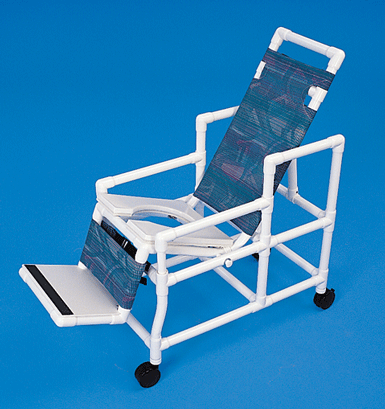
Bathroom safety for older adults is one of the more overlooked dimensions of home care planning. Falls in wet environments remain one of the leading causes of injury among seniors, yet the equipment designed to prevent those falls is often dismissed, misunderstood, or selected based on outdated assumptions. Shower chairs, in particular, carry a long history of misconceptions that quietly influence purchasing decisions made by family caregivers, home health aides, and occupational therapists alike.
PVC shower chairs sit at the center of many of these misconceptions. Because they are lightweight, widely available, and relatively affordable, they are sometimes treated as a last resort or a temporary fix rather than a legitimate safety tool. That perception is worth examining carefully, because the decisions made around shower seating have real consequences for the people who depend on them every day.
What follows addresses five of the most common myths surrounding PVC shower chairs, and explains why each one deserves more scrutiny than it typically receives.
Table of Contents
Myth 1: PVC Shower Chairs Are Only for the Severely Mobility-Impaired
This is perhaps the most widespread assumption, and it causes families to delay introducing shower seating until a fall or near-miss forces the issue. The thinking goes that shower chairs are for people who cannot stand at all, and that using one before reaching that stage is premature or even discouraging to the user’s sense of independence.
In practice, the opposite logic applies. Shower chairs are most effective when introduced before a person’s balance or stamina has significantly declined. Waiting until a senior is in crisis means introducing new equipment at the worst possible time — when coordination, confidence, and physical condition are already compromised. For anyone researching this category, a thorough Pvc Shower Chair overview makes clear that these products are designed for a wide range of users, including those who are relatively mobile but experience fatigue, dizziness, or minor instability during prolonged standing.
The functional population for shower seating includes people recovering from surgery, individuals managing chronic fatigue conditions, and older adults who are otherwise independent but find that prolonged standing in wet, warm environments creates genuine risk. Mobility impairment does not need to be severe for a shower chair to be appropriate and beneficial.
Why Early Adoption Matters
Introducing assistive equipment in a familiar, low-pressure environment gives users time to build comfort and routine before the stakes become higher. A senior who begins using a shower chair while they are still reasonably mobile will develop habits around its use that carry forward naturally. Someone who first encounters the same equipment after a fall or balance crisis may associate it with decline rather than safety, which creates resistance precisely when the equipment is most needed.
Home care coordinators and occupational therapists often note that equipment acceptance is highest when it is introduced early, framed as practical rather than medical, and when the user has a say in selecting it. None of that is possible if the product is withheld until a crisis point.
Myth 2: All Shower Chairs Are Basically the Same
Because shower chairs share a general shape and serve a broadly similar function, many buyers treat the category as interchangeable. This leads to selections based primarily on price, which is not an unreasonable starting point but becomes a problem when it is the only criterion applied.
PVC shower chairs vary meaningfully in how they are constructed, how their joints are assembled, how they distribute weight, and how their surfaces respond to water exposure over time. A chair that performs adequately on a dry surface in a store may behave quite differently after months of regular use in a humid, wet environment. Joint integrity, surface texture, and the stability of the leg assembly are all factors that affect long-term safety rather than just initial functionality.
The Role of Construction Detail in Long-Term Safety
The points where chair legs connect to the seat frame are the most structurally significant areas of any shower chair. Chairs that rely on friction-fit or loosely assembled joints may feel stable when new but develop play over time as repeated wetting and drying cycles affect the material. For a senior who relies on the chair for daily stability, a frame that shifts or flexes unexpectedly is a genuine hazard, not a minor inconvenience.
Surface texture on the seat itself also matters more than it may appear. A smooth seat that becomes slippery when wet shifts the fall risk from the shower floor to the chair itself. Contoured or textured seating surfaces address this directly, and their presence or absence is a functional distinction, not an aesthetic one.
Myth 3: PVC Is Inferior to Metal for Shower Use
There is a general assumption that metal equals durability and plastic equals compromise. In many contexts, that logic holds. In a shower environment specifically, it breaks down for practical reasons that are worth understanding clearly.
Metal frames, whether aluminum or steel, are subject to surface degradation in consistently wet environments. Aluminum resists rust but can oxidize and pit over time. Steel, even when powder-coated, can develop rust at joints, scratches, or areas where the coating has worn. Either condition can compromise both the structural integrity of the chair and the safety of the surface it presents to a user who may be gripping it for support.
PVC does not corrode. It does not rust, pit, or degrade in response to water exposure the way metals do. According to general material properties documented by the CDC’s occupational safety resources, environmental exposure is a key factor in the long-term reliability of safety equipment, and material selection should account for the specific conditions in which equipment will be used. In a shower context, PVC’s resistance to moisture-related degradation is a functional advantage, not a consolation prize for those who cannot afford metal.
Weight and Handling Considerations
For caregivers who assist seniors with bathing, the weight of equipment matters practically. A lighter chair is easier to reposition, clean around, and move between bathroom spaces if needed. PVC chairs are consistently lighter than comparable metal-framed options, which reduces the physical demand on caregivers and makes it more likely that the chair will be used correctly and consistently rather than left in a fixed position because repositioning it is inconvenient.
Myth 4: A Non-Slip Bath Mat Eliminates the Need for a Shower Chair
Non-slip mats are useful and worth using. They address one specific risk — foot slippage on a wet surface — but they do not address the full range of conditions that make showering hazardous for older adults. Fatigue during standing, sudden dizziness, loss of balance during movement, and reduced reaction time are all factors that a mat cannot compensate for.
A pvc shower chair addresses a different and more fundamental concern: it removes the requirement to remain upright through the full duration of showering. A senior who becomes fatigued or lightheaded while seated on a stable chair is in a far safer position than one who experiences the same sensation while standing, even on a non-slip surface. The two products address different parts of the same risk profile, and treating them as alternatives rather than complements is a meaningful misunderstanding.
Layered Safety in Wet Environments
Effective bathroom safety for seniors generally involves more than one intervention. A grab bar near the entry point, a non-slip surface underfoot, and a stable shower chair used during bathing work together to reduce risk across the full sequence of activities involved in showering. Removing any one layer because another is present weakens the overall arrangement in ways that may not be apparent until something goes wrong.
Families and caregivers who are thinking carefully about bathroom safety for an older adult in their care should consider the shower chair not as a standalone fix but as one component in a broader approach to fall prevention in the bathroom environment.
Myth 5: Seniors Will Resist Using a Shower Chair, So It’s Not Worth Introducing
Resistance to assistive equipment is real, and it is worth taking seriously. But the assumption that resistance is inevitable — and therefore that the equipment should not be introduced — mistakes a process challenge for a reason to abandon the goal entirely.
How a shower chair is introduced matters as much as which chair is selected. When the conversation is framed around practicality and daily comfort rather than decline or disability, acceptance rates improve. When the senior has a role in choosing the product — including its color, design, and features — they are more likely to use it consistently. And when the chair is introduced during a period of relative stability rather than in the aftermath of a fall, the emotional stakes of the conversation are lower.
Framing and Participation in Equipment Adoption
Occupational therapists who work with aging adults regularly observe that the language around assistive equipment shapes how it is received. A shower chair described as something that makes bathing less tiring, or that allows the user to shower more comfortably without needing help, lands differently than one presented as a safety measure for someone who can no longer manage independently.
Seniors are also more likely to use a pvc shower chair regularly when it fits their bathroom well, feels stable underfoot, and does not require complicated assembly or adjustment. Usability and adoption are connected, and selecting a chair that genuinely fits the space and the person using it reduces resistance in ways that no amount of persuasion can substitute for.
Closing Thoughts
The myths surrounding pvc shower chairs are not unusual in the assistive equipment space. Products that exist at the intersection of medical need and everyday living tend to accumulate assumptions — about who they are for, what they can and cannot do, and whether their benefits justify the adjustment they require. In this case, most of those assumptions work against the people the products are designed to protect.
A senior who could benefit from a pvc shower chair but does not use one because it was introduced too late, selected poorly, or dismissed as unnecessary is exposed to a risk that is both real and preventable. The equipment itself is not complicated. What is complicated is getting past the layer of received wisdom that delays or distorts the decisions surrounding it.
Families, caregivers, and healthcare professionals who work with older adults in home settings are better positioned than anyone to ask the right questions early, select equipment thoughtfully, and introduce it in ways that support long-term use. The myths examined here are worth carrying into those conversations, not as arguments to win, but as context that makes the decisions clearer.
-

-

-

-

-

-