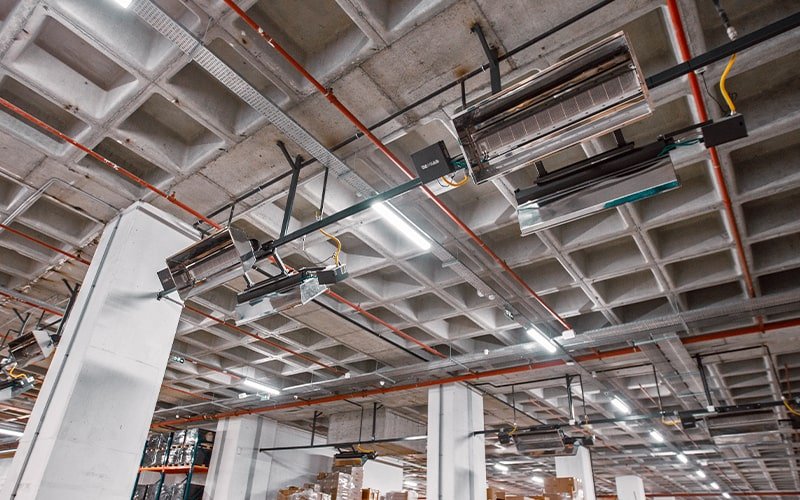
Heating decisions in large industrial facilities rarely get the attention they deserve until something goes wrong. A poorly matched system, an unqualified provider, or an installation that wasn’t designed for the actual conditions of the space can lead to uneven temperatures, increased fuel consumption, uncomfortable working conditions, and equipment that fails during the coldest months of the year. For facility managers overseeing warehouses, manufacturing plants, distribution centers, or large workshops, choosing the right heating provider is not a procurement formality. It is an operational decision with consequences that extend well beyond the first winter season.
The challenge is that the heating industry includes a wide range of providers — from generalist contractors who occasionally install radiant systems to specialists who design and service them as their primary business. Knowing the right questions to ask before making a commitment helps separate providers who understand industrial environments from those who simply sell equipment. The following questions are designed to support that evaluation process.
Table of Contents
1. Does the Provider Specialize in Industrial Radiant Heating or Offer It as a Secondary Service?
Specialization matters more than most facility managers realize when it comes to heating systems for large industrial spaces. Industrial radiant heating involves infrared technology that transfers heat directly to surfaces and occupants rather than warming the surrounding air, which makes it distinctly different from conventional forced-air systems. Providers who specialize in industrial radiant heating understand the nuances of system design, combustion management, gas-fired versus electric configurations, and how building characteristics affect performance. A generalist contractor may be capable of installing a unit, but designing a system that performs consistently across a large or complex facility requires focused experience.
Why Specialization Affects Long-Term Performance
A provider who works exclusively or primarily in industrial radiant systems will have encountered the full range of installation challenges — high ceilings, variable occupancy zones, mixed-use spaces, and facilities with significant air infiltration. That experience shapes how they approach system design before a single component is ordered. Providers who treat radiant heating as an add-on service tend to apply standard configurations without accounting for site-specific variables, which leads to performance problems that are expensive to correct after installation.
2. How Does the Provider Approach System Design Before Installation?
System design is where the outcome of any industrial heating installation is effectively determined. The way a provider designs a system — how they assess the facility, calculate heat loss, position emitters, and plan for airflow — has a direct impact on whether the installed system performs as expected. A provider who begins a proposal without conducting a thorough site assessment is working from assumptions, not data.
The Role of Heat Loss Calculations and Zone Planning
Accurate heat loss calculations are the foundation of an effective radiant system design. These calculations account for building envelope characteristics, occupancy patterns, door frequency, ceiling height, and the types of activities taking place in different areas of the facility. Zone planning, which determines where heat is needed most and at what intensity, is equally important. A facility with a loading dock, a production floor, and an office area adjacent to one another has different thermal requirements in each section. A provider who designs the system as a single uniform installation rather than a zoned approach will consistently produce uneven results.
3. Can the Provider Demonstrate Experience With Facilities Similar to Yours?
Industrial facilities vary significantly in their construction, use, and thermal characteristics. A food processing plant, a metal fabrication facility, and a vehicle storage building each present different challenges for heating system design and installation. When evaluating a provider, it is reasonable to ask for documented examples of completed projects that share meaningful characteristics with your own facility — similar square footage, comparable ceiling heights, or the same general use category.
What Project History Reveals About Capability
A provider’s project history is not simply a portfolio of past sales. It is evidence of how they handle complexity, how they manage installations in occupied facilities, and how their systems have performed over time. References from clients who operate similar facilities can offer practical insight that no product specification sheet can provide. If a provider cannot point to relevant completed work, that absence of experience should factor directly into the evaluation.
4. What Service and Maintenance Support Does the Provider Offer After Installation?
The operational lifespan of an industrial radiant heating system depends significantly on the quality of ongoing maintenance. Combustion components, heat exchangers, burners, and control systems require periodic inspection and adjustment to maintain safe and efficient operation. A provider who sells and installs equipment but does not offer a structured maintenance program is essentially handing over a long-term obligation without the support to manage it.
Service Agreements and Response Times
When heating fails in the middle of winter, the time between a service call and a qualified technician arriving on site directly affects production capacity, worker safety, and in some cases, inventory integrity. Before committing to a provider, facility managers should ask specifically about response times, the availability of service agreements, and whether the provider maintains technicians trained on the specific equipment they install. A provider who relies on third-party subcontractors for service introduces an additional variable that can extend downtime when problems occur.
5. How Does the Provider Handle System Commissioning?
Commissioning is the process of verifying that a newly installed heating system operates correctly and according to the design specifications. It is distinct from installation and is often the step that providers with less experience or less investment in quality control skip or abbreviate. Proper commissioning involves testing all burners, confirming combustion efficiency, verifying control sequences, and checking that heat distribution matches the intended design.
Why Commissioning Gaps Create Hidden Problems
A system that appears to be operating after installation may still be running inefficiently or unevenly if commissioning is incomplete. These problems often go unnoticed until energy costs rise, complaints about cold zones emerge, or a component fails prematurely due to operating outside of its design parameters. According to the American Society of Heating, Refrigerating and Air-Conditioning Engineers, commissioning is a quality-focused process that verifies systems meet the owner’s project requirements. A provider who takes commissioning seriously treats it as a formal step with documentation, not as a brief operational check before leaving the site.
6. What Is the Provider’s Approach to Fuel Type and Energy Efficiency?
Industrial radiant systems can operate on natural gas, propane, or electricity, and the choice of fuel type affects both operating costs and installation logistics. The right fuel choice depends on what is available at the facility, the cost structure of local utility rates, and whether the facility has specific operational or environmental requirements. A knowledgeable provider will explain the trade-offs without defaulting to whatever product line they prefer to sell.
Efficiency in the Context of Industrial Operations
Efficiency in industrial radiant heating is not only about equipment ratings. It is about whether the system is correctly sized, properly installed, and operating as designed. An oversized system that short-cycles or an undersized system that runs continuously will both consume more energy than a correctly designed installation. A provider who addresses efficiency only through equipment specifications rather than system design and controls is presenting an incomplete picture.
7. How Does the Provider Account for Ventilation and Indoor Air Quality?
Gas-fired radiant heating systems, particularly those that are unvented or use certain combustion configurations, interact directly with the indoor air environment. In facilities with limited natural ventilation or high occupancy, this interaction requires careful attention. A provider who does not raise the subject of ventilation requirements during the design process is overlooking a factor that affects both safety and regulatory compliance.
8. What Warranties Apply to Equipment and Installation Work?
Warranty coverage for industrial heating systems typically involves two separate categories: the equipment manufacturer’s warranty and the provider’s warranty on their installation workmanship. These are not the same, and the distinction matters. Equipment may perform exactly as designed while an installation deficiency — an improperly secured mounting, an incorrect gas connection, or a control wiring error — leads to a failure that falls outside the manufacturer’s coverage.
9. Does the Provider Have the Appropriate Licensing and Insurance for Your Jurisdiction?
Licensing requirements for gas work, electrical connections, and HVAC installation vary by jurisdiction. A provider who operates across multiple regions must hold appropriate credentials in each location where they perform work. Insurance coverage — both general liability and workers’ compensation — is equally important, as any incident during installation in an occupied facility can create significant legal and financial exposure for the facility owner.
10. How Does the Provider Communicate During the Project and After?
Communication quality is not a soft factor in the evaluation of an industrial heating provider. It is a practical indicator of how problems will be handled when they arise. A provider who is responsive during the sales process but difficult to reach after a contract is signed creates operational risk. Facility managers should ask directly about who manages the project, how updates are communicated, and who the primary point of contact is for service questions after installation is complete.
Closing Considerations for Facility Managers
Selecting an industrial heating provider is ultimately about managing operational risk over a long time horizon. The questions outlined here are not designed to create friction in the procurement process. They are designed to surface the information that separates providers who understand industrial environments from those who are simply available and willing to quote the work.
A heating system that performs reliably, heats consistently, and can be maintained without significant disruption contributes directly to workforce comfort, production continuity, and energy cost predictability. A system that was selected primarily on price or convenience can undermine all three. The time invested in asking the right questions before a decision is made is far less than the time and cost required to address problems after installation.
Providers who are confident in their capabilities will welcome these questions. Those who are not will reveal that quickly through their responses. Either outcome is useful information for a facility manager making a decision that will affect daily operations for years to come.
-
-
-

-

-

-